English
 Español
 Français
 Deutsch
 Italiano
 Português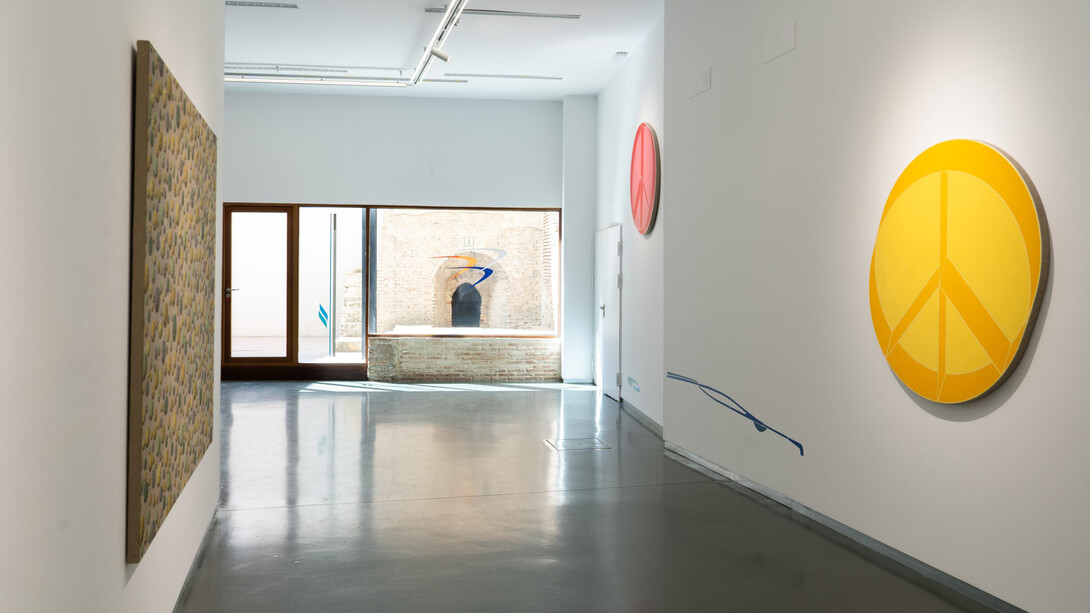
João Marçal (Coruche, Portugal, 1980) is an artist who, after more than two decades of an international career, places great importance on those he acknowledges as his first “masters” at the Faculty of Fine Arts in Porto: Eduarda Batarda (Coimbra, 1943), to whom he owes an essential lesson for every artist: learning how to become one. This is what leads him to say, as he writes to me: “he taught us to think about painting in a highly structural way; to construct ‘our own painting’.” And, much closer to him and, in my view, equally decisive, Pedro Tudela (Viseu, 1962), his first painting teacher, who “helped him to always approach painting in a self-reflective manner and not to be afraid to occasionally explore other languages and forms of exhibition”. Tudela is also a musician and stage designer, and several of his works are grounded more in sound than in visual form. He had a decisive influence on Marçal’s own immersion in music, where he performs under the pseudonym Marçal dos Campos. Although he attaches no importance to himself as a “professional musician,” composition and performance, I believe, have profound repercussions on his work, whose meaning becomes more transparent to me if I attend, even virtually, one of his public performances. There is something in the calmness of his movements, in the rhythmic insistence of the sound, in his empathy with the musicians accompanying him, that allows me to imagine what he must be like when he paints.
The history of contemporary painting allows us to affirm that one of its most recurrent patterns of behaviour has been the questioning of the tradition that regarded it as a discipline capable of operating in an orderly and persistent manner under firmly established norms.
One of the fundamental aspects of this rupture concerns both its very materiality and the argumentative motivations that drive it, that has come to be consolidated in the search for its zero degree of existence. A zero degree that can only be understood as an analysis and investigation of its constituent elements, from which we can consider its material particles, the units of minimal significance, or the pragmatics deduced from its immediate practice, in order to construct from there a visual discourse that is syntactically and semantically coherent.
He himself expresses, in a long paragraph from our epistolary exchange that I take the liberty of reproducing here, the germinal element that has determined his path: “More than the two specific teachers, Batarda and Tudela, I believe my work was structurally influenced by the fact that my formative period took place at a time (the early 2000s) of profound technological transformation (the internet, the massive dissemination of images, digital photography, the accessible production of photographic prints, video software, image editing, and so on) as well as by a widespread disbelief in the purpose of painting. It is a period that I somewhat associate with a post-conceptual attitude, at least in Portugal and within my academic context.
I see my work in painting as a product that naturally absorbed these times and their problematics, and that has always sought to reinterpret them in a manner that is simultaneously practical and affective. There is much of design in my works, but there is also nostalgia; there is a constant temporal and affective vector, in addition to an ongoing self-reflection on the more specific nature of painting.”
From that perspective, there is an unquestionable link between the inherent simplicity of the motifs chosen by João Marçal and the questioning of the romantic-vanguardist heroism of the artist and of the epic nature of his discourse. A space, which, in his case, is occupied instead by a repository of sensations in response to the elements of his reality, present or past, from the public spectacle of advertising brands, or the usually unnoticed details of the everyday world we inhabit, to the intimacy of childhood memories. An assemblage that, on the website describing the features of his participation in the 2024 Coimbra Biennial is defined as “the memories of the ghosts of painting.”
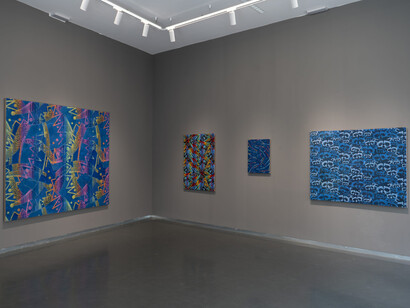
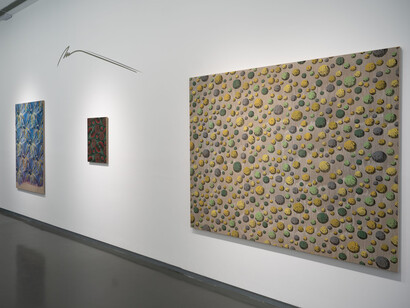
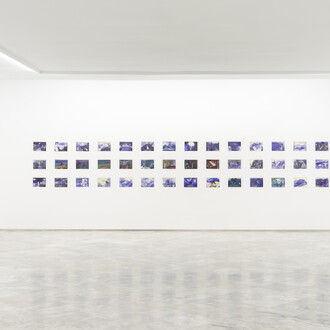
For his first exhibition at Alarcón Criado gallery, Oxigénio, he has selected various paintings from three of his series. To begin with, several works in shaped canvas, a format that has interested him for some time “because of the issues it raises regarding the “objectification” of painting and the space of its surface”. First among them is Verão #6, an unusual keyhole through which one can see the latticework of a reed bed, which “suggests an act of ‘entering,’ ‘peering in’ and, simultaneously, of ‘blocking’ the view”. Alongside it are several previously unseen pieces: tondi that take the peace symbol in various versions of a single colour range and lines painted in metallic pigment that play with the construction of an imaginary volume. “Something that interests me greatly, since metallic pigment steps outside the territory of illusion and invades the plane of objects […] I am drawn to the way in which all instances of painting can coincide, complementing or cancelling each other out: the shape of the support, the painted forms, the represented volume, the abstract ‘flat’ planes, the symbolic void and the possible identification with an emotional charge, linked to a message of empathy for the other.”
Also previously unseen, and closely tied to that attentive predilection for the minimal things that surround us in everyday life and those to which we barely pay attention, are the self-adhesive vinyl works from the Neighbors series, placed either on window glass or on walls, which take as their reference “the ornamentation of the various camper vans I have been observing on the street. They are increasingly common, parked for long periods in my neighborhood in Lisbon, as they are also a phenomenon directly linked to the severe housing crisis affecting several cities.
With these two series I want to reflect on several conceptual and emotional points that obsess me, and which I always translate into the territory of painting: the spatial, always indeterminate, idea of being inside or outside; or the idea that (our) home is either a geographical, concrete place, or an abstract idea that exists only in mental space.”
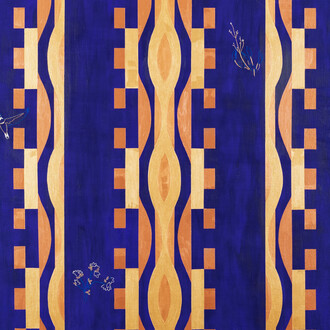
The core of his work derives from the paintings that have made him most recognizable, those featuring the decorative patterns found on the upholstery of bus and train seats, which he has sat on since his student days. “I have always ‘found’ my paintings (or they have found me) in everyday spaces, in ‘non-places,’ in ‘non-moments’; in spaces of transition and introspection. Public transport is closely tied to my growth and transformation as a person and an artist. I used to spend two hours a day on the bus going to high school, and later on, I would travel by train to university on a weekly basis. I began to develop a strong (almost fetishistic) interest in those transitional moments, especially because they were moments of intense inner journey. That is how I began making my public transport patterns, always with an interest in the temporality of nostalgia, in the psychedelic appearance, in the idea that nothing is fixed but always in motion, in transformation. Things never remain the same; every repetition simultaneously incorporates and defines difference.”
“I consider them landscapes,” he has stated, “even more so as mental ones. There is another journey, more interesting than the physical one. The one I undertake when painting each brushstroke, trying to understand how things connect. For me, painting is inexhaustible. When I paint in this way, I know that certain details will return, but in a different form.”
“When I made the first paintings inspired by the patterns of bus and train seats, etc., I naturally took a more graphic approach, technically closer to the series featuring logos and uniform colour fields”, he writes to me. “But over time I began to realize that I was interested in deconstructing form more deeply, in its own materiality. And so it was that, progressively, I undertook a technical and procedural transformation. I started using very thick, raw linen canvas, and a great deal of matte medium so as never to give acrylic paint a plastic appearance. The forms themselves become the result of a set of elements/gestures (thousands of parallel paint marks) that act as a whole and that are transfigured according to the viewing distance of the observer. I very much like the sensation that the painting is all together and all separate at the same time. Something that drives me to continue developing these works is the way in which they transcend optical space and come to occupy a haptic space, one that instinctively awakens other senses at the moment of contemplation. Painting is a diaphanous fabric that conceals the canvas’s own opaque support, which stands physically before us. These works began to raise a number of more philosophical (ontological and phenomenological) questions that I am always, and increasingly, interested in exploring within the territory of painting. Pattern, as a compositional solution, is something that also interests me greatly, as it cancels hierarchy within the pictorial space and introduces the concepts of continuity (a determining factor between the viewer and the pictorial plane) and infinity (something that, in a more classical sense, is also present in the painting of perspective).”
A defining feature of his work in recent years is the installation of his paintings within structures, most often built from materials external to painting itself, which position them away from the wall, freestanding, as components of a larger “picture” that encompasses the exhibition space itself. It also multiplies the visual nature of the proposals it presents, accentuating their differences to highlight their individuality, while orchestrating —a term well suited to his mode of operation— a melodic ensemble sound.
“The use of structures to install the paintings began as a necessity,” he tells me. “The space where I was due to present my work at the 2024 Coimbra Biennial was very large and humid (a hangar next to a 17th-century cistern), and was not suitable for hanging the works on the wall, as they were very dirty and dripping with water. I thought a great deal about the conceptual implications of this type of exhibition, in which painting is objectified within the space and in which its reverse side is visible. I am very interested in the illusionistic space of painting, in the questions raised by Michael Fried regarding theatricality, etc., as I believe I still have a fairly ‘modernist’ framework in the way I relate to painting. I eventually went on to work with the structures, foregrounding the relationship between the origin of the painted motifs and the yellow tubular metal fittings, which also come from the universe of public transport. When travelling standing, passengers hold on to this type of tubular structure, performing a balancing dance and maintaining a firm haptic contact with the metallic surface. In a way, I liked how this very concrete, physical relationship could be linked to the illusory world of the pictorial plane and to a certain optical ‘levitation’. I liked the way in which this very concrete, bodily relationship could be linked to the illusionistic world of the pictorial plane and to a certain optical ‘levitation’. That said, I think my work can be summarized as a continuous commentary on the dualisms embedded in the nature of the medium of painting.” Or, as he said in conversation with Ángel Calvo Ulloa, one of the curators of that Biennial: “As if painting were embracing all thought.”
(Text by Mariano Navarro)