English
 Español
 Français
 Deutsch
 Italiano
 Português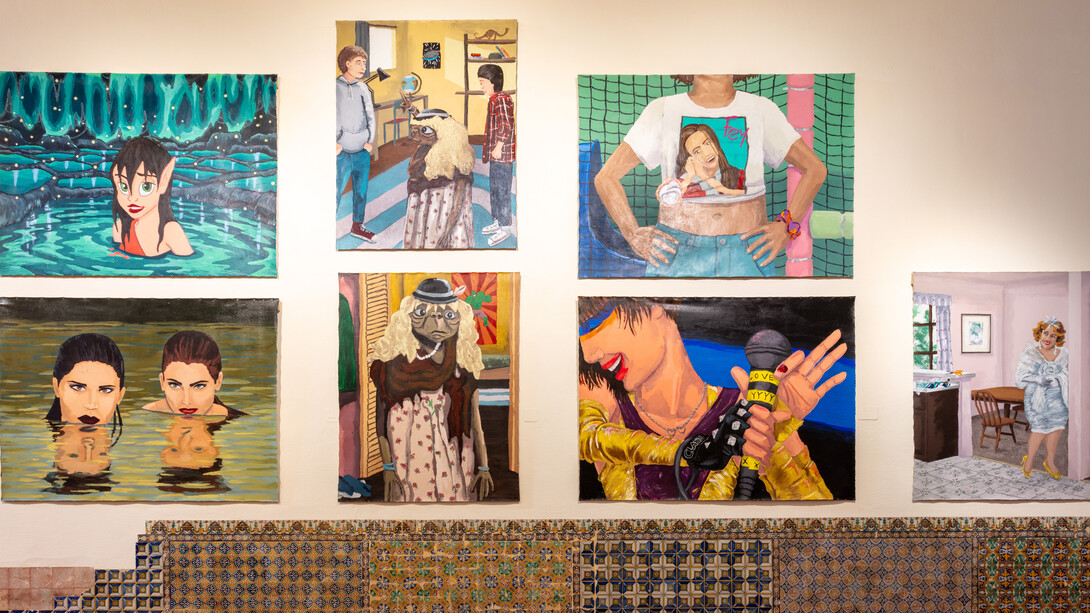
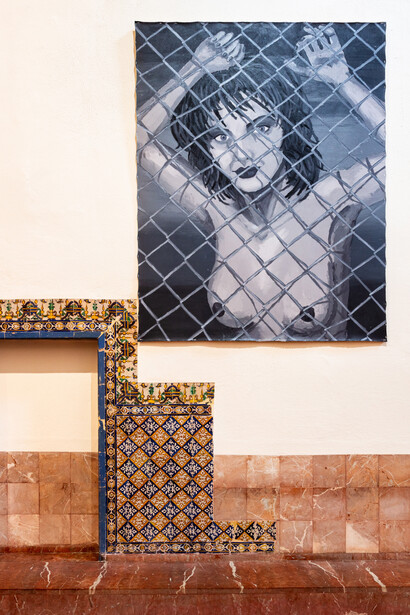
Solano’s (Mexico City, 1987) pictorial practice stems from a need to paint directly with her hands. This act, rejecting the mediation of a brush, reinstates painting as a form of contact or tactile inscription and restores it to its original dimension: the imprint or impression as embodied thought.
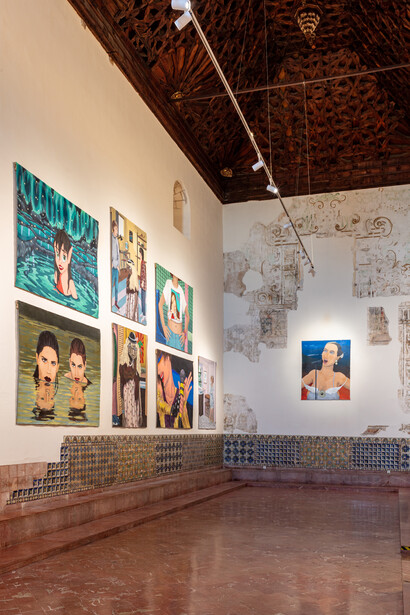
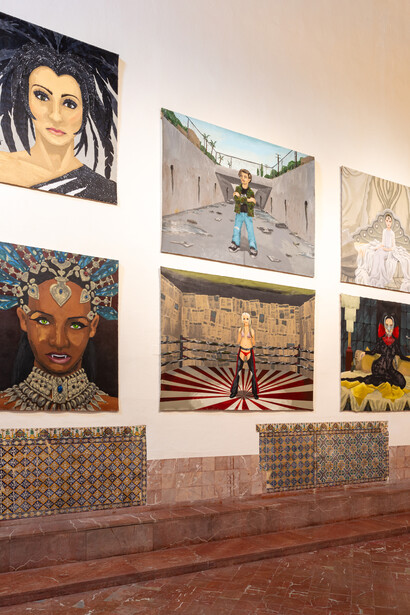
Far from mere mimesis, Solano’s work entails organizing a repertoire of images that are almost unconsciously devoured by those of us who, like her, were born in the heyday of mass culture, from MTV to the rampant teen consumerism of the late twentieth century. Now she gives those images back to us in an intimate tone, guided by her personal experiences and memory. Mainstream culture, individual and collective obsessions run together on a picture plane that, like a palimpsest, alternates between autobiographical reconstruction, the social imaginary, and the questions inherent to pictorial praxis.
It is paradoxical that a figurative painter should be the one to free painting from the tyranny of the image. Solano does not think of it as an imitation of reality, and although this painting series does have a specific underlying narrative, it is designed from a specific position: that of Manuela Solano, who grants each piece an autonomy that allows it to escape form as its ultimate purpose. Was this not Kandinsky and Mondrian’s dream when they invoked abstraction? In this way, Solano reconciles seemingly incompatible positions, for an attentive viewer will also pick up on the hints to what the Baroque revolution meant for the seventeenth century, when painting became the theater of memory and apparatus of visual excess. Like the Baroque folds described by Deleuze, Solano’s works aim to multiply rather than alleviate tensions: the tug-of-war between public and private, intimacy and spectacle, expands painting to a place beyond representation. The paint layers, their textures and buildups, do not just record a working process; they make it possible to construct a constantly changing life experience, one layer at a time.
Solano thus reasserts her belief that painting is a thing of the mind, just as Da Vinci suggested, in an unexpected turn toward the dogma of faith established by Clement Greenberg as a corollary of modern art. She expands the possibilities of painting in and of itself, but does not submit to it as a closed language. As Jorge Luis Borges once remarked in an interview, when your sight cannot guide you, you must focus on words; and it is in that solitude where the word (for poets) or the action and painting (in Solano’s case) find their fullest expression.
Having chosen a path parallel to that of Paul Klee, for whom painting did not imitate nature but made the invisible, the spiritual world visible, Solano uses her own experience as a starting point, carefully chewing up collective images and regurgitating them transformed, reshaping a repertoire of icons that lit up the adolescence and adulthood of those who grew up with them. What appears on her canvases are smoldering remnants of that cultural bonfire, embers that still illuminate us today, breaking down and consuming our present.
In that respect, Solano’s oeuvre ties in with the methodology of Aby Warburg, who assembled his Atlas mnemosyne as a constellation of gestures, symbols, and emotions spanning multiple periods and cultures. Similarly, Alien queen / Paraíso extraño composes a pantheon of margins and the marginalized, an alternate order that shifts hierarchies and rewrites possible genealogies for contemporary visual culture.
Far from what a quick glance might suggest, Manuela Solano’s work doesfall within pictorial tradition, but rather than seeking a nostalgic return to that tradition, it proclaims its relevance as an outpost of resistance against the surfeit of digital images. The image is an ephemeral surface, whereas the painting is impression and permanence; photographs and screens are consumed in the moment, whereas paintings embody the long haul, require contemplation and preserve, above all else, the symbolic dimension of gesture and memory. However, that gesture is anything but visceral; indeed, like all of Solano’s processes, it has a strong analytical component that can combine form, idea, and action, carefreely gliding over yet another new crisis of painting.
(The hand that guides me, text by Gilberto González)