English
 Español
 Français
 Deutsch
 Italiano
 Português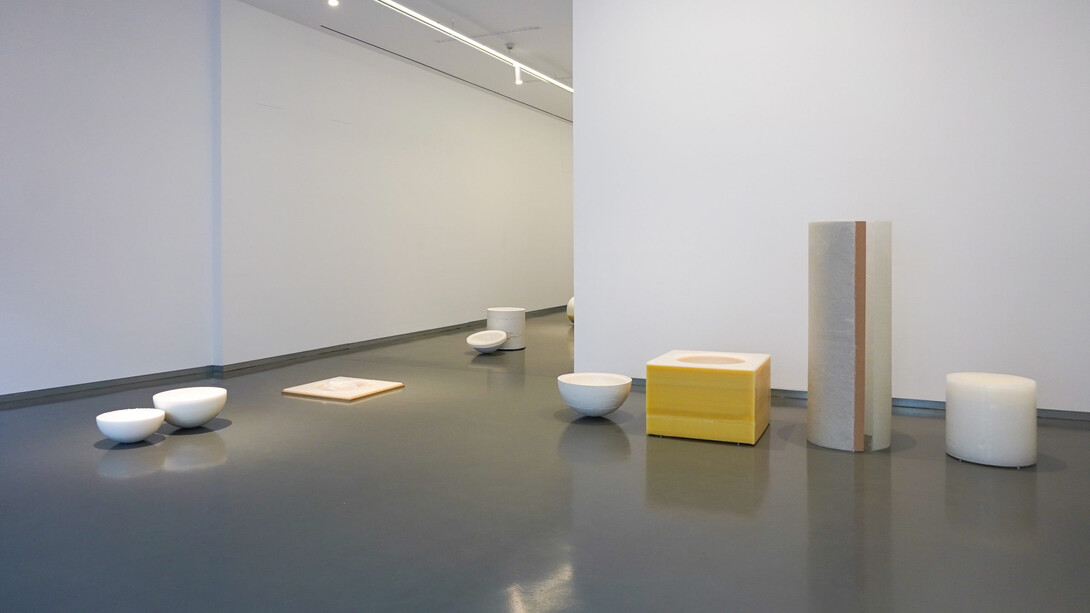
Homogenization and flexibility may seem like opposing terms, but it is precisely standardization that allows for the optimization of space usage and circulation. To homogenize means introducing rigidity, in the sense that it requires defining specific and strict rules, not to go so far as to become exclusive or singular, but rather to modulate to adapt to infinite situations, to fit into multiple contexts.
These are the concepts present in key case studies that are fundamental to Mercedes Pimiento’s research, who has been constructing a complex body of artistic work for years around the relationships between bodies, materials, and architecture.
Some of the case studies that act as triggers for this investigation and practice include Non Stop City, the speculative utopian architectural project developed in the 1970s by the Florentine group Archizoom. The project proposed the dissolution of the city and of architecture itself, replaced instead by a continuous, homogeneous, and potentially infinite interior space where functional suitability was no longer prioritized, but rather maximum flexibility.
Another example is the Free Trade Zones, understood as points of contact between material flows that sustain a specific urban environment —typically peripheral— whose internal urbanism is global, indistinguishable from other logistical and infrastructural enclaves across the planet.
Armazón y envoltura is yet another turn of the screw in an ongoing investigation preceded by earlier projects by Mercedes, such as Superficie neutra (2022–2023), Less than a container load (2023), or Sin título. Una búsqueda que es un tanteo (2024–2025).
It is unusual to literally provide a “framework and enclosure” for a curatorial text with an artist’s previous projects or research, but I do not doubt that in this case, the fairest approach is to acknowledge a long path of theory and practice that resists fragmentation and is essential to understanding the complexity and extraordinary synthesis embodied in the current work.
To omit that would be to hide the structure that sustains this project — one whose very pieces aim to do precisely the opposite: to make visible the behavior of materials and to reveal the infrastructure that supports and enables them.
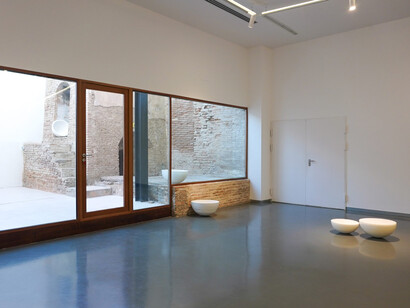
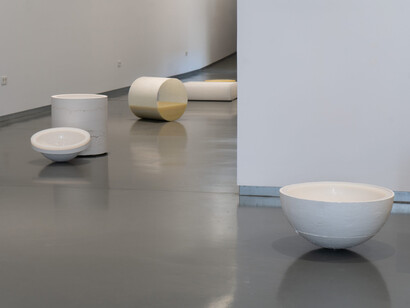
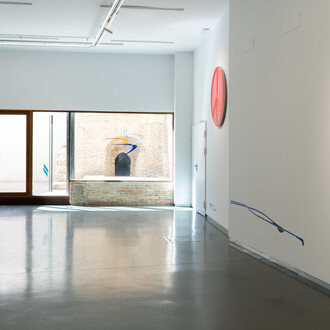
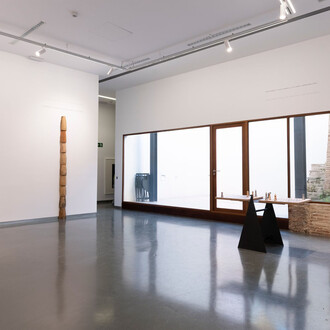
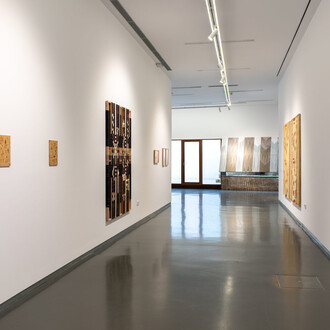
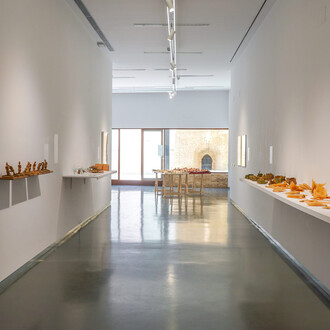
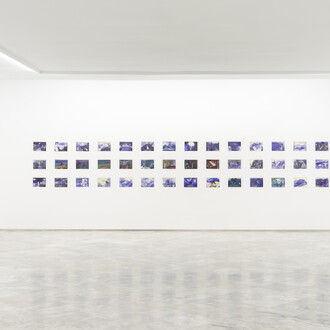
The pieces that make up the exhibition are arranged according to the linear tendency of the gallery space itself, which could stretch into infinity. Their specific placement seems to follow a pattern based on groupings and repetitions that could form part of a grid, establishing a continuous rhythm.
The size of the pieces is comparable to the human body: we cannot hold them, but neither do they contain us; their scale lies somewhere between the domestic and the structural, turning our own bodies into just another module within the grid.
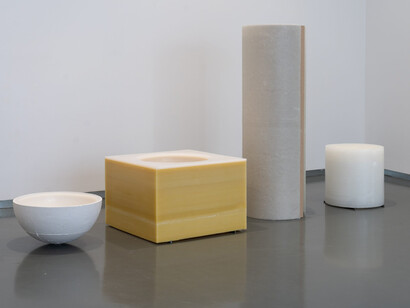
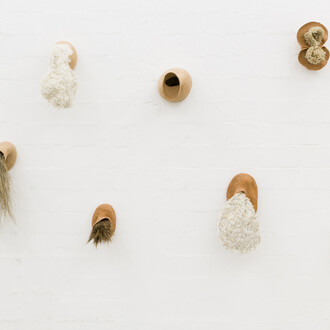
These groupings speak to us of container and content: they are pieces that can, in a sense, contain – which is why concave and convex surfaces are so present – yet they are composed of the very materials they contain. The groupings also reveal the artistic process undertaken by the artist in their making.
As if we were witnessing an animal that has just shed its skin, we see the behavior of the materials through their different phases, visible through the infrastructures that have supported them. The materials used in the process are still present — there is nothing hidden.
Thus, a fiberglass and resin cylinder — materials often considered unattractive by conventional aesthetic standards — visibly holds within it half a cylinder of beeswax; or a silicone mold rests on MDF, very near a plaster piece that also served as a mold for another half-sphere made of paraffin and vegetable wax.
One could go on almost endlessly in this play of inside and outside, of frameworks and enclosures that, in some way, flatten — or rather elevate — all materials to an equal footing, democratizing them, making them interchangeable.
Beyond the grid formed by the arrangement of the pieces, the behavior of the materials themselves generates, in some cases, their own textures and rhythms. The paraffin pieces produce patterns linked to the bell curve. Meanwhile, the beeswax pieces reveal contraction patterns that emerge when the material shifts from a liquid to a solid state, corresponding to what are known as Turing patterns —stripes and dots that arise naturally from a uniform and homogeneous state. Precisely —and to bring this meta-project, which also tends toward infinity, to a close— the same political intention the aforementioned utopian architectural projects sought to achieve.
(Text by Marta Sesé)