English
 Español
 Français
 Deutsch
 Italiano
 Português
In recent years, the role of art fairs has increasingly been questioned due to the growing distance between market-driven logics and the experimental, collective practices that are becoming ever more relevant to emerging artists. In this context, Swab Barcelona has evolved into a horizontal platform that brings together galleries, independent spaces, and artist collectives alongside professionals, collectors, and audiences in order to propose new forms of relationship, support, and exchange. Beyond its commercial function, the fair is conceived as a meeting space for critical thinking, collaborative networks, and community building.
For its 19th edition, Swab expands this line of work, consolidating a model that responds to contemporary tendencies while seeking new (or perhaps old) forms of intersection between art and society.
This new edition reflects on the perception of value in contemporary art, questioning the hegemony of capitalist narratives and opening the debate toward its social, symbolic, and affective dimensions. In this sense, it proposes an investigation that places at its core the value of the relationships between artwork, practice, and context, in both their tangible and intangible aspects.
In the words of its director, Carolina Díez-Cascón: “This edition represents the continuation and consolidation of the approach initiated the previous year: a commitment to building a solid ecosystem for the emerging sector in which art fairs function as platforms for encounter, exchange, and network-building. Within this framework, Swab defines itself as a space where a necessary balance between artistic creation and the market is articulated, while reinforcing its intention to weave new connections between art and society. From this perspective, and in the face of a context increasingly marked by violence and dehumanization, the fair reclaims culture as a critical, shared, and essential space.”
Swab 2026 programmes
Off-Site, a new programme for this edition, emerges from an urgency to rethink and transform exhibition formats and ways of inhabiting the urban context. Through the activation of mobile, reused, or disused spaces within urban centres, Off-Site proposes more flexible and situated ways of working that build from what is available while reformulating the relationship between artistic practice and context. The programme is conceived as a space for experimentation that expands forms of production, exhibition, and encounter, shifting artistic practice toward new geographies and generating alternative ways of relating to audiences and territory, while also contributing to opportunities for new generations to sustain their projects over time.
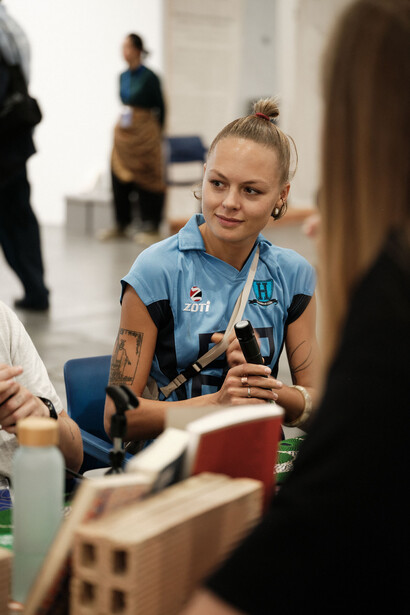
Polar & Tropic remains the fair’s main curatorial project, articulating both the exhibition project and the public programme. Building on its previous edition, it connects independent spaces and collaborative structures from the Nordic region and Southeast Asia, incorporating local initiatives in 2026. The programme promotes shared projects between participating spaces and proposes an extensive public programme including talks, radio (Station of Commons), posters (Lumbung Press), and workshops, activating the fair as a space for participation and collective reflection. Through these initiatives, the programme promotes dialogue, learning, and experimentation while addressing questions of identity, territory, and the relationship between community-based artistic practices and the market.
Meanwhile, Vortex, curated by Lena Solà, further develops its previous format of exchange between local and Latin American projects, generating shared spaces for dialogue, cohabitation, and long-term collaboration both within and beyond the fair. The dual cohabitation structure is maintained: each stand is shared by one Spanish gallery and one Latin American gallery, jointly presenting a project within the fair. This format, which has already demonstrated its ability to generate lasting networks, fosters a truly relational space where projects circulate and connect between both regions, strengthening collaboration between local and international art scenes.
The General Programme brings together galleries and independent spaces within the same framework, creating an ecosystem that connects different forms of artistic production, exhibition, and circulation. Beyond their structures or trajectories, participants are placed within a shared field of dialogue where hierarchies become blurred and a more open and transversal understanding of the sector is encouraged.
In this context, both established galleries and emerging initiatives contribute to making innovative practices visible and to generating new connections between artists, agents, and audiences. The programme thus promotes an environment based on collaboration, where different formats not only coexist but are also articulated together, activating exchange networks that expand possibilities for relationships, work, and sustainability within the artistic ecosystem.
MYFAF is a non-profit programme promoted by the Swab Barcelona Foundation that continues to play a key role as a platform for support and visibility for recently established galleries. The programme offers three free-of-charge stands to galleries with less than two years of activity that have never previously participated in an international art fair, thus facilitating their first access to this professional context.
MYFAF is conceived as a space for learning, visibility, and integration within the international artistic ecosystem, enabling participating galleries to present proposals with high cultural value without the economic pressure associated with art fair circuits. This condition encourages the exploration of more daring discourses consistent with their lines of work, while facilitating connections with new audiences, professionals, and collectors.
Taken together, this artistic programme reaffirms Swab’s sustained commitment to supporting emerging practices and generating new forms of exchange between artists, professional agents, and audiences. Rather than operating as isolated structures, the different programmes are articulated as a network of interconnected spaces where diverse methodologies and approaches can coexist, intersect, and activate new forms of production, circulation, and experience of art.