English
 Español
 Français
 Deutsch
 Italiano
 Português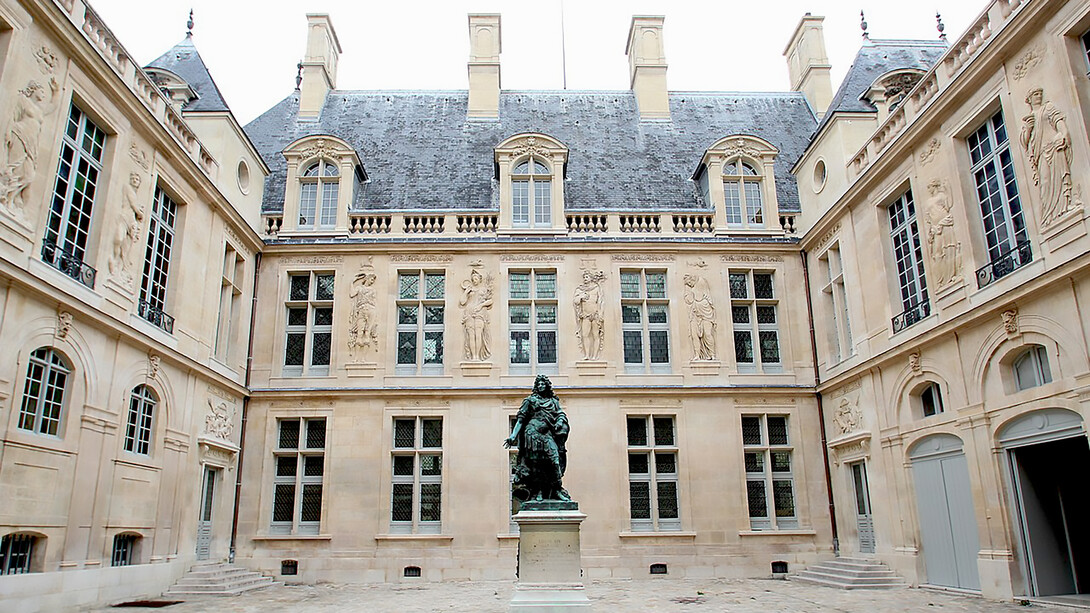
Sous le ciel de Paris
Jusqu'au soir vont chanter, hmm-hmm
L'hymne d'un peuple épris
De sa vieille cité(Jean Dréjac)
Under the Paris sky
All day long they will sing
The song of a people in love
With their old city
With its combination of Gothic, Renaissance, Neoclassical, and Haussmannian architecture, it could be argued that Paris is an outdoor museum in itself, as well as hosting some of the most famous museums and art galleries in the world. So a museum dedicated to the city of Paris may appear, if not unnecessary, somewhat excessive. But, like many attractions in the capital, it is so beautifully realized, one wonders how we managed without it during the long years of refurbishment.
Positioned proudly in the heart of the Marais—itself the heart of the city—the Carnavalet Museum embodies the rich narrative of Paris: the story, the people, and the gossip. The house itself is part of the history: it was built in the 16th century by Renaissance architect Pierre Lescot and sculptor Jean Goujon, both known for their work at the Louvre. The name Carnavalet comes from the hotel’s second owner, Madame de Kernevenoy, a Breton name that Parisians found difficult to pronounce.
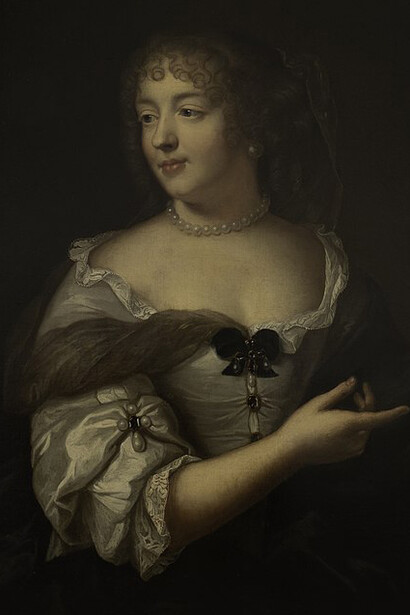
Stepping in from the Rue de Sévigné, the street Madame de Sévigné would have looked down from the window of her apartment here, we find ourselves in a square courtyard, typical of hôtels particuliers of the time. In the centre of the square, facing the entrance, Louis XIV, wearing a breastplate and a cape like a Roman emperor, welcomes visitors with an elegant, relaxed gesture. Above, full-size bas-reliefs attributed to Jean Goujon represent the four seasons. Impressive as they are, the visitor is advised not to linger—there are centuries of artefacts to explore.
Before the city of lights
Fittingly, the ancient and mediaeval halls are reached via a long and narrow staircase descending between old, cold stone walls. Archaeological research of the 1990s uncovered artefacts from the early Neolithic (4700-4200) to the early Iron Age. Displayed here, vases, hunting tools, and oak canoes that testify to humans inhabiting the area that is now Paris since prehistoric times. Along the banks of the Seine and the Bièvre, they lived on hunting, fishing, and agriculture. The life of Lutetia, the small Gallo-Roman city established on the left bank of the Seine, like today’s metropolis, was centred on the river. It gave the city its emblem—the sailing ship—and its motto, Fluctuat nec mergitur (rocked by the waves, but not sinking)—a declaration of resilience, courage, and ability to overcome hardship, from the flooding of the Seine to the terrorist attacks of 2015.
There is an area dedicated to Sainte Geneviève, one of the patron saints of Paris. She is celebrated for having saved Paris from the Huns, led by Attila, in 451, and rescuing Parisians from famine by organising a wheat aid convoy. Until the Revolution, processions carrying Sainte Geneviève’s relics traversed the city at times of uncertainty and on her feast day, 3rd January.
To defend itself against enemies, the city built a strong wall surrounding it. An interactive display in one of the introduction halls tests the visitor’s knowledge of the various enclosures and fortifications over the centuries. The map looks like ragged concentric, irregular circles, as if drawn by a child, expanding outwards from the Gallo-Roman wall.
A sign of the times
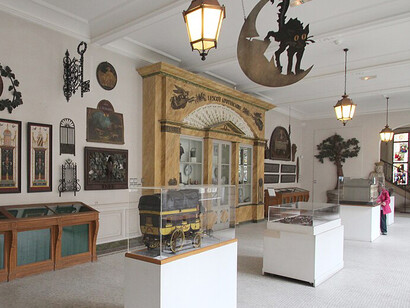
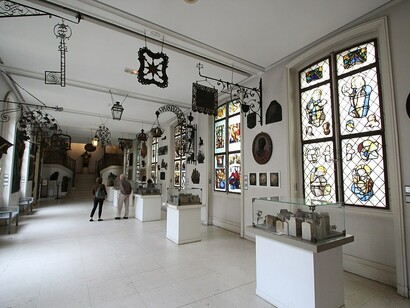
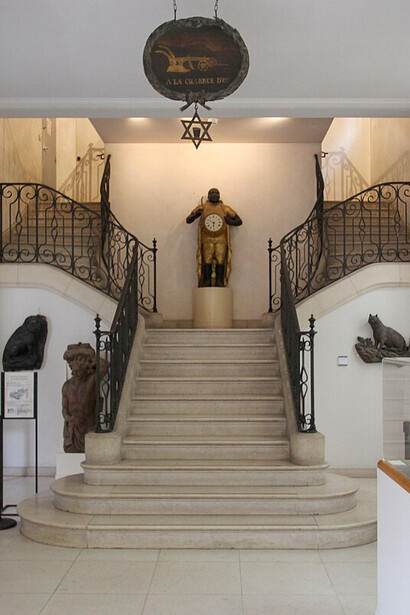
As the city grew—more in population than in size—it may have been difficult for a newcomer to find their way. Streets didn't yet have names, and even when they did, not many people were literate. Shop signs were essential for the orientation and identification of products and services on offer. Made of iron or wood, stone or canvas, painted or carved, the shop signs—keys, boots, roosters, pigs, and a dragon—demonstrate a variety of skills and provide a lively and colourful urban landscape. In this rich kaleidoscope, historians and visitors find copious examples of the various professions that flourished in the city: locksmith, butcher, clockmaker, tobacco seller, cobbler, and innkeeper. Here, in the first two halls of the museum’s permanent collection, one feels like strolling through an old street, criss-crossing from one shop to the next.
A historical museum, Carnavalet teaches us that history is made not only by kings and battles but also by artisans, shopkeepers, and the citizens running the complex machine that is the city’s daily (and nightly) life.
The city as a stage
In the introductory rooms, visitors can test their knowledge of Paris's fortifications, monuments, and entertainment venues on the interactive screens, amusing both children and adults. How many drinking fountains are there in Paris? (over 1,300) How many cinema screens? (400)
Chronology is not the most important thread in this museum, and one of its charms is the chance to lose your way between the two main buildings and to meander through its corridors and staircases. You can wander through an 18th-century music salon to Proust’s austere bedroom lined with cork tiles, or walk into Madame de Sevigné’s rooms and admire the desk on which many letters were written. Visitors interested in more opulence can step into the boutique of jeweler Georges Fouquet, transported from its original location on Rue Royale. Complete with peacocks, sculptures of a female nude, and painted glass, this is a beautiful example of Art Nouveau decorative design.
No chronicle of Paris is complete without this most spectacular of spectacles, the storming of the Bastille on the 14th of July 1789. The Carnavalet Museum pays due respect to this event and to the three Glorious Days that marked the French Revolution: here are pamphlets and paintings, caricatures and cockades, and a bust of Robespierre; there is a scale model of the Bastille made in a block of stone from the Bastille.
A new Belle Époque
George-Eugène Haussmann has always been a controversial figure for Parisians. Commissioned by Napoleon III, the vast programme of renovation overseen by Haussmann created the large, tree-lined avenues and boulevards, elegant stone apartment buildings, and new parks and squares decorated with fountains and statues. This gigantic project of urban modernisation enabled Paris to embrace the Belle Époque and open its doors to peace, optimism, can-can, and the World Fair. Haussmann's opponents bemoaned the loss of the city's mediaeval treasures and the charming narrow streets, ignoring the fact that some of these insalubrious streets were overcrowded and prone to disease. It may have been the reason for Haussmann's decision to advise the purchase of the Hôtel Carnavalet by the Municipal Council of Paris, which opened it to the public in 1880.
Narrating history in its unique modern fashion, the Carnavalet invites the visitor to embrace the history of Paris and become part of it. Today is tomorrow’s inspiration, and every era is—in its own way—a Belle Époque.
So step right in—make an entrance and join the conversation.