English
 Español
 Français
 Deutsch
 Italiano
 Português
When Juan Uslé was a student in Valencia, he and Victoria Civera decided to paint their bedroom black. It was the mid-1970s, they were young and free—fledgling artists in love. Then, with the first money they earned from an extra job, they acquired a camera and a little darkroom equipment; naturally, the room where they had been sleeping became the room where photographs would be developed. But there was still some leftover paint, so their new bedroom was made black too, at the opposite end of the small old house.
“The two spaces were connected diagonally through black,” Uslé tells me by video from his studio in Saro, a mountain village in Cantabria, Northern Spain. I watch him pause and gaze off into the middle distance, as if seeing the floor plan of his old college digs once again. “The photographic laboratory occupied the same space where we had been dreaming.”
And there it is, I think: an origin story just strange and precise enough to feel like one of his pain tings. Two rooms, two kinds of dreaming, a diagonal connection through the darkness. In one black chamber, a pair of young lovers asleep; in the other, an image slowly appearing in the che mical solution. Uslé confesses that he particularly loved the moment before the image resolved. Just as it began revealing itself, he would switch on the light. Then the photograph would start to deliquesce—it would fog up, scatter, partly vanish. An intermediate thing, delivered up to him by the reaction of liquid and light. He had little money for paper. Still, he risked the sheet.
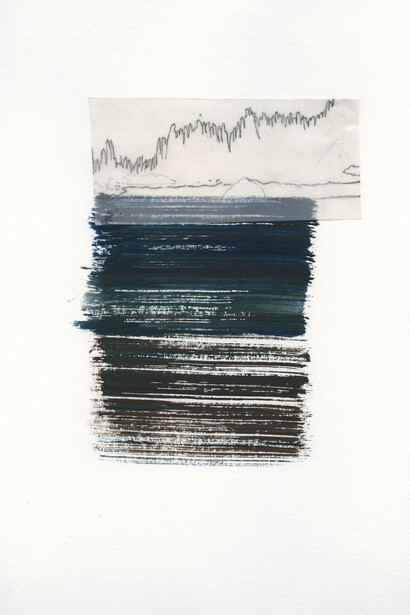
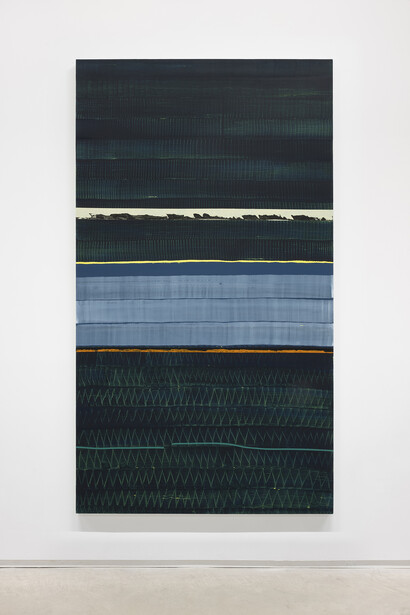
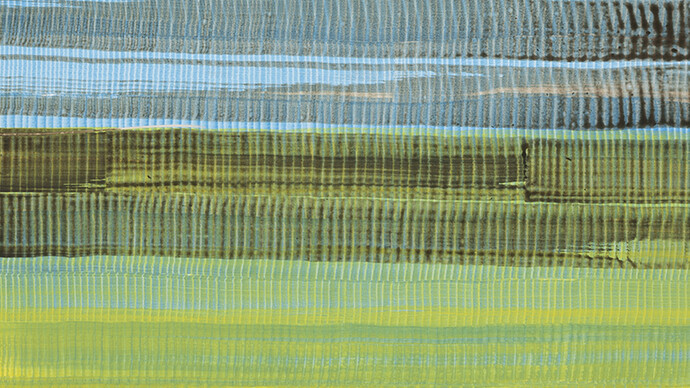
Remembered acts are apertures. Let’s step through this one into Uslé’s new exhibition, which he calls Intemperies. The Spanish word connotes exposure, weather, vulnerability, the condition of being without shelter… English, of course, forces us to choose among them—it’s our loss, each time. Uslé’s paintings inhabit the intervals. They disclose themselves slowly because they were made slowly, one increment of attention following another. They’re what remains after submis sion to accident, memory, body, atmosphere, the pressure of other paintings, the possible ruin of too much light. Horizontal passages emerge: thousands of short vertical marks gathered into unstable rows, like rain seen at night, like the lighted windows of a distant building, like informa tion trying to cross a damaged screen. It’s not clear, awash as they are in weather.
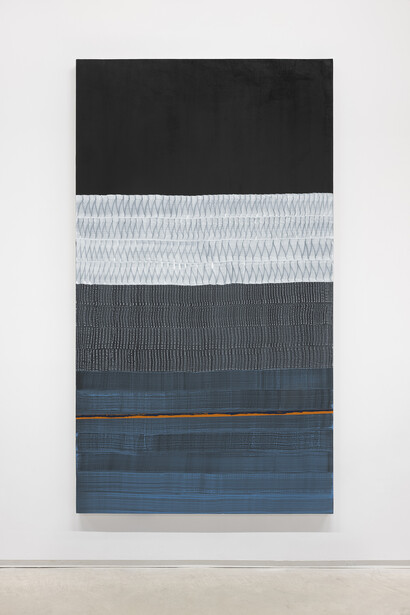
The exhibition’s three large Soñé que revelabas paintings make this especially vivid. From a dis tance, Bélaya appears to be nearly all black, though sustained looking separates its darkness into rows, pulses, minute shifts of pressure. Anadyr opens onto blue before crossing a broad, dark red interior and seeking to return. Usumacinta, on the other hand, is a plunge, a descent, from blac kness into a red interruption—then into rose, into earth. They bear the names of rivers, and the watery weight of duration, division, remembered geography, maybe even ethics.
“I don’t personally know all the rivers I use,” Uslé admits. “I navigate the internet to see what happens there—where the river goes, how long it is. I look for photographs.” Then there are the dams, cuts, and interventions, imposed not just on the rivers but on the mountains. He refuses the sentimental luxury, he tells me, of claiming that life was simply better before electricity and comfort. Yet the manner of our progress troubles him. The river is at once a natural and wounded form—free movement and harnessed force.
Geography, for Uslé, began where the image failed. His childhood textbook on the subject con tained only poor black-and-white photographs. Because he could not adequately see the moun tains, rivers, and countries depicted, he had to imagine them. They became part of his very being. It makes sense, then, that his abstractions should lean toward landscape without surrendering to it. Of the paintings in Intemperies, he says that they make “a slow move into the fusion of con ceptual abstraction and landscape.” Then he adds something more revealing: “In one way, I am becoming more and more the child of eleven or twelve again.”
That child lived in the rural countryside, where his parents worked as gardeners for cloistered nuns and tended other people’s cows. The family possessed almost nothing. “But we had free dom,” Uslé assures me. He spent hours alone in fields, climbing trees, going “crazy with the wind when it came and whipped through everything.” But such freedom was not without its fear. His parents were away all the day long; the child had to learn to trust they would return. “When you grow up being alone so much, so often,” he tells me, “you build inside you a kind of architecture that really saves you.”
The paintings feel like that inner architecture, left open to the weather. Their horizontal bands both shelter and expose one another. Siberial (pausado), Pequeño belt, Luminoso gran belt, and Deep nordic—these medium-sized works are all the same tall format, yet each puts forth a diffe rent climate. Gray is crossed by restrained signals. White pulses between black and blue. Green rises under a luminous sky. Pale yellow, orange, turquoise, and bone-colored lines keep a nor thern darkness electrically alert. As soon as a boundary is drawn, it’s rendered permeable. Wea ther suffuses it all, even the inside structure of the painting. But the trust is there, too. That inside structure: it keeps out chaos.
Is this balance? More a continual push and pull between two very different kinds of freedom. Uslé has mentioned Morandi and Picabia as exemplars of this contrast, and I ask him about it. “In Morandi’s case,” he replies, “it is a little like saying: ‘It doesn’t matter whether I am modern, contemporary, avant-garde, or whatever. I have these bottles or cans in front of me, and when I need to paint, I begin.’ It is like beginning one of my Soñé que revelabas paintings. You don’t begin by asking whether it will surprise the world, or whether it will make some tremendous statement. You try to purify and find richness in something as simple as repeating the same bottle.” When I suggest that Morandi achieved freedom by drawing a circle, so to speak, around his bottles—by sticking to a small, circumscribed world—Uslé nods at once and says, “Completely!” It’s depth instead of expansiveness. Morandi doesn’t need to demonstrate his freedom.
Then there’s Picabia. “He was a gamberro—a rascal,” Uslé tells me with a smile. Picabia repre sents contradiction, provocation, stylistic misbehavior. He’s the ancestor of Kippenberger: the artist who not only exercises freedom but performs it.
Juan Uslé requires both attitudes. He’s disciplined enough to sustain a pulse across a monumen tal canvas, but sufficiently mischievous to introduce dissonance, or abruptly move a picture into another “family,” as he calls his different series. After all, he confesses to me, he doesn’t want to be a nun or monk! “I am enough of a monk already.”
His mother apparently had another word for him. “She always said, “Juanín is not a bad child, but he is travieso.” Travieso means mischievous, someone who likes “to play with serious things,” twis ting what is formal or supposedly correct. His mother was onto something—it may be the most concise description of Uslé’s artistic character. And it puts him in fine company. Nietzsche said that he didn’t “know any other way of associating with great tasks than play.”
Play…and music. By now it’s well known that the famous pulse in the Soñé que revelabas pain tings began when Uslé tried to repeat a black painting and discovered that repetition was im possible. Following his heartbeat—boom, boom, boom—he moved the brush, pressed, stopped, moved again. The attempted copy became another being. A dance partner. The body had entered as a clock whose units—or steps—could never be identical. “The only music I have,” Uslé tells me of working in the country, “apart from my boom, boom, boom, is the river.”
This exhibition’s smaller paintings compress the dance, perhaps, but with no loss of grace. They’re measured and full of breath, even if it’s sometimes held. Dances done by someone suspicious of destinations.
Perhaps such suspicion was born of the secrecy that, by necessity, surrounded Uslé’s early atta chment to art. His parents, loving and poor, heard the teachers praise his drawing and unders tood only the potential expense of an education in art: another city, rent, materials, instability. Art, Uslé shares, was “not for us.” So he began hiding his drawings. Finally, one of his teachers, growing frustrated at the potential waste of such a talent, marched to his parents’ house and insisted that the boy be sent to art school in Valencia. Years later, at Uslé’s invitation, that same teacher attended the artist’s retrospective opening at the Reina Sofía. “This was the perfect mo ment,” Uslé says. His story leaves us both wiping our eyes and smiling quietly at each other.
There’s no resentment as we pause to recognize this old prohibition, only understanding. And tenderness. Even now, Uslé hears the parental voice telling him that art belongs elsewhere, to other people. But his freedom is built on loyalty rather than repudiation. And his answer has been to make paintings private enough to protect concentration and open enough to receive the world. Photography, he informs me, helps him test that permeability. He’ll photograph a light on a wall, a corner, a person sleeping on the street—things considered unimportant. Later he recognizes in them the same concerns pursued within a canvas. The ivory tower, he says, exists only for those who fail to understand how deeply one can go inside “a limited vocabulary, a limited time, a limited space.”
Speaking of limited time—we both realize we’re running out of it, but there’s a hesitation. It has been a beautiful conversation, a kind conversation. We speak of taking a walk somewhere in na ture—preferably in Northern Spain, I suggest. “I’m sure we will make some kind of excursion,” he responds. “If I can still walk! It would be fantastic.”
And then, as if to say what we’ve been trying to express all along, he says: “For me, life is a fan tastic gift. It is wonderful to feel and enjoy life.”
I show him that I concur, but it becomes clear he’s thinking about what he does with these fee lings. He’s thinking about his paintings. “I am a very visual person. Perhaps my childhood gave me the possibility of discovering images, moments, lights, colors that change, shadows that be come animated—the magic of life. My only pretension sometimes is to bring my work close to some of those moments, in a very silent way.”
I tell him that I admire this quality in his work.
“Other times,” he continues, “I become more pretentious and Picabian. We are spirit and body; sometimes we need to change, explore, scream, even insult somebody. I like doing that kind of painting too.”
“Right,” I say.
“But I don’t want to punch anybody with an image.” He wants to invite a person to approach slowly, he tells me, and “feel their body against the body of the painting.” The more fully the viewer feels themselves, he adds, the more naked the encounter becomes, and the deeper the conversation.
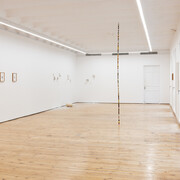
Intemperies leaves that encounter exposed. Somewhere between our dreaming and their wea ther, an image is still appearing.