English
 Español
 Français
 Deutsch
 Italiano
 Português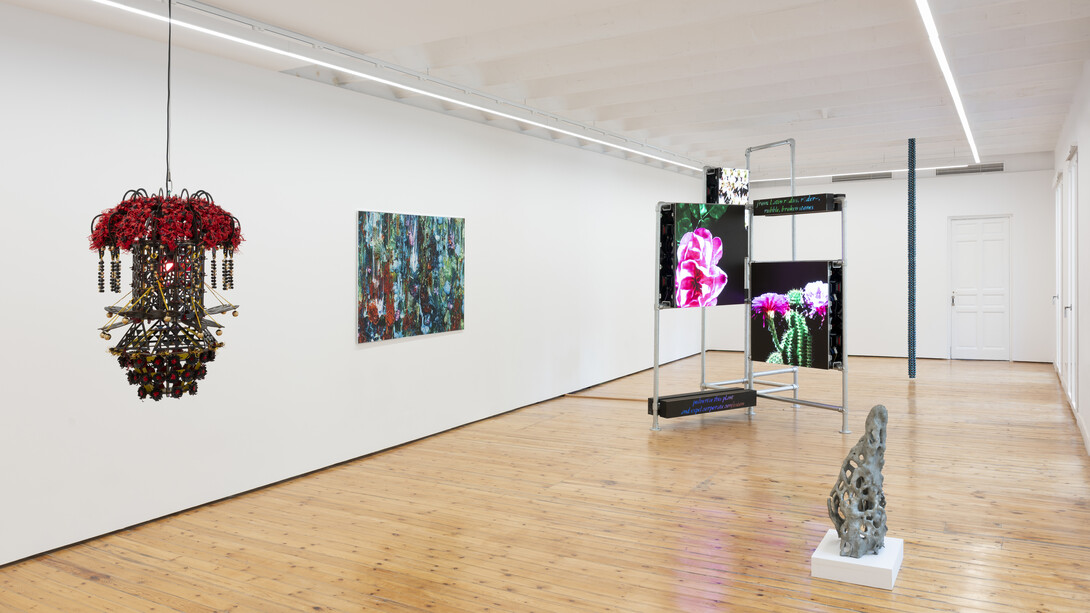
Prats Nogueras Blanchard is delighted to present Feral agency. This exhibition brings together works by Agnieszka Kurant, Hito Steyerl, and Haegue Yang that explore forms of agency emerging beyond the limits of individual authorship, human intentionality, and systems of control. Through practices that diverge in materials, methodologies, and references, the three artists address a shared condition: the increasing presence—and visibility—of forces that act, affect, and generate meaning without belonging to a single subject.
Rather than understanding intelligence, knowledge, or agency as being possessed by autonomous individuals, the exhibition approaches them as distributed phenomena emerging through biological organisms, technological infrastructures, economic systems, material environments, and cultural networks. As a result, the works reveal a world in which authorship is collective, matter is active, and the distinction between the natural and the artificial becomes increasingly unstable.
In this sense, the works of Agnieszka Kurant establish the exhibition’s fundamental premise. Through systems involving artificial intelligence, biological processes, and immaterial economies her practice demonstrates how value and form emerge from interactions that exceed individual control. The selected works articulate different manifestations of agency: from collective and machine-generated morphologies to speculative biological futures and invisible structures of economic value. Her works situate the exhibition within a broader investigation into emergence, complexity, and nonhuman forms of production.
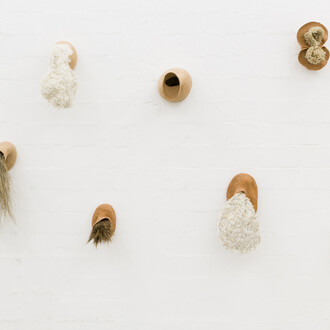
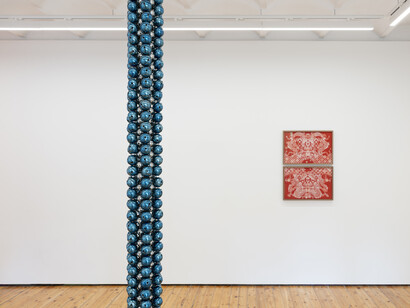
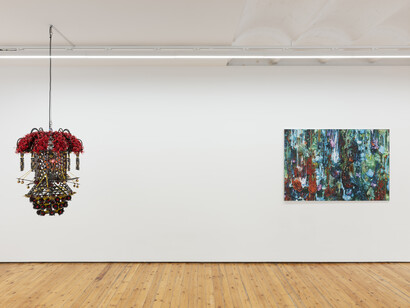
Haegue Yang, in turn, approaches these questions through the material and sensory life of objects. Her works transform industrially manufactured elements into forms that appear animated, relational, and responsive. Sound, movement, ornament, ritual, and abstraction converge to challenge conventional distinctions between subject and object, animate and inanimate, foregrounding forms of intelligence embedded in matter itself. Within the exhibition, Yang expands the notion of agency beyond systems and networks, anchoring it in embodied experience and in the capacity of matter itself to generate relationships, atmospheres, and modes of communication.
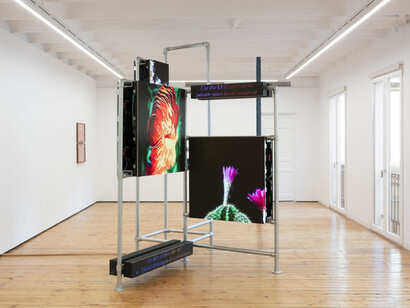
Within this constellation, Hito Steyerl’s Power plants introduces a critical perspective on the technological and political dimensions of contemporary agency. The work brings together artificial intelligence, ecological speculation, and image production to examine how machine-learning systems increasingly participate in the creation of realities, predictions, and futures. The generated plants that inhabit the installation occupy an ambiguous territory between organic life and computational simulation, revealing how technological infrastructures have become active agents in shaping perception, knowledge, and the environment. In this context, Power plants is not merely a reflection on artificial intelligence, but an investigation into the political conditions under which nonhuman forms of agency emerge and operate.
Taken together, these works do not propose a unified theory; rather, they construct a field of tensions between biological, technological, material, and cultural forms of agency. The exhibition suggests that what increasingly defines our contemporary condition is not the emergence of a new intelligence, but the recognition that agency itself has never been exclusively human. It has always been distributed across networks, organisms, infrastructures, objects, and images whose interactions exceed the frameworks through which modernity sought to understand and govern the world.
![Victoria Civera, Refugio, estímulo y deseo [Refuge, stimulus and desire], exhibition view. Courtesy of Prats Nogueras Blanchard. Photo by Roberto Ruiz](/attachments/8545ad200e0a5ab4d1b51e1fc5cb06914e575fe7/store/fill/330/330/20239306f91a45844aade18d7da6c5b050e75f50ec248e14cd4e90b8fc76/Victoria-Civera-Refugio-estimulo-y-deseo-Refuge-stimulus-and-desire-exhibition-view-Courtesy-of.jpg)
![Erick Beltran, Lo que está presente [What is present], exhibition view. Courtesy of Prats Nogueras Blanchard. Photo by Roberto Ruiz](/attachments/524d71d72423f569c5a15d770a7cef0a1c599078/store/fill/330/330/41bf148833855740dccd334164aa8472c92e686970e08dff313690f7c562/Erick-Beltran-Lo-que-esta-presente-What-is-present-exhibition-view-Courtesy-of-Prats-Nogueras.jpg)