English
 Español
 Français
 Deutsch
 Italiano
 Português
Kant put it with a coldness that is still unsettling: we have no access to things in themselves, only to how they appear to us. Twenty centuries earlier, in India, that veil had been given a more beautiful name: maya.
Photography was born in the midst of that suspicion, and deepened it. It promised at last the thing itself, the trace of light on a plate, and delivered one more appearance, only arrested.
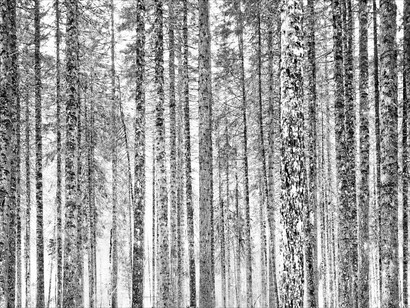
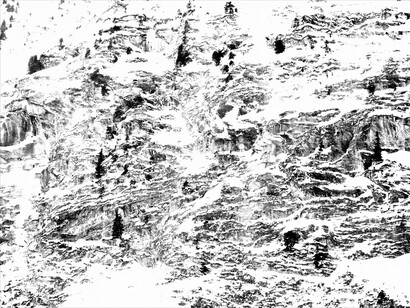
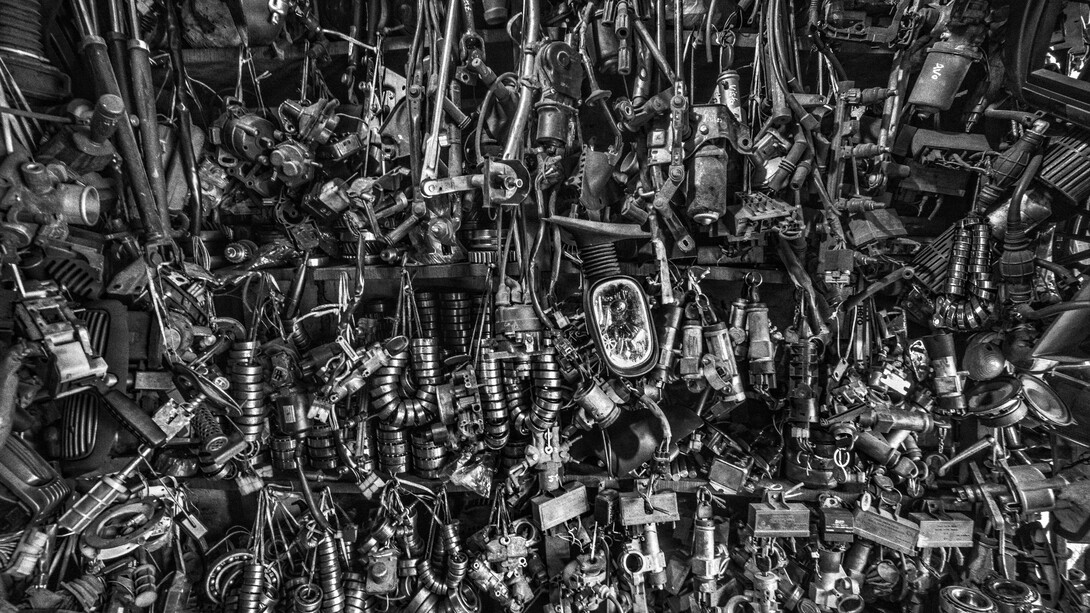
Charles Ewing works with that arrest. His images are pushed to the threshold where grey fades and black and white prevail: what light erases and what light saves.
In German, Flechtwerk is wickerwork, the interlaced, the woven. The same root names the Flechte, the lichen, an organism that is not one but two, holding each other up on the stone.
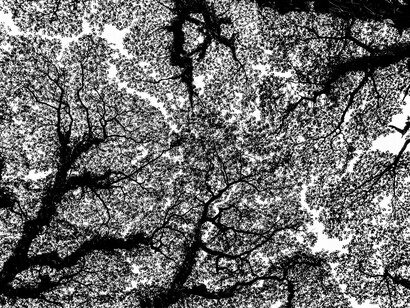
Treetops, pine forests, crowds, a white village, a tapestry of scrap metal, a nebula. In these works the weave lies neither in order nor in chaos but in the oscillation between them, the only state in which something living can grow.
A weave is made as much of thread as of gap. Without the voids there is no braid. And it is through the voids that one senses there is something behind, something the image keeps.
A clear scene absorbs us through narrative; we know what is happening and the illusion works seamlessly. In these images there is no narrative. What absorbs us is the beauty of the weave and the suspicion that, however many gaps it has, the other side is never reached.
Heraclitus wrote that nature loves to hide. Ewing photographs that love: not mystery as a subject but the exact way in which things show themselves by withdrawing.
And perhaps photography, which freezes an instant so that we can look at it, does nothing other than confess that the instant had already gone by the time we looked. What remains is the weave, and in its gaps, the invitation to keep looking.