English
 Español
 Français
 Deutsch
 Italiano
 Português
![Victoria Civera, Refugio, estímulo y deseo [Refuge, stimulus and desire], exhibition view. Courtesy of Prats Nogueras Blanchard. Photo by Roberto Ruiz](/attachments/ffe390e6c4195364aeb1d4283a44aea5a869fb05/store/fill/1090/613/20239306f91a45844aade18d7da6c5b050e75f50ec248e14cd4e90b8fc76/Victoria-Civera-Refugio-estimulo-y-deseo-Refuge-stimulus-and-desire-exhibition-view-Courtesy-of.jpg)
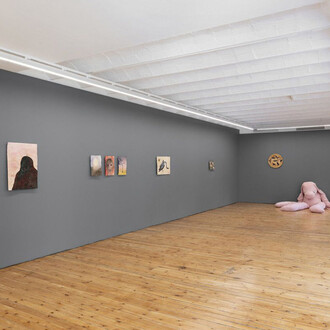
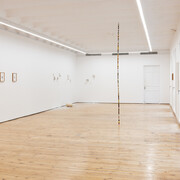
Prats Nogueras Blanchard is pleased to present Refugio, estímulo y deseo [Refuge, stimulus and desire], a new exhibition by Victoria Civera at its Madrid space. Bringing together a group of recent works spanning painting, installation, and objects, the exhibition underscores the artist’s exploration of refuge, memory, and the construction of intimate spaces. Civera’s practice considers the idea of “home,” not as a fixed place but as an emotional territory—fragmented and in constant reconstruction.
Gaps and collage
The “house”, the supposed territory of belonging, is often vague and unstable; very different from the one we inhabit in the pre sent and even in the past. For the house is, above all, the desire to inhabit it, wherever it may be; it refers to a threshold we are not even capable of reproducing in our memory with precision. The “house”—belonging—is a longing, a necessary void, some thing we need to feel we have inhabited, though perhaps we never did: A collage of memories, rather.
So it is better to build it anew each time we need it, and to imagine ourselves living there—in Clifford’s 1854 photograph of the Alhambra, which awakens in Barthes what he calls in Camera Lucida the désir d’habitation: a desire to inhabit, not merely to look at or visit. To inhabit even the “homes” dreamed up by others, since, after all, the “home”—the familiar—springs up where one would least expect it—, if we are fortunate enough for it to appear at all. How strange: to live in a photograph from long ago; to find one’s own home in a past that did not even belong to us.
This is what Bachelard refers to when he describes “poetic space”—which the writer associates with the lines of an engraving when he refers to the “home” of memory, a utopian time, and sated voids. For him—and in this he recalls Barthes—it is a feeling that is both powerful and elusive, perhaps just like those associated with the “house” itself: the sense that one ought to live there, between the lines of the engraving; uninhabitable places in a physicality that becomes possible within the gaps of desire itself. Where does the “home” dwell? What do we call by that name if the ultimate memory of belonging—the place we believe we recognize and seek relentlessly—refers to a territory of impossible return, the place that inevitably transports us to a collage of gaps: past longings.
Filling in the gaps
The rain catches Vicky Civera by surprise in her studio. It’s not unusual. She spends many hours there. She makes the most of her time there. That’s her way of working: she tests colors on the walls, creates mock-ups, and rehearses the set designs that will guide the installation... The works do not form a unified whole in the classical sense; rather, they unfold as a kind of staging that spreads out in search of a necessary refuge—an architecture of emergency, akin to the structures of Japanese architect Shigeru Ban, made from paper and recycled cardboard tubes. I would prefer to call it an “architecture of shelter.”
Civera is searching for refuge, exploring nothing less than a space of comfort, a “home”; an embrace, in Vicky’s words. The task requires a skilled hand to stitch together the scraps and remnants—often literally speaking—the Pantone; an invisible hand that understands how to weave together raindrops as they mingle with the sound of the sea; when the vertical and horizontal move ments of the water compose a symphony that envelops and carries us far back in time, to childhood, to those earliest memories of comfort.
Working right up until the last moment—something we women know all too well—; leaving nothing to chance: chance is power ful enough as it is, without us adding to it. I would venture to say that Vicky loves being in her studio, and not because her stu dio is her home—which it is, of course—but because her studio is inhabited by those homes she builds in every piece, in every painting, in every object; in every material, a fundamental part of her work—selecting them, finding them, even seeking them out. “Going out to meet them is like traveling to a different country; engaging in a dialogue with the landscape they offer; taking things out of context or visualizing what truly surprises the eye,” she writes to me in an email.
And so the studio is home to the refuges that give rise to her works, and to Vicky Civera, who manages to capture them. She creates poetic spaces of habitability that expand with each work, leaping from one to another and infusing them all. They emer ge in the gaps, stitching them together, fostering a refuge of spaces that—despite being built in fragments, or perhaps because of it—offer the embrace the artist often speaks of: a sense of safety, I suppose.
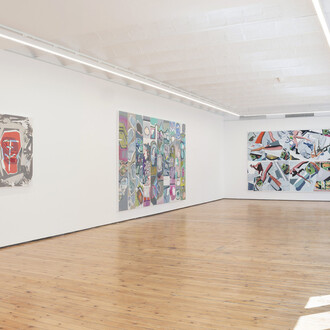
There, in the gaps inherent to any collage—a tradition to which Civera is often said to belong—the approach to visuality takes on a certain syncopated quality that is revealed even in his large, self-contained paintings. In these three large-scale works presented here as well, the interplay of materials and scenography within the scenography is evident: through his works, Civera experiments with different ways of communicating, and I would dare to say with moods that move comfortably between the figuration of En el camino de Saja (the name of Civera’s granddaughter and a reflection on adolescence), and the abstract worlds of Gensō (in Japanese, fantasy worlds that appeal to art and, once again, to comfort and the pleasant) or the third painting, Privado, a strategy for protecting intimacy and feeling safe. In these two latest works, Civera returns, in a way, with her planes and constructive forms, to the tempered works of the 1980s and 1990s—the artist’s “patchwork” surfaces—fragmented, with scraps of dazzling fabrics, both physical and metaphorical. It is a strategy to establish the architecture of shelter that Civera seeks and needs, which she crafts to protect herself.
Although shelter is, after all, an elusive, ungraspable concept. It certainly does not inhabit the studio, but perhaps it does not even inhabit the pieces themselves; rather, the care taken in the relationships between each piece—which distills a seriality like an expanded narrative that is fully (re)cognized only within the individual pieces and the juggling act that extends toward the others—weaves—yes, I think this is the word I’m looking for—a comfortable place to inhabit—once again, the lines of Bache lard’s engraving. Certainly, Civera’s gaps trace a map of poetic spaces.
The rain and the sound of the sea catch Vicky Civera working in her studio: the pieces must never be considered finished, nor the world. And some sounds draw in other musics. They attract them to the artist’s imagination, an improvised mixing board. After all, her work has something of a mixing board about it, where the needle stitches up the gaps—those that, in a paradox, become essential for sheltering from the inclemency of the passage of time. Or, above all, from any other inclemency as we drift away from that first childhood memory, where the whole world was an infinite embrace. She seeks it in her studio when she can’t quite bring herself to go out and prefers to listen to the rain that brings news of the eternal, of the frozen moment. Civera seeks to heal herself, and in her search, she ends up healing us.
Cracks, shelters
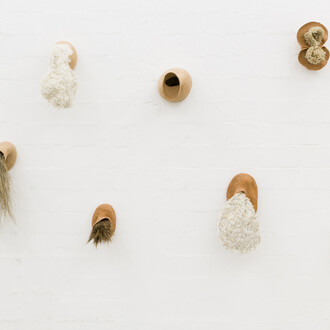
I call these pieces sculptures. Civera prefers to call them objects. Shelters, to be more precise. And the difference is not merely semantic—quite the contrary. To call Vicky Civera’s shelters sculptures is to imbue them with a certain solemnity that the artist neither desires nor seeks. Her pursuit lies elsewhere.
Civera’s work is a collage in the broadest sense of the term, a maneuver in which the large and the small speak; the abstract dialogues with the figurative; the constructive—traditionally cold—with the warm geometries of textiles, the warmth in the style of Lygia Clark and Helio Oiticica. And the backgrounds transform into figures—once again the imaginary mixing console so evident in the sound pieces—imperceptible and subtle shelters, taking the radicalism of Ángel Ferrant in his sophisticated pieces a step further or adding a twist to Oteiza’s Experimental laboratory. The small pieces are, for me, among the most extraordinary in Civera’s work.
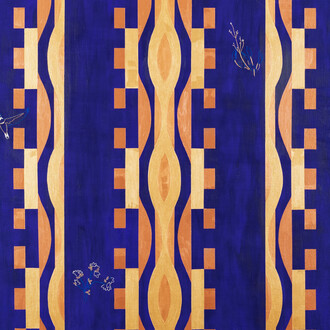
Because Ferrant’s found objects—in Civera’s case, river stones, carved stones, or constructed artifacts—are transformed by something absent in the other two artists mentioned, Ferrant himself and Oteiza; something extraordinary and assertive in Vicky Civera. In the shelters she creates in 2025 and 2026, as in so many of her works, the fabrics—soft and malleable—subtly intrude upon the visual narrative, which is sometimes blue; blue for years now. In Syria, it is the color of mourning, mourning for that rain that fell in another time, I think as I stand before Civera’s work, searching for my own home. They disrupt tradition. The scraps—textiles—add and trace new paths through stitching and recycling, turning traditional collage on its head and turning our eyes toward Lévi-Strauss’s idea of bricolage: working from what is available.
Working with what is already there seeks to gradually incorporate the everyday, which is why I have spoken of a patchwork strategy—one rooted in the practices of radical women. Gifts from friends, relatives, neighbours; colours that interact with the scraps; scraps that find refuge in the hollow of the small object. There, inside, the fabric lives.
I am moved by this small space where the material takes shelter from the elements. The crack, the broken, transforms into a refuge, into a shelter. In these necessary fissures, we find comfort. The hollow, at last, embraces us. If Freud suggested that without loss there is no narrative, perhaps without a crack there is no shelter either.
(Donde habite la casa [Where the house may inhabit], text by Estrella de Diego)
![Victoria Civera, Refugio, estímulo y deseo [Refuge, stimulus and desire], exhibition view. Courtesy of Prats Nogueras Blanchard. Photo by Roberto Ruiz](/attachments/338c62b65b67a17c6ef886c93543aac3ab3af9a3/store/fill/410/308/1b98869e2b27ceadabf72ef4b5829948230326b16e187e277bbb182192c5/Victoria-Civera-Refugio-estimulo-y-deseo-Refuge-stimulus-and-desire-exhibition-view-Courtesy-of.jpg)
![Victoria Civera, Refugio, estímulo y deseo [Refuge, stimulus and desire], exhibition view. Courtesy of Prats Nogueras Blanchard. Photo by Roberto Ruiz](/attachments/4257045308b126e781a728b41a66e360d6be8b11/store/fill/410/308/375281627f78bf3b76ffffb8ac4f7284d36ae2261524bb2f9fe85f4f8008/Victoria-Civera-Refugio-estimulo-y-deseo-Refuge-stimulus-and-desire-exhibition-view-Courtesy-of.jpg)
![Victoria Civera, Refugio, estímulo y deseo [Refuge, stimulus and desire], exhibition view. Courtesy of Prats Nogueras Blanchard. Photo by Roberto Ruiz](/attachments/09d8e6b92fc836d46b84e6578e21b878df63fc6a/store/fill/410/308/73cc73a8318b7a1bff0b92513d59ed60597dfd4e2d235db5a1dfb74b7d66/Victoria-Civera-Refugio-estimulo-y-deseo-Refuge-stimulus-and-desire-exhibition-view-Courtesy-of.jpg)
![Erick Beltran, Lo que está presente [What is present], exhibition view. Courtesy of Prats Nogueras Blanchard. Photo by Roberto Ruiz](/attachments/524d71d72423f569c5a15d770a7cef0a1c599078/store/fill/330/330/41bf148833855740dccd334164aa8472c92e686970e08dff313690f7c562/Erick-Beltran-Lo-que-esta-presente-What-is-present-exhibition-view-Courtesy-of-Prats-Nogueras.jpg)