English
 Español
 Français
 Deutsch
 Italiano
 Português

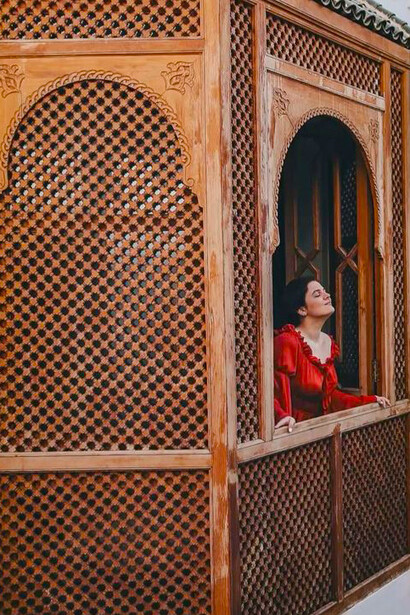
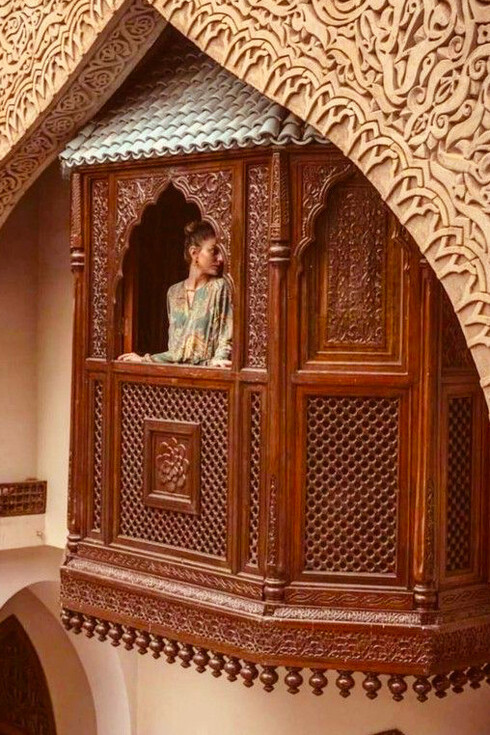
There are cultures that regard the window as an eye and others that regard it as skin.
An eye opens in order to see. Skin closes in order to protect. This difference tells a story about how a community imagines the relationship between human beings and the world.
Architecture is never merely a system of walls, roofs, and openings. Every house is a silent autobiography. Every window is a society's self-portrait. As Gaston Bachelard writes in The Poetics of Space, the house is not simply the place where we live; it is the soul's first universe, the topography of our memory. Rooms, thresholds, attics, and windows are not merely objects, but ways through which we establish a relationship with the outside world.
A window simultaneously invites and keeps at a distance. Through it flow light, air, and the changing seasons. Yet through the very same opening comes the gaze. And the gaze is never merely an optical phenomenon. It is always a social relationship.
For this reason, a curtain is never just a piece of fabric.
According to Mary Douglas, every society draws invisible boundaries around itself. These boundaries define not only what is considered pure or impure, but also who may enter a space and who must remain outside. Maintaining order always means maintaining boundaries as well. From this perspective, the curtain is a cultural membrane. It is not a wall, yet it separates. It does not block the light, but it regulates the gaze.
Erving Goffman describes the same phenomenon in different terms. He imagines social life as a theater in which we all perform roles. There is a front stage, where we present ourselves before others, and there is a back stage, where we can finally set those roles aside.
A family home is, for the most part, that backstage. It is the place where we no longer need to perform ourselves.
The only question is, where does this backstage world begin?
In many parts of the Netherlands, even the living room facing the street may belong to this backstage. Open curtains do not necessarily imply the abandonment of privacy. Rather, they express the idea that a home may be visible without granting anyone the right to stare inside. Within the Protestant bourgeois tradition, openness long symbolized transparency and honesty. The house is visible, yet the family's intimacy remains inviolable.
Other societies draw this boundary in entirely different places.
Traditional Damascene houses turn inward. The courtyard is the family's world. The street façade often remains silent. Here, architecture does not tell its story to the outside world; instead, it creates a refuge for those who live within. The few openings onto the street, the screens, the lattices, and the curtains are not merely architectural elements—they are the material expressions of family intimacy.
Pierre Bourdieu would most likely describe this as habitus.
People rarely stop to ask themselves why they draw the curtains. Just as they seldom question why shoes are removed at the entrance in some countries but not in others. These are not conscious decisions; they are cultural routines inscribed into the body. Habitus does not teach rules—it teaches a sense of naturalness. It instills the feeling that "this is simply how things are done."
This is why a custom appears self-evident within one's own culture while seeming incomprehensible in another.
A country that has endured years of war learns the meaning of visibility differently.
War destroys more than buildings; it transforms the relationship people have with space itself. Uncertainty, displacement, checkpoints, the experience of constant surveillance, or simply the need for perpetual adaptation may leave behind habits that, from the outside, appear excessively cautious but, from within, are simply part of everyday normality.
It is within this line of thought that I recall the story of a friend.
He was a guest of a family in Syria. They welcomed him warmly and kindly, offering him his own room. Their hospitality was genuine. They had only one request: that he should never open the curtains in his room—neither during the day nor at night.
At first glance, it seemed like an insignificant request. Yet it unsettled him. No natural light entered the room, and whenever he worked indoors, he had to sit in darkness. For him, this was not merely a practical inconvenience—it was a natural expression of personal autonomy. His hosts, however, were most likely living within an entirely different narrative.
Perhaps the window overlooked an inner courtyard where the women of the household moved about in their home clothes. Perhaps the rule was part of a long-established mutual discretion among neighbors. Perhaps years of war had fostered the habit of ensuring that no one from the street could see into the home. Or perhaps this was simply how they had always lived, and the request carried no deeper meaning than taking off one's shoes before entering a house does in our own culture.
Their answer was simply: "This is how it's done."
Perhaps one of the most important insights of the social sciences is that the very same action can carry profoundly different meanings in different worlds.
One day, I spoke with my friend, who had struggled with the permanently drawn curtains. We briefly discussed women who wear the niqab, alongside news reports about restrictions on women's freedom of movement and the stories we had come to associate with the Middle East. He felt that he was observing two different manifestations of the same social logic.
He was not motivated by ill will. Quite the opposite. He was motivated by compassion.
By the conviction that wherever we perceive an absence of freedom, we have a responsibility to stand up for it. That the world can be made better, and that individuals have a moral obligation to speak out whenever they encounter injustice.
This intention is worthy of respect. Yet the interpretation may still be incomplete.
Edward Said's theory of Orientalism speaks precisely to moments like these. Not because the West is inherently malicious, but because it is remarkably easy for "the East" to become a single, unified story within the Western imagination—a story in which every sign points toward the same conclusion.
The curtain becomes a symbol of oppression.
The niqab becomes a symbol of the absence of freedom.
Silence becomes a sign of consent.
Reality, however, is rarely so compliant.
A curtain may signify a religious norm, family intimacy, a security routine, protection from the climate, a habit, or any combination of these. Just as the motivations for wearing the niqab cannot be reduced to a single explanation, neither can a curtain automatically serve as evidence of the same social phenomenon.
Cultural relativism is often misunderstood. It does not mean that every social practice is inherently right, nor that we should refrain from critically discussing women's rights, authoritarian regimes, or social inequalities. Rather, it means that understanding must precede judgment. Before deciding what we think about a custom, we must first understand the world in which it came into being.
There are things that, at first glance, seem to belong to the same story simply because both involve concealment. Both the niqab and the drawn curtain conceal something. In both cases, something is rendered invisible. Yet their social meanings are neither the same language nor the same body.
The niqab—in certain communities in Syria and more broadly in parts of the Muslim world—appears as a religious and cultural practice that regulates the visibility of a woman's face and body in public space. Its meaning, however, cannot be reduced to a single sentence. In some cases, it stems from personal religious conviction and the Islamic ideal of modesty (ḥayāʾ), according to which concealing certain parts of the body forms part of one's relationship with God. In other cases, it reflects family or community expectations, where "proper behavior" and "respectability" are defined through social norms. And there are also contexts in which it is imposed through pressure, where the space for personal choice narrows, and the garment comes to represent not only meaning but also coercion.
The curtain, by contrast, is not a rule written upon the body but a rule written into space.
In my friend's story, the curtain was neither a religious symbol nor a means of regulating the female body. Rather, it marked the boundary of the household's inner world. He was simply told, "Don't open it." This instruction was not about his body, but about what would become visible through the room's window—from inside the house to the outside, and from the outside back in. Here, the curtain functioned as an intermediate zone: it was not part of the public sphere, yet neither was it entirely private, because it belonged to a shared family structure.
And yet there is one common thread that runs deeper than their differences: BBth concern the control of visibility. Not whether something should be visible, but who may see whom, when, and under what conditions.
The difference begins where power and meaning diverge. And if we fail to look carefully enough, the world all too easily conflates the two. The curtain, however, does not fall across the face—it falls across space.
Edward Said would caution us that, when looking at an unfamiliar world, it is all too easy to impose a single narrative upon every detail: a narrative of closure, of control. Within that narrative, different kinds of veils—the veil of fabric and the veil of space—merge into one overarching symbol.
Yet a curtain does not conceal a face. And a niqab does not conceal a window.
One protects the boundary of a family's inner world. The other shapes the way a person appears in public space. At times, they may coexist in the life of the same woman, within the same house, in the same city—but they do not tell the same story.
Seeing truly begins when we resist rushing toward a single interpretation.
When we refrain from saying too quickly, "This is the same as that." Instead, we pause at the threshold, where meanings still exist in the plural. The niqab may, for some, be an act of prayer. For others, it may be a social expectation.
A curtain may signify intimacy. Or order. Or simply protection from the sunlight. Perhaps the most important distinction is not what these things conceal, But who decides, and within what kind of story does that decision come to feel natural?
My friend's experience is not a judgment; it is a mirror. It reveals how easily we assume that the curtain in someone else's home speaks the same language as the veils of our own world.
Yet sometimes it speaks only of the fact that every home learns to breathe in its own way. And if we listen carefully enough, we may hear that the curtain is not an answer.
It is a question. Just as the niqab is, too. And questions are not always answered in the same language.
References
Bachelard, G. (1964). The Poetics of Space. Beacon Press. (Original work published 1958).
Bourdieu, P. (1977). Outline of a Theory of Practice. Cambridge University Press.
Bourdieu, P. (1990). The Logic of Practice. Stanford University Press.
Burns, R. (2005). Damascus: Houses and Palaces of the Old City. I.B. Tauris.
Clifford, J., & Marcus, G. E. (Eds.). (1986). Writing Culture: The Poetics and Politics of Ethnography. University of California Press.
Douglas, M. (1966). Purity and Danger: An Analysis of Concepts of Pollution and Taboo. Routledge.
Fathy, H. (1973). Architecture for the Poor. University of Chicago Press.
Geertz, C. (1973). The Interpretation of Cultures. Basic Books.
Goffman, E. (1959). The Presentation of Self in Everyday Life. Doubleday.
Hall, E. T. (1966). The Hidden Dimension. Doubleday.
Lynch, K. (1960). The Image of the City. MIT Press.
Rapoport, A. (1969). House Form and Culture. Prentice-Hall.
Said, E. W. (1978). Orientalism. Pantheon Books.
van der Horst, H., & Messing, J. (2006). It's Not Dutch to Close the Curtains: Visual Privacy in the Netherlands. Home Cultures, 3(2), 131–150.