English
 Español
 Français
 Deutsch
 Italiano
 Português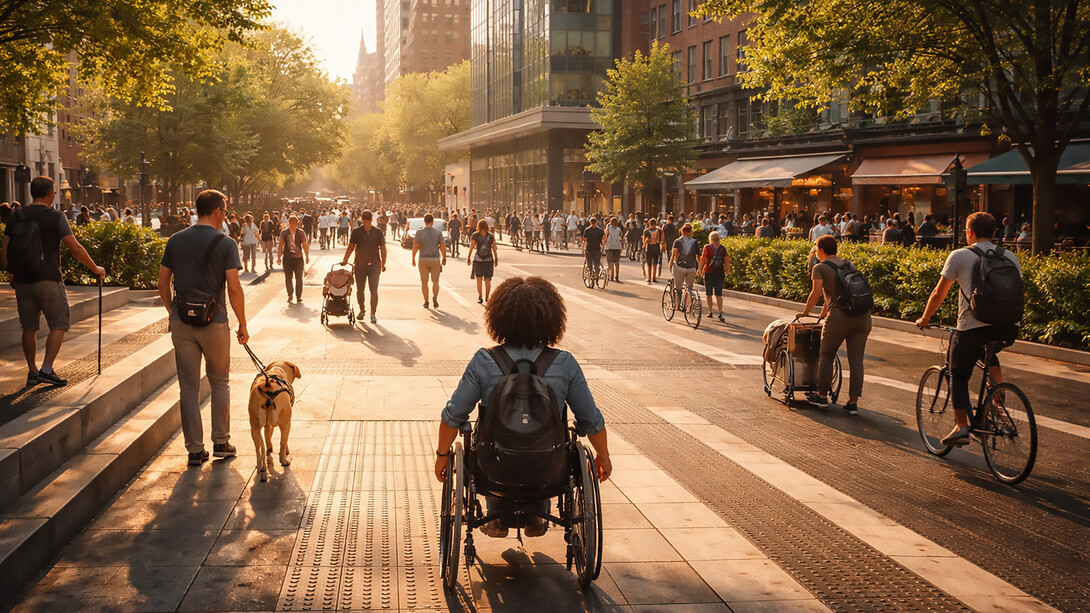
Societies reveal their moral architecture not in how they celebrate excellence, but in how they design for limitation. Access is not a peripheral issue. It is a structural one. It exposes whether a civilization understands human potential as universal or conditional. When access is treated as charity, it implies that participation in society is a favor granted, not a right earned.
From a systems perspective, this is a design failure. In electrical engineering, if a grid supplies power only to high-load-efficiency nodes while ignoring difficult terrain, we do not call that generosity. We call it incomplete infrastructure. A civilization that excludes people with disabilities from full participation is not preserving resources. It is misallocating them.
Hannah Arendt once wrote that politics is about the conditions under which people can appear and act, in layman's terms. Access determines whether appearance and action are possible. It is not a kindness. It is the foundation of public existence.
Charity is emotional, infrastructure is structural
Charity responds to visible suffering. Infrastructure prevents it. Charity is episodic. Infrastructure is continuous. When people give access as charity, the main focus of the story is sympathy. When people give access as part of the infrastructure, the focus shifts to design.
The distinction is important. Sympathy changes depending on mood, media cycles, and political fashion. However, even when attention fades, infrastructure remains. A ramp built from sympathy may exist as a token. A ramp built from structural reasoning exists because the building is incomplete without it.
In control systems theory, stability emerges from design parameters, not emotional responses. If accessibility depends on compassion alone, it will oscillate. If it depends on structural integration, it will persist.
Disability as a systems stress test
In engineering, stress testing identifies weak points in a structure. Disability functions as a social stress test in a similar way. It reveals whether our institutions are strong or fragile. If a school, workplace, transportation system, or digital platform cannot handle the presence of a disabled person, the problem is not the person. The problem is the design margin.
Most societies operate with minimal redundancy for human variance. They optimize for the statistically average body and mind. This produces efficiency in the short term and fragility in the long term. Systems built only for uniformity fail under diversity.
Charles Darwin emphasized variation as the engine of adaptation. Yet socially, we resist variation architecturally. Access forces us to confront that contradiction. A civilization that claims to value diversity must build for it.
Growing up inside the margin
I was born into constraint. Not metaphorical constraint. Physical constraint. Early in life, I understood something most children are not forced to understand. The world is not designed neutrally. It is designed around assumptions.
Stairs assume legs. Speed assumes coordination. Social cues assume typical processing. When you grow up aware of those assumptions, you begin to see the hidden architecture of everyday life. You realize that exclusion is rarely explicit. It is embedded.
This early exposure did not make me resentful. It made me analytical. I began observing the world as a system with parameters. Why is this built this way? What is the hidden variable? What load condition was assumed? Constraint-trained perception.
Access as bandwidth, not accommodation
In communication systems, bandwidth determines how much information can flow. Access functions as social bandwidth. When bandwidth is low, human potential is throttled. When bandwidth expands, expression increases.
Accommodation is often treated as a special adjustment. In reality, it is a bandwidth upgrade. It increases the range of participation without degrading the system. In fact, broader bandwidth often benefits everyone.
Consider curb cuts. Initially justified for wheelchair users, they now serve parents with strollers, delivery workers, and travelers with luggage. Universal design is not an act of charity. It is intelligent optimization.
Access expands system throughput.
The psychology of internalized architecture
External barriers eventually become internal beliefs. When access is consistently denied, the mind begins to encode limitation as identity. This is not a weakness. It is adaptive learning. If a system repeatedly blocks output, the system stops attempting transmission.
Martin Seligman’s work on learned helplessness demonstrated that organisms exposed to uncontrollable stressors eventually stop trying to escape, even when escape becomes possible. Societies often interpret this withdrawal as a lack of ambition. In reality, it is predictive coding. The brain minimizes wasted effort.
From a systems perspective, motivation depends on both perceived agency and the probability of access. When access approaches zero, motivation collapses regardless of talent. This is why infrastructure precedes inspiration.
Dignity is a structural condition
Dignity is frequently discussed in moral or spiritual terms. But dignity is also infrastructural. When someone cannot enter a building independently, cannot use digital systems, or must constantly request permission to participate, dignity is compromised.
Immanuel Kant argued that humans must always be treated as ends, never merely as means. But that philosophical principle fails in practice without access. If participation requires dependency at every stage, autonomy becomes theoretical.
Dignity is not preserved through praise. It is preserved through design. Autonomy is a physical condition before it is a psychological one. When environments assume competence rather than deficiency, dignity stabilizes.
Economic irrationality of exclusion
Exclusion is expensive. It reduces workforce participation, innovation diversity, and collective intelligence. Yet societies persist in building narrow access pathways. This contradiction is rarely analyzed economically.
In machine learning, reducing data diversity degrades model robustness. Similarly, reducing human participation reduces adaptive capacity. When environments exclude disabled individuals, they are effectively discarding a potential signal.
Collective intelligence increases when diversity and participation rise together. When participation falls, the problem-solving range contracts. Access is not a social cost. It is an investment multiplier.
The hidden labor of adaptation
When infrastructure fails, individuals compensate. They adapt manually. They calculate routes, energy expenditure, social risk, and emotional load continuously. This hidden labor often goes unseen.
Growing up, I became highly efficient at planning. Every environment required pre-computation. Where are the steps? How much energy will this consume? What assistance might be required? This constant optimization builds resilience but at a cognitive cost.
According to cognitive load theory, working memory capacity is limited. When people with disabilities must use working memory simply to navigate environments, less capacity remains for creativity, innovation, and contribution.
Access reduces unnecessary cognitive load. It liberates cognitive capital.
Sympathy fatigue vs structural permanence
Societies often respond to disability narratives emotionally. A viral story emerges. Temporary attention rises. Then it fades. Structural change requires something different. It requires design permanence.
Emotion-driven change is temporary because emotions fade. Environment-driven change endures because it is embedded in law, policy, and physical space.
Electrical power systems are not based on goodwill. They rely on engineering standards. Accessibility should be treated the same way. It should be non-negotiable, built into baseline parameters.
Sustainable change becomes more likely when structural integration is strong and emotional variability is low. This is how access transitions from charity to infrastructure.
Normal is a design assumption, not a biological fact
Most systems are built around a statistical average and then labeled universal. But the average is a mathematical abstraction, not a human being. Designing for the average is often another way of designing for exclusion.
In signal processing, filters based only on mean values ignore outliers that may carry critical information. In human systems, so-called outliers are often sources of innovation because they operate under different constraints.
When environments assume one mode of mobility, cognition, or communication, they encode a narrow definition of humanity. Over time, deviation is pathologized rather than accommodated.
Normal is not reality. It is a design shortcut.
The arrogance of frictionless design
Design arrogance emerges when creators assume their own embodiment is universal. Many architects, engineers, and policymakers unconsciously project their capabilities into the systems they build.
In AI, dataset bias produces model bias. If training data lacks representation, performance degrades in those contexts. The same principle applies socially. If decision-makers lack lived experience of disability, their designs underperform.
Design equity improves when decision-making includes broader representation and varied lived experience. Accessibility is not added complexity. It is expanded representational intelligence.
Innovation under constraint
Constraint is often misinterpreted as limitation. In engineering, constraint forces optimization. Some of the most elegant solutions emerge under restriction.
Living with disability requires constant adaptation. That adaptation cultivates systems thinking. Efficiency becomes instinctive. Workflows are optimized because they must be.
This is not romanticizing hardship. It is recognizing that constraint produces unique insight. When societies exclude disabled individuals, they exclude problem-solving strategies shaped under pressure.
Access allows these strategies to enter the collective system.
The politics of visibility
Disability is often made visible symbolically while remaining invisible structurally. Awareness campaigns coexist with inaccessible public spaces. Inspirational stories circulate while policy remains stagnant.
Visibility without infrastructure creates emotional satisfaction without material change. It allows society to feel progressive without redesigning itself.
Symbolic progress does not equal structural progress. Access requires structural modification, not narrative adjustment.
Power revealed through inclusion
Power reveals itself most clearly in who does not have to adapt. The majority rarely notices infrastructure because it was built around them. Those outside the design frame experience friction continuously.
When access improves, friction redistributes. What was once an individual burden becomes a shared design responsibility. This is often resisted because it challenges comfort.
True inclusion redistributes effort. It requires those previously centered to adjust. But that adjustment produces a more robust system overall.
System resilience increases when the burden of adaptation is shared. When it is isolated to individuals, fragility persists.
Civilization measured by its friction
Every civilization leaves behind architecture—roads, buildings, digital systems, laws. But beneath the visible infrastructure lies another metric: friction.
How much friction does a society impose on those who differ from its dominant design template?
Friction appears as extra time, energy, money, and cognitive load required to perform ordinary tasks. When one group must expend double the energy for the same output, civilization is miscalibrated.
The quality of a civilization improves as unnecessary friction decreases. A mature civilization minimizes unnecessary friction across human variability, not for compassion but for efficiency.
Moral maturity as systems awareness
Moral maturity is often framed as kindness. But at scale, morality becomes systems awareness.
Designing accessible systems requires recognizing that variability is not deviation. It is fundamental structure. Human beings are not standardized components. We are high-variance biological systems.
Philosophers like Immanuel Kant spoke of treating humanity as an end in itself. Modern complexity theory reframes this: each individual is a node in an interdependent network. Excluding one node weakens the network’s coherence.
Collective coherence strengthens when inclusion is dense and interaction flows freely. Accessibility is therefore not altruism. It is network optimization.
Technology as an amplifier of bias or equality
Artificial intelligence and digital infrastructure are rapidly amplifying design decisions. If bias is embedded early, it scales quickly. If accessibility is embedded early, it scales just as powerfully.
In machine learning, model generalization depends on training diversity. Homogeneous training produces brittle systems. Diverse training produces robust systems.
System robustness grows when diverse inputs are matched with flexible capacity to adapt. When accessibility is built into technology from inception, it becomes invisible support rather than expensive retrofit.
The future will not be inclusive by default. It will be inclusive by design or exclusive by acceleration.
From sympathy to structural intelligence
Sympathy reacts to suffering. Structural intelligence prevents it.
Many people express sympathy toward disability. Far fewer advocate structural redesign. Sympathy is emotionally satisfying because it preserves hierarchy. Structural change redistributes responsibility.
The shift from sympathy to structural intelligence marks a developmental leap in civilization. It requires seeing disability not as a tragedy but as information about system failure.
When a person cannot access a building, the building has failed. When a digital platform excludes assistive technologies, the platform has failed. Reframing the locus of failure shifts the narrative from personal deficiency to design deficiency.
This reframing is intellectually uncomfortable. It is also transformative.
Access as collective self-respect
Ultimately, access is not about ramps, captions, or policy clauses. It is about collective self-respect.
A society that builds infrastructure assuming universal participation signals something profound. It signals that every human being is considered part of the operating system of civilization.
Childhood with a disability taught me early how systems either acknowledge or ignore human variation. Over time, this understanding moved from personal survival to structural critique. You begin by noticing what blocks you. Eventually, you notice what blocks everyone.
Access is not charity. It is not benevolence. It is not generosity.
It is infrastructure.
And infrastructure determines whether human potential remains theoretical or becomes operational.
Human potential is realized most fully when access expands and opportunities are widely distributed. When access is denied, talent is wasted silently.
Civilization is not judged by its monuments. It is judged by who can actually use them.