English
 Español
 Français
 Deutsch
 Italiano
 Português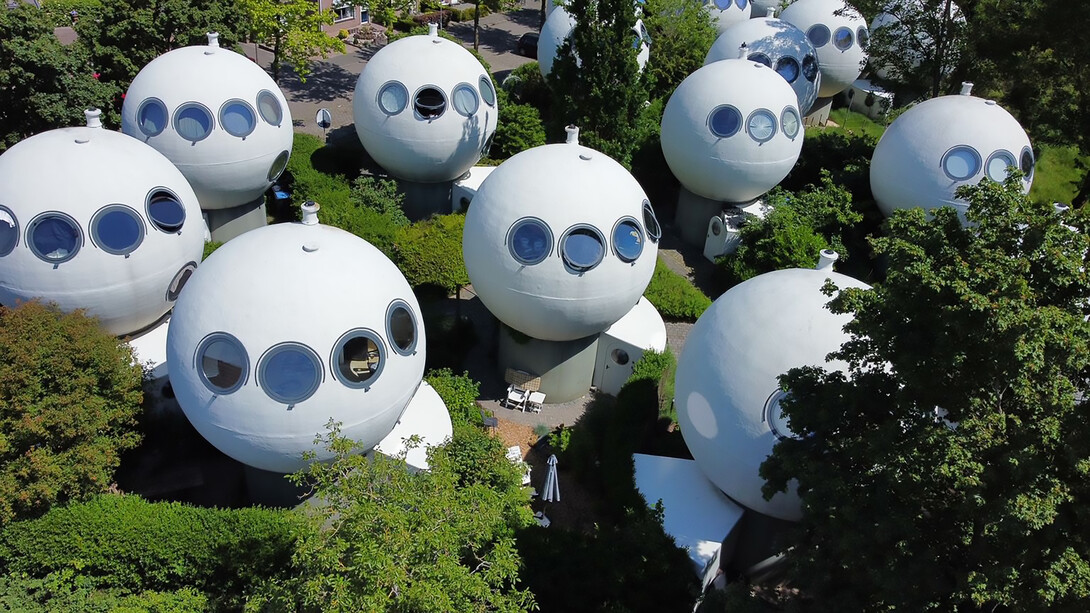
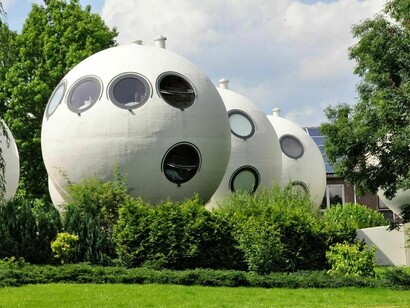
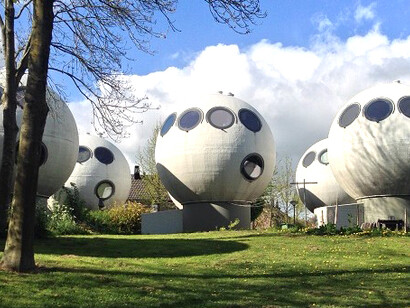
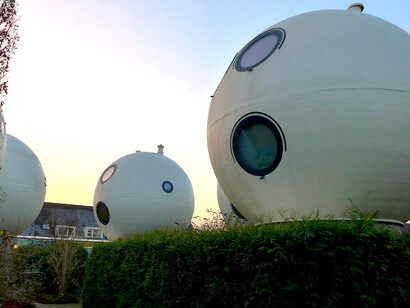
In the Dutch city of 's‑Hertogenbosch (commonly Den Bosch), an extraordinary housing experiment quietly claims a suburban street: Bolwoningen, or "ball houses"—a cluster of fifty futuristic, spherical dwellings designed by artist‑designer Dries Kreijkamp in the early 1980s.
Vision and origins
The concept dates back to the 1970s, when Kreijkamp began sketching spheres as ideal dwellings. Influenced by the space‑age aesthetic of Sputnik, Mylar balloons, Atomium, and a broader cultural fascination with roundness, he believed that the sphere was the most "organic, natural shape possible"—"we live on a globe, we are born from a globe…” he argued. Bolwoningen was ultimately selected for funding through the Dutch government’s experimental housing programme launched in the late 1960s, aimed at redefining social housing beyond conventional rectilinear forms.
Construction, materials, and design
Constructed in 1984, Bolwoningen comprises exactly 50 homes, each perched on a concrete cylindrical base and topped by a fiberglass‑reinforced concrete sphere approximately 5.5 meters in diameter, yielding a compact 55 m² of living space—remarkably lightweight at about 1,250 kg per unit.
The prefabricated spheres, produced in Rotterdam, were installed briskly—sometimes in a matter of a single day—highlighting Kreijkamp’s ambition for modular, low‑maintenance, and energy‑efficient architecture.
Spatial layout and living experience
Each Bolwoning is organized over three internal levels, connected via a spiral staircase:
Ground (base cylinder): entry hall and storage.
Middle level: bathroom and toilet.
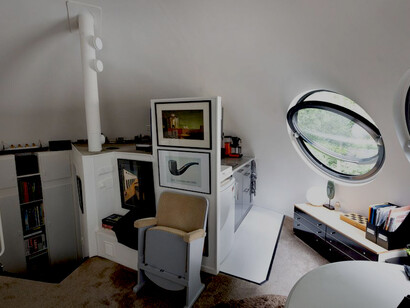
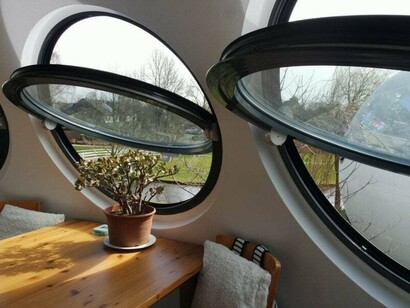
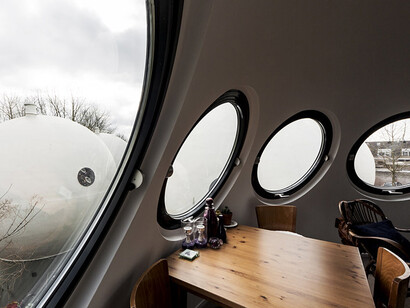
Top sphere: open-plan living area and kitchenette, illuminated by round pivot windows offering panoramic views.
The window apertures are primarily oriented toward the surrounding tree‑lined gardens, and with no communal outdoor spaces, each dwelling retains a strong sense of privacy and introspection.
Reception, limitations, and cultural impact
Praised for its radical yet coherent vision, the project was seen as a rare example of successful avant‑garde social housing—“highly successful” in the eyes of some commentators—and continues to fascinate architectural tourists for its surreal, sci‑fi appearance, often likened to “giant golf balls” or an “alien settlement” in suburbia.
Yet the unconventional form brought challenges: curved walls impede furnishing with ordinary flat-faced furniture, and early units suffered issues of window leakage and minor structural cracking—maintenance problems that persisted over decades.
Although Kreijkamp envisioned a broad rollout—including floating or mobile sphere homes powered by sun or wind—few expanded beyond the original fifty. Attempts at further applications were rebuffed by authorities, with a local housing agency reportedly rejecting his offers: “We already have some, thank you very much”. Despite these setbacks, Bolwoningen survived through active restoration efforts and remains fully inhabited to this day.
Legacy and contemporary reflection
Compared to other Dutch experimental housing projects of the same era—such as Piet Blom’s Cube Houses in Rotterdam—Bolwoningen offered a unique counter‑narrative: a vision rooted not in urban density or infill but in sculptural utopia and ecological minimalism.
Although the concept never scaled to mass housing production, its ideals—prefabrication, material efficiency, small ecological footprint, and poetic spatial form—resonate strongly in today’s architectural discourse. As the tiny house movement blossoms and ecological concerns grow, Bolwoningen feels strikingly relevant as a forerunner of radical yet functional design philosophies.
Adaptation, use, and the everyday reality
Despite its radical form, Bolwoningen has proven to be more than a visual curiosity—it functions as a practical, if unconventional, living space. Over the years, residents have creatively adapted the interiors to meet their daily needs, often crafting custom furniture or installing curved shelving to better suit the spherical volume. This DIY spirit has helped foster a strong sense of ownership and individuality among inhabitants.
Moreover, while early criticisms targeted the limitations in furnishing or insulation, many of these challenges have been addressed through renovations and resident-led improvements. Some homes now include upgraded heating systems or enhanced insulation materials, blending the experimental shell with modern comfort.
The neighborhood itself has evolved into a tight-knit community, often hosting guided tours and architectural visitors from around the world. This public attention, while sometimes intrusive, has also helped preserve the project and maintain awareness of its historical and cultural significance. Today, Bolwoningen stands not only as a symbol of creative experimentation but also as proof that even the most unusual architectural ideas can adapt into everyday life.
Conclusion
Bolwoningen stands as one of the most compelling architectural experiments of late‑20th century Europe: fifty nearly identical spheres that dared to challenge our assumptions about form, habitation, and community. Though limited in scope, the project manifests Kreijkamp’s utopian ambition and remains occupied and admired four decades later. In its daring combination of poetry and pragmatism, Bolwoningen invites us to rethink: must housing always be rectangular—and can a building shape inspire a new way of living?
As architecture faces the challenges of climate change, urban sprawl, and housing crises, Bolwoningen endures as a visionary prototype—one that dares to suggest that imagination, sustainability, and livability can indeed coexist within the same curved walls. Its story is not just about eccentric design but about resilience, experimentation, and the power of built form to shape how we live, dream, and connect. In an age hungry for fresh answers, these round houses still ask the right questions.