English
 Español
 Français
 Deutsch
 Italiano
 Português
Biophilia, if it exists, is the innate emotional affiliation of human beings with other living organisms.
(E. O. Wilson)
We are witnessing a gradual shift towards biophilic design that upholds an inclination towards everything alive and organic. This approach is implemented so that designers and creatives use nature as a tool to imitate, undoubtedly, the most established mechanism on earth. Utilising nature as a source of inspiration to mimic environmental phenomena to create stronger connections.
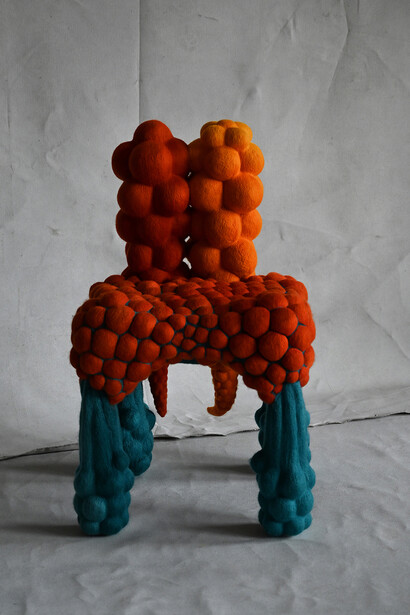
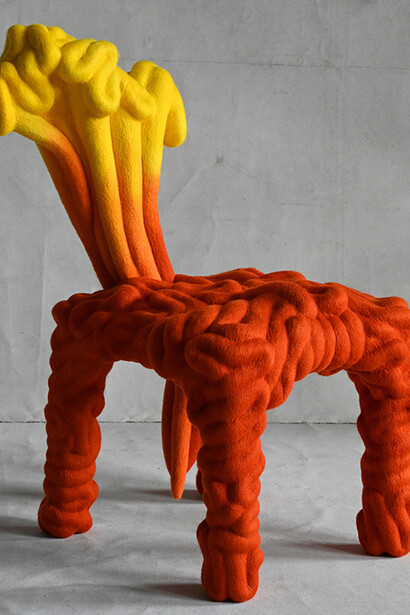
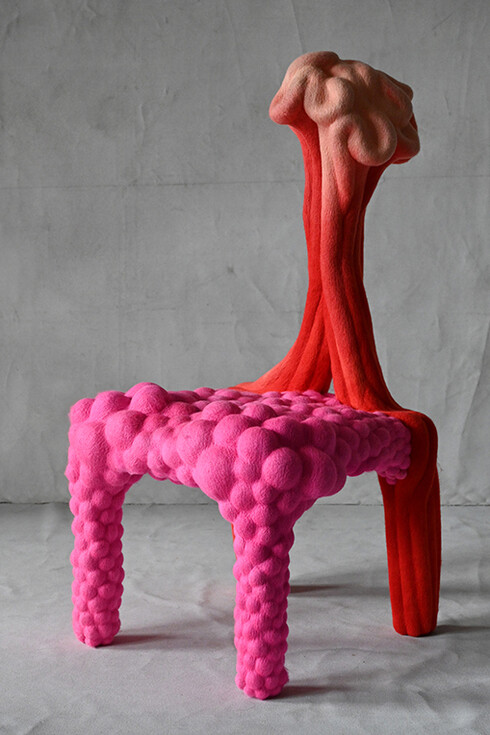
Liam Lee is a designer whose works are symbolic of research that intends to mirror natural landscapes; he creates a resonance of the underworld by sculpting forms that echo a likeness to coral and algae. Each object acts as a functional sculpture that takes on a new contemporary language.
Lee’s colour scheme is often saturated and bright, giving the pieces a fictional yet surreal aesthetic. He has an ephemerality in making the domestic landscape one of dreams by designing furniture that bridges the space between reality and fantasy. In doing so, the artist encourages an immersive experience through our everyday objects, which encourages us to give deeper meaning to moments of life that exceed the mundane.
In Lee’s work, the notion of material as texture also succeeds in advancing the experience of nature; wool fibres act as the skin of an organism, such as the coating found on coral. However, it also associates the familiarity of the domestic, allowing us to rediscover the multifaceted nature of an object.
In doing so, I question the intention of the artist, who is designing new associations. Lee connects the product to nature, but not as a means of a sustainable solution, instead as a cognitive stimulus and an unsuspecting aesthetic. Lee’s furniture designs began as a nod to biological forms; at their core, these pieces explore how the domestic relates to the outside world. In finding these connections, the designer creates a form that challenges expectations and common associations.
In the most recent additions to this body of work, Lee explores the affiliation between architecture and the human body. The sculptures integrate shapes ranging from moss-covered stones, branches, and seed pods, visualising a process whereby Lee studies complex organisms and processes. The artist's story began with making smaller textile pieces, which he sold to the Noguchi Museum. Soon after, Patrick Parrish, a New York gallerist, contacted Lee for a hopeful commission, which eventually manifested into two solo shows; this sanctioned a freer and more layered approach to design that showcases a deep curiosity for biophilia.
Throughout our contemporary culture, we are seeing artists and designers alike approach design as a tool for mystery and ambiguity. Lee admits that his work aims to provoke a sense of unknowing, intentionally leaving questions about the origin and creation of his objects.
We are seeing leaders not only in design, science, and medicine establish a voice on matters, but also world leaders and activists.
The world is catching on: “We must draw our standards from the natural world. We must honour with the humility of the wise the bounds of that natural world and the mystery which lies beyond them, admitting that there is something in the order of being which evidently exceeds all our competence.
(Vaclav Havel)
We can see the clues of nature-based innovation universally, such as Velcro, first inspired by the wrestling hooks of seeds, or holistic medicine, whereby we find trust in the oldest doctor of time to formulate insight into natural solutions.
A wave of distrust and distaste for technology, which has stripped us from our most natural state, as organisms at home on earth. Is again bringing us back as nature’s protégés.
In this reckoning, we are not observing to learn about nature so that we can control and constrain it, but learning as a means to coexist harmoniously with natural cycles, changing the way we think and move so that we do not only live on earth, but we complement it. As we discover our many questions about what nature now understands, we will learn how it feels to soar like a bird, meaning to be a fragment of, not distant from, the absolute mastermind that frames us.
As we establish this discovery into contemporary design, which is an active and evolving term that summarises a wide variety of existing styles and trends in the design world. It is rooted in the present, endlessly modifying to display the newest innovations in tools, materials, and collective values. As a result, our aesthetic likings as consumers are varied, often combining various periods and styles, including modernism, postmodernism, and minimalism, to design spaces that are reflective of our diverse lifestyles.
The cultural magnitude of contemporary design rests in the capacity to mirror modern collective trends and values. Its visual and functional flexibility makes it resonate through various cultures, which permits a universal dialogue about the potential of design and how it will address universal disputes and ambitions.