English
 Español
 Français
 Deutsch
 Italiano
 Português
Europe faces complex problems, and there is fear of political polarization in the air. We seem to be approaching American-style "us versus them" polarization. Europeans across the political spectrum wish it would stop, yet it continues to happen. Where can we look for lessons on how to remain united whilst fighting for conflicting interests and conflicting visions of what Europe's future should look like?
Perhaps we should look to a somewhat unlikely place: the USA, though not today's USA, whose political discourse is characterized by crude language, lies, and violence, but to the nineteenth-century abolitionist movement. In a world corrupted by slavery, brave and eloquent people like Harriet Tubman and Frederick Douglass stood against the norms of their time. But a less well-known figure, Reverend John Rankin, provided a masterful lesson in achieving compassionate political change.
A new biography of Rankin, Caleb Franz's book The Conductor: The Story of Reverend John Rankin, Abolitionism's Essential Founding Father1, illuminates these lessons. The Conductor is a gripping journey through Rankin's extraordinary life, charting his efforts to rid the world of slavery. At times thrilling and at others deeply moving, Rankin's life story, as told by Franz, takes readers by the hand through the adventures and lessons it offers.
Rankin’s story is well worth reading for Europeans. Franz’s compelling book takes the reader on a journey as Rankin forged a new path for abolitionism from the town of Ripley in the state of Ohio. Before long, his influence extended far beyond Ripley. For his efforts campaigning against slavery, Rankin suffered attacks by means of people throwing eggs and rocks at him, not to mention bounties being placed on his head and people attempting to assassinate him. Still, he pressed on; such was the importance of his mission.
The most compelling and important part of Reverend Rankin's story concerns his brother, Thomas Rankin. Thomas, to his brother's horror, was buying slaves. Rankin's reaction to this situation, the fact that his own brother had betrayed the cause to which he had dedicated his life and, in his eyes, committed appalling acts against his fellow human beings by exploiting their bondage, was legendary.
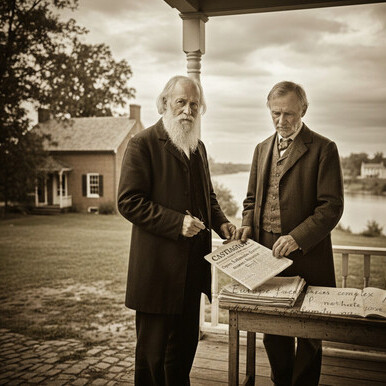
The Reverend responded with a series of open letters addressed to Thomas and published in the Castigator newspaper. Unknowingly, he thus laid the intellectual foundations of the abolitionist movement, reaching a significant new audience with his arguments against slavery. However, the letters were addressed directly to his brother, and it is clear that he had him primarily in mind when writing them, despite their broader significance.
The Reverend circumvented the risk of political polarization by refusing to "other" Thomas. He did not stoop to an "us versus them" mentality and did not regard his brother as one of the enemies to be defeated. Instead, he held to his familial compassion and used it to fuel his efforts to undermine slavery in a way that was just to the gravity of the cause, whilst still loving, not hating, his brother. These letters later became Letters on American Slavery, which were published separately and which more than earned their place in developing abolitionism.
The lesson for contemporary Europe is profound. The Brussels bubble does many things wrong, and many of them cause real harm, though none of them approaches the tragedy that the slave trade caused worldwide. There is a temptation to regard the Brussels bubble, the people or institutions within it, as an enemy to be defeated. However, embracing this way of thinking only takes us backward. Europe is a family.
It is legitimate and useful to write criticism of Brussels' mistakes, as Rankin did regarding his brother's decision to engage in the slave trade. However, we must avoid falling into polarization. Instead, we should speak and write as if we were trying to win over a beloved family member who has made a series of bad decisions.
This does not mean we do not take problems seriously. Rankin did not downplay his brother's actions, did not seek excuses for them, nor did he trivialize the issue with his response. He approached slavery with the seriousness it deserved, and we must approach Europe's problems today in the same way. But we can do so with compassion rather than displeasure, as Rankin did. For him, it was personal. His family was at stake. We should think the same way in political discourse.
This means that even when Brussels makes incomprehensible, self-destructive decisions that seemingly undermine everyone's interests and sometimes have tragic real-world consequences, we should not take an uncompromising, aggressive stance. Instead, we should be loving and constructive. We must point out Brussels' mistakes and call for urgent correction by all means, but without a hostile undertone.
We discuss European politics publicly and with such emotion because it matters, not because we want the European project to fail, but because when Brussels succeeds in its work, the continent is richer, freer, and happier. It would be good to realize this.
References
1 The Conductor: The Story of Rev. John Rankin, Abolitionism’s Essential Founding Father.