English
 Español
 Français
 Deutsch
 Italiano
 Português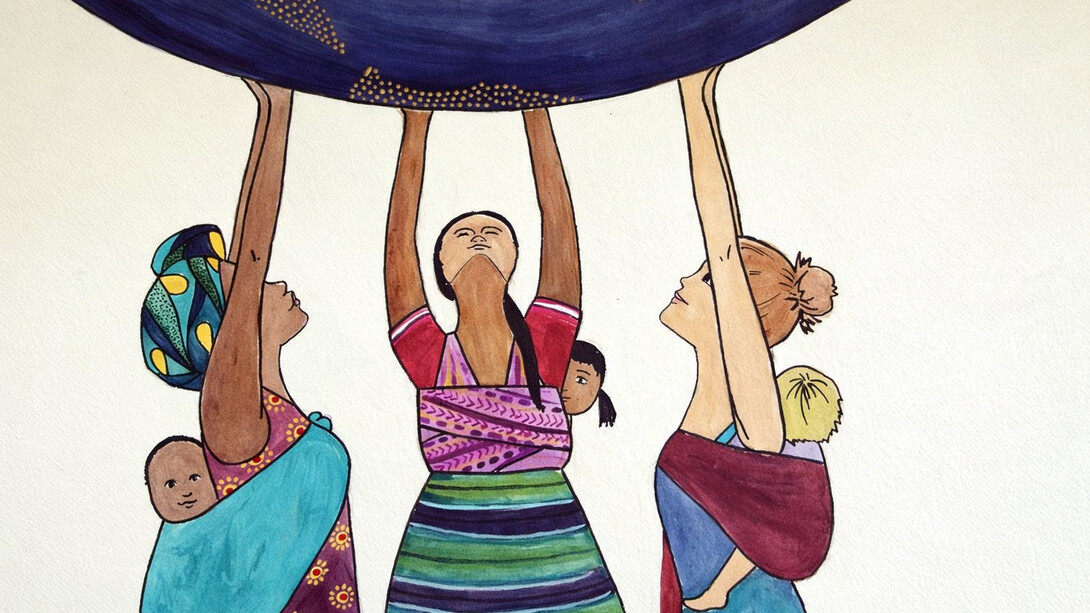
Imagine a world created with women, not against men, but with intuition to create values that have been suppressed for far too long. In this world power is less defined by oppression and more by responsibility, leadership listens prior to commanding, and the definition of progress has become a function of the dignity inherent in each human and not one of continued conquest. Women lead with clarity of purpose, a high level of self-awareness, and an understanding of a woman's connection with another human. Women will use both empathy and efficiency in the decision-making process; the strength of women is shown by the ability to support, care, and treat all equally.
Conflict can be resolved by means of dialogue rather than war, communities can grow by cooperation, and success can be seen as shared rather than that of an individual. This is not a future without men; this is a future with balance where women's voices, wisdom, and decisions are all at the center of a new world that is ultimately more humane, just, and complete. In this presentation I will cover the significance of psychological empowerment of women and how that empowerment produces the vision and strength to impact the globe.
Although countries worldwide have increasingly been calling attention to gender equality, many women continue to experience barriers to independence, participation, and ability to influence decisions that affect their lives. Therefore, when considering the status and level of empowerment for women, we should consider the scope of empowerment and what constitutes empowerment as well as the various ways women experience empowerment. We need to understand the role(s) women play in their communities, their contributions to community development, and how they can participate in promoting the economic and social well-being of their communities. Gender equality should not only focus on the same level/status between women and men but also be an opportunity for women and men both to have equal opportunity to use their rights and make meaningful and constructive contributions to the economic, social, cultural, and political development of society.
Women are half of the world's population. By limiting their rights, we limit the societal advances that are possible. Gender equality is a major factor in peace, economic growth, education, and the overall health of families, showing the importance of women's contribution to building strong, sustainable communities. Yet, women continue to face significant barriers and gaps that limit their ability to play their role in society, driven by numerous reasons that constrain their empowerment. Two of the most powerful reasons include entrenched social stereotypes and internalized self-doubt. These barriers continue to create ongoing inequalities in empowerment. Therefore, to truly understand what empowerment is, we must also understand the key areas associated with empowerment, i.e., autonomy, agency, self-confidence, and self-determination. When considering these areas, it becomes clear that empowerment is not a simple outcome but rather an ongoing evolutionary process within ourselves.
Women’s empowerment is a continuous journey of creativity, through which women grow in independence, self-assurance, and decision-making abilities with regard to life experiences that significantly affect their well-being and development. Women’s empowerment encompasses the enhancement of self-worth, the expansion of opportunities to improve self-esteem, and the reduction of stigma, all of which are barriers to achieving gender equity. The psychological dimensions of women’s empowerment are a crucial component of achieving true gender equity and supporting women in realizing their full potential.
To address a potential gender disparity and achieve women’s empowerment, there are numerous strategies that can be employed. First and foremost, building self-confidence is essential to developing women’s self-worth, and this is often an inner process. Therefore, self-confidence is a subjective, internal experience that is not measured through statistical means. Women report a strong sense of importance and self-worth. In conversations with others, many women express a level of confidence in their self-image and in their potential to achieve positive outcomes as a result of their positive characteristics.
Secondly, it appears from my research that many people still view leadership as predominantly masculine in nature. When respondents of my research were asked, "Who is more likely to be a successful leader?" they instinctively chose men. The reason for this selection is not necessarily due to lack of capability or potential for female leaders but the way in which society has historically portrayed the roles of men and women, where family responsibilities were primarily placed on women while men held positions of authority. Deeply ingrained stereotypes continue to shape society, and many individuals still think of leadership in terms of daily life and professional settings as being male-dominated.
The research further reveals the reluctance of younger women to view themselves as leaders. While many men confidently express support for women serving in leadership positions, fewer women feel comfortable stating the same about themselves. This reluctance appears to arise not so much from an inability or lack of skill and ability to be successful as a leader, but due to an insufficient number of opportunities to serve in leadership capacities. Education has a subtle yet powerful impact on this dynamic, as it increases one's awareness regarding available leadership opportunities, builds confidence within individuals, and provides them with the perspective that leadership is more of a right than an exception, particularly for female leaders.
A third method to empower women is through an understanding of their rights. More women today are becoming aware that they can use the law to protect themselves, seek justice, and find dignity in their marriages and families, for instance. This change from passive acceptance to active awareness demonstrates a movement away from ignorance toward knowing that you have the right to act. A woman is empowered when she understands her rights; she has confidence to act, her leadership commands respect, and equality moves from being a concept to being a reality. Women who understand their rights have also gained knowledge of those rights through education, experience, and financial independence. With every step of their life journeys, their comprehension of their rights will expand and increase their feelings of agency and self-protection.
The fourth empowerment strategy focuses on capability. It refers to the opportunity and the ability for women to formulate choices, to take actions, and to make contributions to the world around them. Many women today no longer view themselves as passive participants in their communities and view themselves as equally capable of improving the well-being of society as their male peers; additionally, they are committed to standing with each other to provide support when necessary. The feeling of capability is shown in the daily acts of women: giving advice, pursuing legal avenues, sharing financial resources, and helping when others hesitate. Women often feel they must keep quiet when they feel their concerns are not being taken seriously.
Finally, women are not empowered until they have personal autonomy. Personal autonomy means having the freedom to act, make decisions, and be involved in all aspects of life without limitation. While some women feel they have the freedom to travel to visit family members, participate in local organization activities, or attend community meetings and speak their minds during public forums, most women still experience the effects of being limited by many factors that affect their overall independence. Autonomy is not just the freedom of being independent but also relates to the confidence and empowerment derived from being mentally and emotionally secure. When women are allowed to act independently, make decisions for themselves, and interact with their peers and communities, they have an increased sense of power over themselves and their lives. It is this type of self-determination that transforms the concept of empowerment into a tangible experience.
In conclusion, women’s empowerment ultimately begins from within. While structural barriers and social constraints undeniably exist, a woman’s transformation cannot be achieved through external change alone. True empowerment requires personal accountability: the conscious refusal to surrender agency to circumstance or to place responsibility solely on others. A woman who is empowered cultivates unshakable self-confidence, develops leadership capacity, understands and asserts her rights, strengthens her skills and capabilities, and exercises personal autonomy in thought and action. When these dimensions converge, empowerment is no longer impossible; it is claimed. Only then can women move from being passive to actively participating in their societies.