English
 Español
 Français
 Deutsch
 Italiano
 Português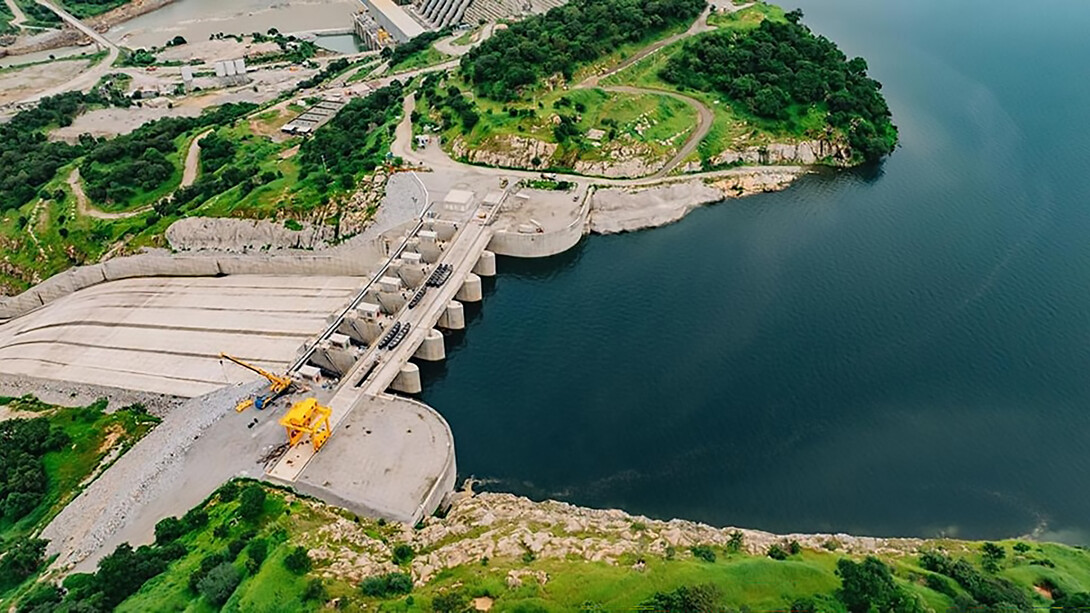
Egypt has once again found itself locked in a tense standoff with Ethiopia following Addis Ababa’s unilateral decision last month to complete the fourth filling of the Grand Ethiopian Renaissance Dam (GERD)—a move Cairo has condemned as “irresponsible” and a direct threat to its national security.
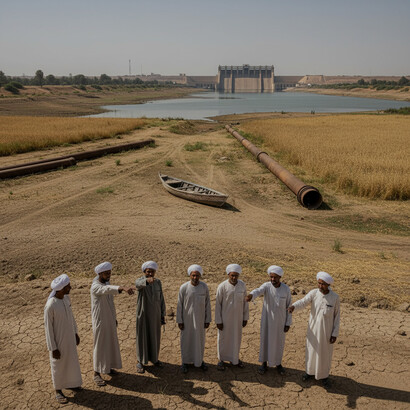
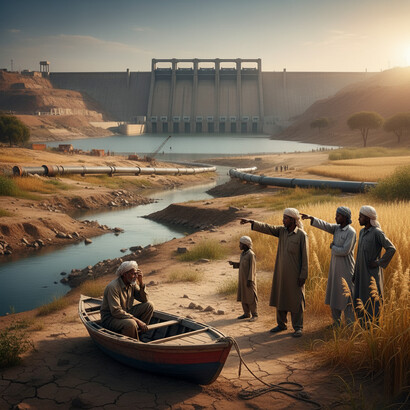
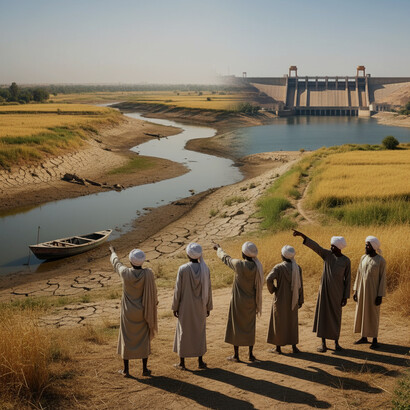
The latest filling, which experts say trapped nearly 24 billion cubic meters of water in the dam’s reservoir, has already begun to show catastrophic consequences for downstream nations. Satellite imagery analyzed by hydrologists in both Sudan and Egypt reveals a sharp decline in water levels in the Blue Nile, accompanied by visible drought conditions in agricultural zones that traditionally relied on annual flooding.
A decade-long crisis deepens
Built on the Blue Nile in the Ethiopian region of Benishangul-Gumuz, just 14 kilometers from the Sudanese border, the GERD is one of the largest hydropower projects in the world. Its massive concrete structure stretches 1.8 kilometers across and stands 145 meters tall, capable of holding 74 billion cubic meters of water and producing up to 6,000 megawatts of electricity—making it the largest power-generating dam in Africa.
When construction began in 2011, Ethiopia framed the project as a symbol of national pride and economic renewal—hence its name, the “Renaissance” Dam. Officials in Addis Ababa argued that the dam would provide electricity to millions of Ethiopians and help export energy to neighboring countries, fueling economic growth across East Africa.
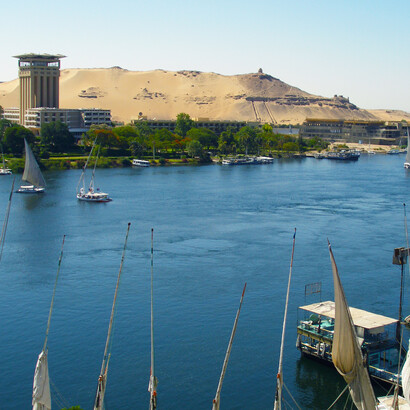
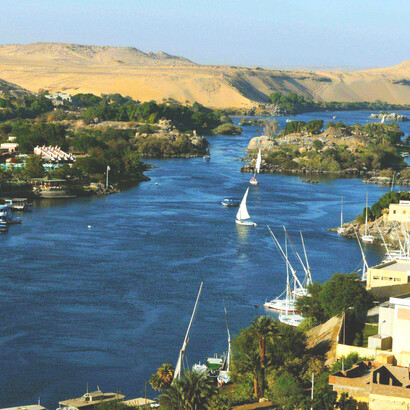
But for Egypt and Sudan, countries that rely almost entirely on the Nile for freshwater and agriculture, the GERD has long represented an existential risk. Cairo fears that rapid filling and mismanagement could drastically reduce the flow of the Nile—a lifeline for over 100 million Egyptians.
The fourth filling: a turning point
According to Dr. Abbas Sharaki, a leading Egyptian hydrologist, the fourth filling marked a dangerous escalation. “The reservoir stored 24 billion cubic meters of water this year alone,” he said. “That is equivalent to 130 percent of Sudan’s annual water share and nearly half of Egypt’s.”
The effects, Sharaki explained, were immediate. “For the first time, satellite images showed the Blue Nile’s flood season effectively ending. Farmers in Sudan lost their flood-based crops and are being forced to adopt irrigation systems requiring expensive infrastructure. Egypt, meanwhile, has lost about 12 billion cubic meters of its annual water supply, despite partial returns once the dam’s turbines operate.”
He warned that the dam’s operation, combined with below-average rainfall in Sudan this year, could transform vast agricultural lands into arid zones, increasing food insecurity in both countries.
Cairo’s diplomatic retaliation
Egyptian officials have described Ethiopia’s latest unilateral move as a violation of international law and of the principles agreed upon in the 2015 Declaration of Principles, which emphasizes cooperation and non-harm among Nile Basin countries.
In a statement from the Ministry of Water Resources, Cairo announced that new negotiations will be held in Cairo later this year, marking the fourth round since the collapse of previous talks in Addis Ababa in 2023. However, officials warned that Ethiopia had already backtracked on several technical agreements reached in earlier meetings, casting doubt on its willingness to reach a legally binding accord.
Foreign Minister Sameh Shoukry, speaking before the United Nations General Assembly in September, delivered one of Egypt’s strongest statements yet: "There can be no acceptance of unilateral actions concerning the Nile. The idea that a single country can impose its will on more than 100 million Egyptians is both unacceptable and dangerous."
He added that Egypt faces a water deficit exceeding 50 percent of its needs, forcing it to recycle and reuse its water multiple times—a situation he described as “unsustainable.”
Presidential warning and strategic shift
President Abdel Fattah el-Sisi echoed the same message during a cabinet meeting in September this year, calling Ethiopia’s decision “an irresponsible act that disregards the lives of millions downstream.” According to sources close to the presidency, Egypt is preparing a multi-level response combining diplomatic, legal, and environmental strategies.
On the diplomatic front, Cairo has intensified its outreach to the African Union, the United Nations, and its Arab and European partners, seeking to internationalize the dispute and pressure Addis Ababa into compliance. At home, Egypt has accelerated projects to mitigate the impact of reduced Nile flows—expanding seawater desalination plants, modernizing irrigation systems, and developing new water recycling facilities.
A senior Egyptian official, speaking on condition of anonymity, described the president’s current approach as “measured but firm.”
“Egypt will not be drawn into conflict, but neither will it tolerate unilateral measures that endanger its survival,” the official said. “We are entering a phase of deterrence through diplomacy and technology.”
The human toll downstream
While political leaders exchange statements, the crisis has already reached local communities. In parts of northern Sudan, farmers have reported crop failures due to declining floodwaters, while Egyptian agricultural cooperatives along the Nile Delta are facing water rationing and reduced planting seasons.
Experts fear that the collapse of traditional flood-based agriculture could drive migration from rural to urban areas and spark wider social tensions. Environmentalists warn that the reduced sediment flow—once rich in nutrients—will degrade soil fertility and increase dependence on costly chemical fertilizers.
A fragile future
As both nations prepare for another round of talks in Cairo, optimism remains scarce. Ethiopian officials continue to assert their sovereign right to operate the dam as they see fit, while Egyptian negotiators insist on a legally binding framework governing filling schedules and drought management.
With each new filling, however, trust erodes further. Analysts now view the GERD not merely as an infrastructure project, but as a test of regional diplomacy and resilience in an era of climate stress and resource competition.
For Egypt, the stakes could not be higher. As President Sisi recently warned, “The Nile is the artery of Egypt’s life—and we will defend our right to live.”