English
 Español
 Français
 Deutsch
 Italiano
 Português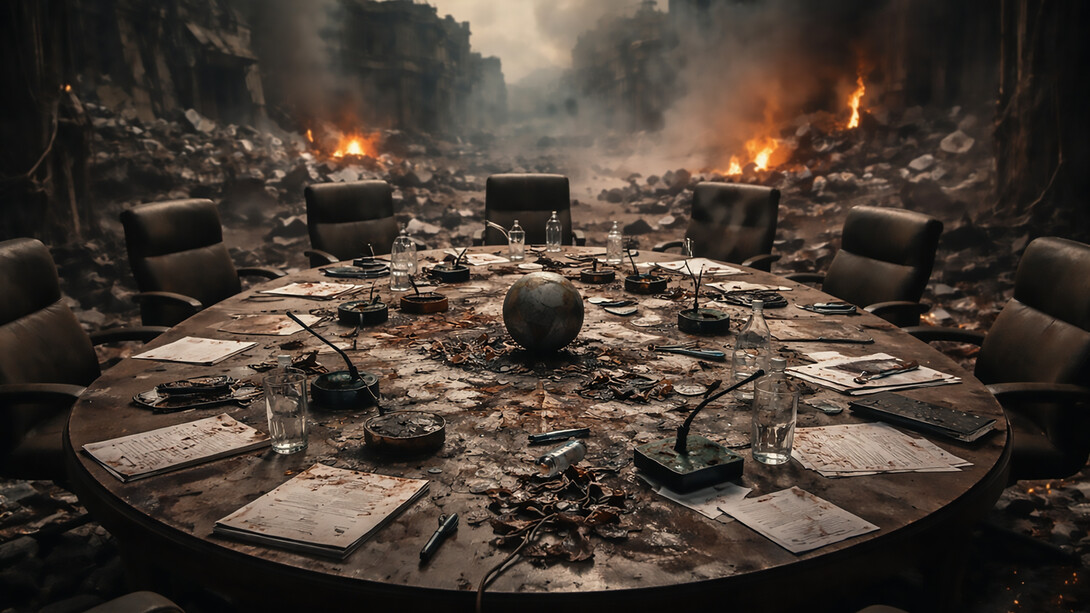
Acting more diplomatically in life and at work and staying peaceful with people is an imagination not yet achieved by mankind.
Today, the world is on the edge of an abyss. The world is in a critical period, given the system’s rising inability to tackle challenges related to the management of conflict, to its prevention, its outbreak, and its resolution. Conflict prevention is defined as ‘involving diplomatic measures to keep interstate tensions and disputes from escalating into violent conflict.' The basic principle of the United Nations Charter is non-aggression. But the ‘so-called’ civilized man uses more and more sophisticated military technology and solves the problems by direct armed conflicts.
And today when the United States and Israel have launched an unprovoked, ruthless, destructive, and murderous war against Iran and killed Iran's supreme leader and 49 other senior figures, and 170 girls were killed in the bombing of an elementary school (an unprecedented crime) in flagrant violation of Article 2(4) of the UN Charter without the authorization from the US Congress and UN Security Council and any legitimate claim of self-defense under Article 51 (as it happened in the former Yugoslavia), and caused a totally devastating war in the entire Middle East, pushing it into chaos. Another pointless war that the US and the world don’t need.
Then the US attacked Venezuela, a sovereign country, and kidnapped its legally elected president and violated all international rules. US President Donald Trump has managed to set a new and sad record: that of being the first president to bomb 8 sovereign countries (Iran, Iraq, Nigeria, Syria, Somalia, Yemen, strikes in the Caribbean Sea and the Pacific Ocean) in a single year. And the US President Donald Trump measures democracy by barrels of oil. A new way of waging war, called terrorism. And international law died in Gaza. Gaza became the graveyard of international law. The law was buried methodically, publicly, and without consequences for the aggressors. And western countries never accused anyone of all these attacks and murders and never showed solidarity with the civilian victims, but worse, we see victim blaming (Gaza and Iran) from the western leaders, and some of the EU countries are considering joining the strikes against Iran.
So, after all, is it worth writing about conflict resolution through dialogue and diplomacy when international law is being trampled on constantly? International law is flagrantly violated, and the question is, how can the world solve it? Is diplomacy alone enough?
Or maybe it is the right moment to turn to an exclusively diplomatic way of resolving conflicts. The most powerful countries should behave in a civilized way and sit down at the negotiating table, cooperate, and respect the interests of other countries, instead of resolving disagreements only with weapons and advanced military technology and imposing their interests on other countries. The UN, as a principal multilateral institution, is responsible for the management of conflict, but the UN has become inefficient and useless. UN Secretary-General Antonio Guterres argued that there has been ‘too little progress on adequate, predictable, and sustained financing for peacebuilding by UN member states. Modern diplomacy must move beyond state sovereignty and shift from national interest to human security. And to prioritize individual dignity and human rights, holding states accountable for violations, and promoting inclusivity and equity.
A just diplomacy requires building non-state actors, civil society organizations, and underrepresented communities into the negotiation process. encouraging partnerships and cooperation between emerging nations that can break traditional power hierarchies and more balanced global relationships. Redefining diplomacy involves economic justice, ensuring fair trade practices, labor rights, and environmental sustainability in international economic agreements. Redefining diplomacy by implementing specialized and ethical practices and specialized diplomacy focused on global challenges, ensuring diplomacy is bound by moral rightfulness and truth. By focusing on all important areas (like climate change, health, and migration), diplomacy can evolve from a tool for managing power dynamics into a mechanism for creating a more just, equitable, and sustainable global order. Four core principles of diplomacy:
Negotiation, communication, building relationships, and promoting interests. These principles serve to facilitate the peaceful resolution of conflicts and promote international cooperation. The historical evolution of diplomacy in conflict resolution can be traced to ancient civilizations, where emissaries were sent to negotiate peace treaties and resolve disputes between warring states. International relations have long been shaped by the complex dynamics between the Global North and the Global South, characterized by political influence, significant disparities in economic development, and access to resources. The industrialized Global North countries, including the United States and the European Union, have advanced economies, have traditionally controlled trade agreements, and set terms that are beneficial for their economies and industries.
The opportunities for economic growth and development in the Global South are limited by their unequal bargaining strength. The North-South divide has influenced the power dynamics in diplomacy, affecting negotiations. The North-South split first occurred in the colonial era, when European countries imposed rule over large areas of the world, exploited resources, and shaped political systems to their benefit. The highly industrialized countries of the Global North make a profit from most modern infrastructure, technology, and access to international markets. The Global South is unable to fully engage in international economic systems due to poverty, poor infrastructure, and reliance on raw resource exports. By promoting a more equitable distribution of power and influence, the international community can foster cooperation and stronger partnerships and tackle shared challenges more effectively.
A comprehensive approach and redefining power relations in diplomacy are required, one that incorporates inclusive diplomacy. Conflict resolution diplomacy involves using peaceful negotiation, direct dialogue, and arbitration to manage or resolve disputes between international, regional, and bilateral parties. The core principles and approaches should be neutrality, collaboration, and ensuring fair and sustainable outcomes. The essential methods in transforming conflict into opportunities for cooperation and building lasting peace are stabilization diplomacy, used to de-escalate, manage relations, and prevent further conflict; governance diplomacy, focusing on establishing new norms and rules for state behavior; and actions taken to prevent disputes from arising or escalating.
The role of diplomacy in resolving conflicts is a significant aspect of international relations and has been a subject of academic inquiry and practical application for centuries. Diplomacy serves as a means of managing power relations and preventing conflicts from escalating into open hostilities. Diplomatic efforts to resolve conflicts often involve a combination of negotiation, arbitration, mediation, and peacebuilding initiatives tailored to the specific causes of the conflict in question. For example, to illustrate the application of diplomacy in conflict resolution, we have the Cuban Missile Crisis (1962), which exemplifies the critical role of diplomacy in preventing a nuclear confrontation between the Soviet Union and the United States.
The two superpowers managed to defuse the crisis and to reach a settlement that involved the removal of Soviet missiles from Cuba and a commitment to avoid direct military confrontation. But today, the US, European states, and NATO are widely present in Ukraine through financing and arming Ukraine and the presence of Western military structures, intelligence services, and technology. And there is no diplomacy, only talk about peace, no actions, and still the West supplies weapons to Ukraine, and the war continues. There is no willingness to prevent conflict from escalating to a catastrophic level. And attacks on Gaza continue after Israel agrees to a ceasefire, and the Gaza Strip faces continued violence and destruction; Israel’s genocide against the Palestinian people continues.
The ceasefire did what it was meant to do—make Gaza invisible. Mass death in Gaza continues, and yet the world no longer pays attention. The 1993 Israeli-Palestinian Oslo Accords were portrayed as a model of peace negotiations and mutual recognition between the two parties, but there is no diplomatic engagement and no peaceful resolution of the long-lasting conflict. A Norwegian diplomat who was involved and his family were on the payroll of Epstein. So, it was evident that the Oslo Accords were for Palestinians, set by Mossad, with a careful connivance of Norway under the garb of 'peace.' The Iran Nuclear Deal (2015), known as the Joint Comprehensive Plan of Action (JCPOA). The JCPOA, negotiated between Iran and the US, UK, France, Russia, and Germany, aimed to curtail Iran’s nuclear program in exchange for sanctions relief and diplomatic normalization.
The agreement showcased the potential of sustained diplomatic dialogue, but the latest US-Israeli attack on Iran that is happening right now, unfortunately, shows that diplomacy is losing its meaning. Diplomacy on many occasions failed, but still, every conflict is resolved and can only be resolved through negotiations and diplomacy, and never on the battlefield. The postwar system has never eliminated wars and conflicts, which continue to this day. Failing in conflict prevention undermines the credibility of international diplomacy, reverses years of development, and increases the need for costly reactions. Today, the EU is less engaged in mediation, dialogue, and diplomacy and more in military spending.
Today’s challenges include, but are not limited to, rising geopolitical tensions among nuclear-armed major powers, a seemingly inevitable climate catastrophe, and technological changes. Based on today’s landscape, peace resolution diplomacy is navigating a highly fragmented multipolar world, where traditional large-scale UN mediation is often blocked by superpower rivalries, leading to a greater reliance on behind-the-scenes 'private' diplomacy and targeted mediation. Peace diplomacy should be conducted by professionals who are trained to prevent de-escalation or resolve violent conflict and manage crises. Conflict is the result of deliberate decisions. It seems that the great powers (US) pretend to negotiate and tell others, "Either you agree with our proposals, or we will change your destiny in the heat of wars and coups" (and their tactic is to attack the opponent during negotiations). The so-called free world imposes its views by force.
Major international security issues are dominated by high-intensity armed conflicts, systemic warfare, and AI-driven threats. Key security areas include: Geopolitical conflict—an intense and continued rivalry between global powers. AI and emerging technologies, cyber warfare, and cyber attacks on critical national infrastructure by hostile actors. Grey zone warfare—including deployment of drones and unmanned systems for sabotage and intelligence gathering, environmental and maritime, and supply chains.
These threats are increasingly interconnected, requiring collective and transnational action. We must revive support for peacekeeping and peacebuilding efforts. And the urgent priority is addressing the gravest crisis of our time: Gaza, Sudan, Ukraine, Iran, and others, to protect civilians and to give peace a chance by deploying international peacekeeping forces, the UN-mandated multinational peacekeeping forces. And the world desperately needs more than ever a reformed and efficient UN, or the founding of a completely new world body, to continue to evolve the central role in diplomacy for peace, deploying multiple tools to negotiate, mediate, and foster cooperation. And the UN can’t stop war until its resolutions become binding for the member states, and because the UN doesn’t have its own pool of soldiers, it must rely on the goodwill of its member states to provide them (of course, countries are reluctant to risk the lives of their troops in conflicts in which they have no stake).
Diplomacy can stop or restrain great war powers by acting as a strategic, non-violent instrument of statecraft that manages crises. And while military power relies on brute strength, effective diplomacy uses negotiation, economic tools, and international norms to prevent escalation. Diplomacy acts to stop great power conflict by economic sanctions—trade embargoes and freezing assets of a state elite—forcing leaders to rethink aggressive policies (unfortunately not against all aggressors). Nations use coercive diplomacy to make the cost of conflict higher, forcing an adversary to stop or reverse an action (and here we have the use of double standards).
Diplomacy also provides mechanisms for leaders to facilitate negotiations without losing face, which is essential when national pride is at stake. Providing options for a power to retreat from an aggressive stance while still operating strongly for their domestic audience. Diplomacy faces significant obstacles, as domestic politics, when hardliners within a nation may refuse to compromise, and when there is a lack of trust between nations, can cause negotiations to fail, and individuals and groups may also actively try to sabotage peace efforts. World leaders should work in solidarity to solve the difficult challenges facing our world today.
Wars can be stopped by refraining from belligerence, de-escalating the concept of enemy, and treating the other side with respect. Decoupling war from political goals, an excessive focus on tactics, and succumbing to victory disease are the three obstacles that prevent states from ending conflict. Diplomacy may not have always succeeded in preventing conflicts, violence, and instability---but still holds the power to stop them. If we don’t engage in diplomacy, what would be the solution to end the conflicts? The endless wars?