English
 Español
 Français
 Deutsch
 Italiano
 Português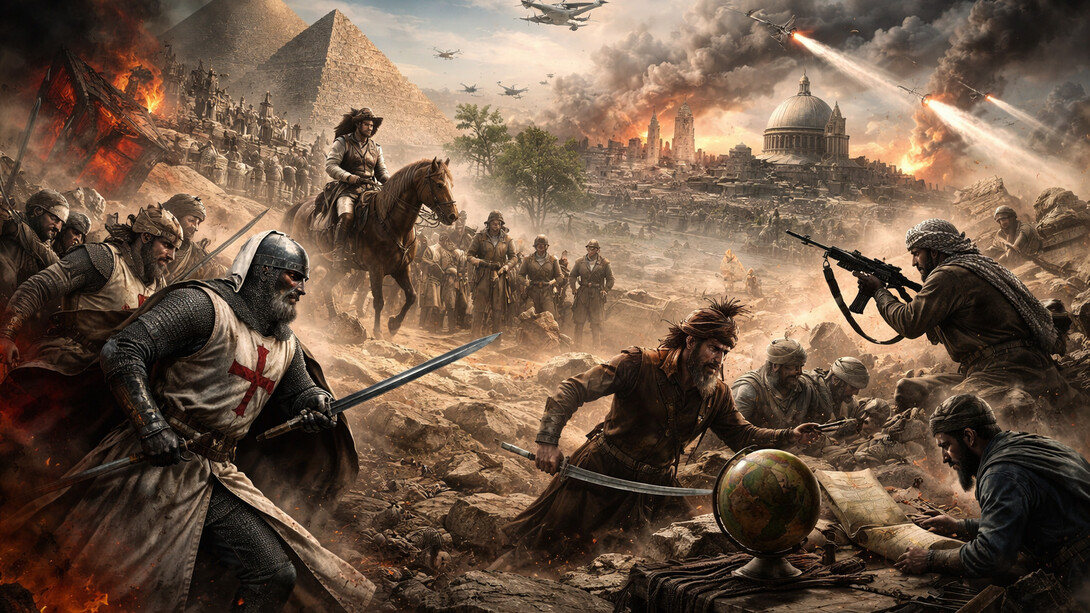
To understand the qualitative leap of the ongoing catastrophe in the Middle East and the process that could transform it into a global catastrophe, we need to go back in time. By prioritizing the assassination of religious leaders, especially Supreme Leader Ali Khamenei, Israel and the US have turned this war into a religious war. The war is between Islam and the Zionist version of global Judeo-Christianity. Of all the religions that were defeated by Western Christianity, Islam was the one that felt the defeat most harshly. It began in the 11th century with the Crusades, continued with the so-called Reconquista of Al-Andalus in the 14th and 15th centuries, and culminated with the end of the Ottoman Empire after World War I.
Just as Christianity is today divided between Catholicism and Protestantism, Islam is divided on several levels, but above all between Shiism and Sunnism. Islamic religious power is less concentrated than Judeo-Christian power. No one in Islam occupies the place or has the power of the Catholic Pope. But, on the other hand, the concept of religion is different in the two worlds in conflict. Since the religious wars of the 16th and 17th centuries and the Western Enlightenment of the 18th century, Western Christianity has undergone a process of secularization. Contrary to popular belief, secularism did not mean the separation of religion and the state. Rather, it deepened the relationship between the two, giving it a new meaning. Secularism was the process through which earthly power was sacralized by freeing it from the sacrality of heavenly power to which it was previously subject. With this, religion became a strategic resource for the state, an effective instrument of domination, as colonialism clearly demonstrates.
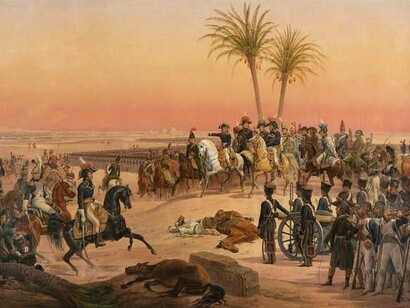
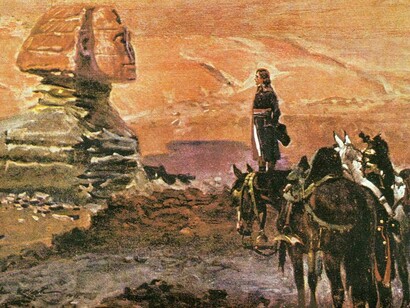
This understanding of Enlightenment secularism finds its most complete formulation in Napoleon. At the start of his expedition to Egypt on July 1, 1798, Napoleon, a young 29-year-old general, made a statement to the Egyptians that was surprising in many ways. In this declaration, he said, "Qadi, shaykh, and shorbagi, tell your people that we are true Muslims. After all, weren't we the ones who destroyed the Pope, who said that all that was left to do was to wage war on the Muslims?” It seems like a contradiction, but it is not, as Mohamad Amer Meziane clearly demonstrates.1 For Napoleon, religion is a strategic resource. If the majority religion in Egypt is Muslim, the state must respect this as a policy of domination. What Napoleon criticizes is not Islam but the political power of the Mamluks, the power he wants to reserve for himself.
Egyptians have every right to live according to their religion, a right that the state must respect. The Prophet Muhammad, far from being the Antichrist of the Roman Curia, was merely a legislator, a position that Napoleon could now occupy. The underground connections between the Sharia (Islamic law) that Napoleon encountered in Egypt and the code civil of 1804 deserve further study.
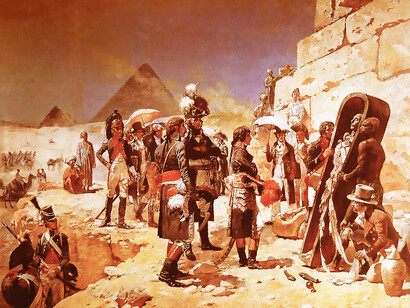
Napoleon's statement was therefore a mixture of lies and truth. The Mamelukes were defeated at the Battle of the Pyramids (although this took place 15 kilometers from the pyramids) three weeks after Napoleon landed in Alexandria. But Napoleon's real goal was to exercise power based on an understanding of Egyptian culture, which was much broader and older than Islam, just as in Iran Persian culture is much broader and older than Islam. To achieve his goals, Napoleon brought with him on the expedition 500 civilians, most of whom were scientists, including 150 biologists, mineralogists, linguists, chemists, mathematicians, etc. Despite the defeat he suffered shortly after his victory at the Battle of the Pyramids—the destruction of his armada by English Admiral Horatio Nelson—Napoleon instructed his scientists (generally as young as he was or even younger) to continue their work and rebuild the lost material with local resources. This is how the artist and engineer Nicholas-Jacques Conté invented the modern pencil, made of graphite, the Conté crayon.
The scientists settled in Hassan Kashef's palace in Cairo, and the Egyptian chronicler Abd al-Rahman al-Jabarti, who had harshly criticized Napoleon's declaration2, could not help but express his admiration for the immense library and scientific environment that Napoleon had created:
The administrators, astronomers, and some of the physicians lived in this house, in which they placed a great number of their books, with a keeper taking care of them and arranging them. And the students among them would gather two hours before noon every day in an open space opposite the shelves of books, sitting on chairs arranged in parallel rows before a wide, long board. Whoever wishes to look up something in a book asks for whatever volumes he wants, and the librarian brings them to him. Then he thumbs through the pages, looking through the book, and writes. All the while they are quiet, and no one disturbs their neighbor. When some Muslims would come to look around, they would not prevent them from entering. Indeed, they would bring them all kinds of printed books in which there were all sorts of illustrations and maps of the countries and regions, animals, birds, plants, histories of the ancients, campaigns of the nations, tales of the prophets including pictures of them, their miracles and wondrous deeds, the events of their respective peoples, and such things that baffle the mind.3
Less than two months after landing, Napoleon created the Institut de l'Égypte (August 22, 1798), following the model of the Institut de France, to which he belonged, and on the next day's session, he proposed the following topics for research: 1) How can bread ovens be improved? 2) How can the water of the Nile be purified? 3) Are windmills practical for Cairo? 4) Is it possible to brew beer in Egypt without hops? 5) Are the raw materials for gunpowder available in Egypt? 6) What is the legal system in Egypt, and what improvements do citizens want? Thus was born a new area of imperial knowledge: Egyptology. Hundreds of books with thousands of illustrations were published in the following decades.
Possible comparison between Napoleon and Trump
What comparison can be made between the brilliant young military man Napoleon and Trump, an old politician convicted of corruption and probably acting under blackmail from the revelation of his sexual crimes contained in the Epstein files or held hostage by secret societies? We are in a time conducive to conspiracy theories. The imperial ambitions of both Napoleon and Trump are evident. Napoleon wanted to destroy the British Empire's trade routes with the Far East, while Trump wants to destroy China's trade routes and access to natural resources. Do the similarities end there? I don't think so. Although this is futurology, it is likely that Trump will be defeated, just as Napoleon was, and that the defeat will also occur in a short period of time. In Napoleon's case, it took three years.
But the imperial differences are more evident. In Napoleon's case, imperial rivalries took place within Europe, between France and England. There were two Western powers with interests in dominating the East. In Trump's case, the rivalry is between the West and the East, which has meanwhile created the conditions to rival the West and even defeat it. Napoleon symbolizes the Enlightenment imperialism of a rising European bourgeoisie that can learn from the non-European world in order to better dominate it and dominate itself. The secularization of the Napoleonic state in Egypt is more consistent than that of the French state.
Trump symbolizes the reactionary imperialism of a decadent Western bourgeoisie that is becoming aware of its irreversible decline in relation to the East. Therefore, the East can only be dominated through destruction. The West has nothing to learn from the East; its panic is that the East has already learned too much from the West. Napoleon sent scientists; Trump sends bombs. Napoleon wanted to know; Trump wants to destroy. Napoleon knew that he did not know (he was an enlightened ignorant); Trump does not know that he does not know (he is ignorant of his ignorance). Napoleon's scientists marveled at the grandeur of the monuments they encountered; Trump's cronies see Trump Towers as the height of grandeur.
Napoleon represents the greatest affirmation of imperial secularization. He represents a regime change that aims to foster the compatibility of Eurocentric government with the religious beliefs of the majority of the population. Therefore, it is necessary to know the culture and history of Egypt, which are much older and more brilliant than those of the West. In Trump's case, regime change implies fighting against the religious beliefs not only of the majority of the population of Iran, but also of the majority of the population of the entire Middle East. That is why it must be declared a religious war. And no one can better lead this war than a religious state, the Zionist Jewish state of Israel, and its allies of global Judeo-Christian Zionism.
This Zionism sees itself as the legitimate heir to the Crusades. In its origin, Islam is as Western as Christianity or Judaism. Islam is the West that the Judeo-Christian West has orientalized. That is why Islam is now a small part of the East. The East is the ancestral culture in relation to which Western culture is not only a newcomer but also has its roots there, in Persia, Alexandria, and the House of Wisdom in Baghdad in the 9th century.
Proxy wars and regime change
Because we are facing a religious war, the strategy of proxy wars has been reversed. The US-Iran war is now a proxy war aimed at creating Greater Israel. The spell has turned against the sorcerer. But since Greater Israel can only be born from the ashes of little Israel, it is to be expected that the great disaster currently unfolding will become even greater. It should be noted that since 2024, more than 170,000 people have left Israel. With the intensification of the war, little Israel (with less than ten million inhabitants) has already become too big for the Israelis, who are abandoning it.
The farce of regime change is now revealing itself with extreme cruelty. We know of no successful cases of regime change policy. Success in terms of increasing the well-being of populations is the proclaimed purpose of regime change. Instead of increased well-being, we have seen destruction, territorial fragmentation, and looting of natural resources. After all, what regime change took place in Venezuela if the “Chavista dictatorship” remained in power? Regime change was just a cover to confiscate Venezuela's oil policy. Once the confiscation was achieved through the arrest of President Nicolas Maduro and his wife, who was held hostage, the “Chavista dictatorship” disappeared.
But Iran is not Venezuela. Because the war was conceived by Israel as a religious war with a view to creating Greater Israel, it would not make sense to arrest Ayatollah Ali Khamenei and take him to New York. It was necessary to assassinate him and the religious leaders who were with him. The confiscation of natural resources and the blockade of China will always be on the horizon, but the paths to get there will have to be much more destructive.
Furthermore, any credible intention of regime change would require troops on the ground. If we take into account the population of Israel and the resistance of the American people to involving the lives of their soldiers in distant wars against countries they cannot conceive of as posing a threat to their security, it is foreseeable that this war will be lost by Israel and, as a result, will be the end of the State of Israel. But given that the world's most powerful military power is involved in this proxy war, it is possible that the regional war could escalate into a global war. Whether after that war there will still be an American empire, or even a world, is an open question.
Conclusion
In view of this, I am distressed that I cannot agree with the proposal of a great historian whom I greatly admire, Ilan Pappé. In his latest book, Israel on the Brink (2025), he admits the possibility of the decolonization of Palestine and a new coexistence between the Jewish world and the Muslim world in the coming decades. For this to be possible, it would be necessary to immediately stop Netanyahu and Trump and all those who hide behind them. Is this possible?
References
1 Des empires sous la terre. Paris: La Découverte, 2021.
2 Cf. Boaventura de Sousa Santos, If God Were a Human Rights Activist. Stanford: Stanford University Press, 2015.
3 Bob Brier, “Napoleon in Egypt," Archaeology, May/June 1999, Vol. 52, No. 3, 44-53, p. 48.