English
 Español
 Français
 Deutsch
 Italiano
 Português
This article is a revised version of the first one I wrote during my third year of art studies in Athens. For two years, I attended the class Psychoanalytic Approaches to Art with Prof. Gerasimos Stefanatos, to whom I owe my deep interest in psychoanalysis. It is often said that a first impression can make one either love or reject a field entirely. Prof. Gerasimos was the kind of human being who made you love the psychoanalytical landscape.
However, it is also important for the student to be open to such knowledge, with a predisposition toward learning. When both student and lecturer are open-hearted, the act of teaching becomes a vehicle for inner growth. On this theme of self-predetermination, I intend to write a future article from the standpoint of a visual artist.
Reflections on Freud’s essay: Leonardo da Vinci, a memory of his childhood
In the following passages, I reflect on Freud’s psychoanalytic perspective on Leonardo da Vinci’s childhood memory. My approach is not to dissect the method in detail, but rather to offer a second reading of Freud’s text through an artistic lens that feels more natural to me.
Freud, employing psychoanalysis as his tool, seeks to examine the inner life of a “great man,” whom he finds enigmatic and difficult to categorize. Through his analysis, I perceive Leonardo as a gentle and sensitive figure, somewhat distant, yet deeply drawn to beauty. Despite this, we know he was not without his critics. Perhaps this was due, in part, to his departure from Aristotelian logic and his inclination toward a more alchemical approach to inquiry—a direction that set him apart from his contemporaries.
Freud’s search into Leonardo’s past resembles an archaeological dig, an excavation into the prehistory of a civilization that mirrors Leonardo’s childhood. It is undeniable that childhood holds vital clues to the construction of a person’s character. In Freud’s view, Leonardo’s nature leaned toward the feminine. He supports this by describing him as non-violent, vegetarian, opposed to war, and fond of dressing elegantly.
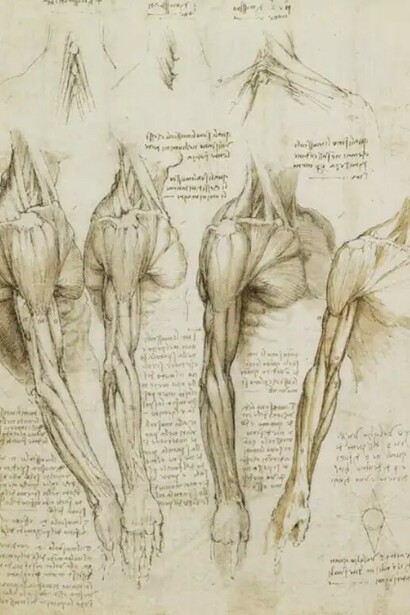
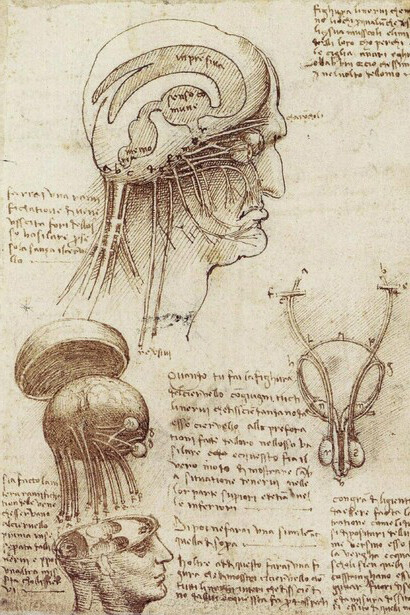
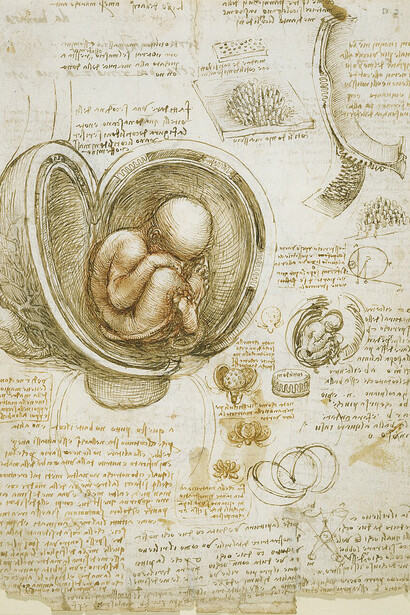
Yet if we see these traits from another angle, they simply suggest a refined sensibility, which is a deeply human orientation toward beauty and harmony. Sensitivity, after all, is not a gendered attribute. Moreover, we know Leonardo engaged in warfare projects, such as designing war machines for Cesare Borgia, and explored anatomy through the dissection of corpses. This reveals a more complex, even shadowy facet of his personality—one that Freud, curiously, does not address in the same essay.
Memory and the image of the vulture
As for sexuality and physical relationships, Leonardo left no explicit record that served as definitive evidence. His statement that “nothing can be loved or hated unless it is first understood” suggests someone who does not deny the existence of emotions but places boundaries around their involvement in men’s lives. Freud famously interprets Leonardo’s childhood memory of a vulture’s tail brushing his lips as symbolic of latent homosexuality. He ties the Italian word coda (tail) to ersatz1, a substitute for the male genitalia, asserting that this image is found in women's dreams.
But I wonder: could this poetic and somewhat surreal image instead reflect the dual parental role played by Leonardo’s mother? He was raised by her alone for a time. Given his knowledge of ancient civilizations, perhaps he was influenced by figures such as the Egyptian goddess Mut2 depicted with a vulture’s head, a female torso, and male genitalia. If Leonardo wrote this memory later in life, as some scholars suggest, his adult knowledge may have reshaped the tone and imagery of the recollection. Memory, too, is a creative act.
A crucial turning point in Leonardo’s understanding of sexuality came with his realization that women do not share the same anatomy as men. This moment reportedly shocked him. Perhaps, due to his introspective temperament, it caused him to abandon preoccupation with sexuality and turn instead to the broader mysteries of nature. I often wonder how differently he might have evolved had this moment not occurred.
A painter's gaze
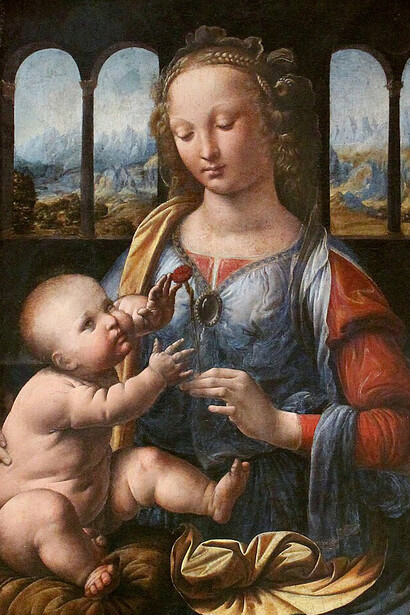
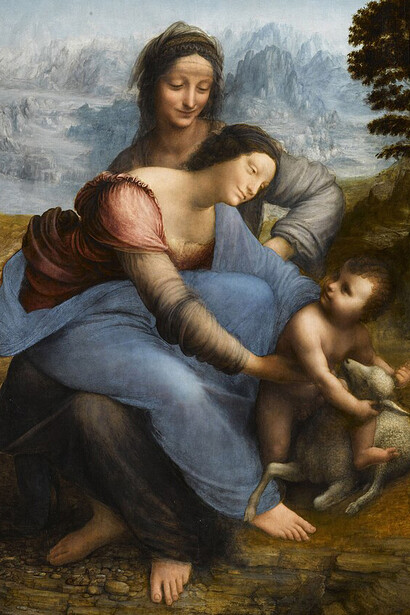
Turning now to his work, if Leonardo were homosexual, as Freud speculates, wouldn’t this be somehow reflected in his paintings and drawings, as we see with other artists? I believe theorists and visual artists read artworks in very different ways.
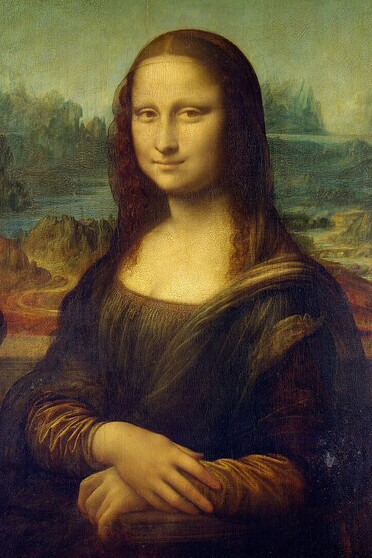
As a researcher of the human form, line, light, and imaginative composition—for example, I approach Mona Lisa not exclusively for its enigma but as a synthesis of formal concerns and lived vision. Painters are often haunted by a detail from an early sketch—a mouth, a look, a light, etc.—and carry it into later works. Perhaps that smile first emerged in preliminary studies of female faces. Or perhaps it echoes the faint smiles of ancient sculptures that Leonardo was aware of—for instance, the Greek ones: the Kore and Kouros3. However, I cannot certainly confirm this.
I make no claim to definitive interpretation. That power rests with the creator. Some scholars claim that Mona Lisa represents ideal femininity. Yet I ask, how could an artist truly express the feminine without having known it intimately, romantically, emotionally, or/and spiritually? At the same time, there are claims the portrait may resemble Leonardo himself. Both could be true.
The artist’s self often infiltrates their work—sometimes intellectually, sometimes psychologically, and sometimes physically. In my own portrait works, I am told that traces of my face appear in the artwork. This is why I often argue against literal psychoanalytic readings. For the visual artist, the subconscious often operates beyond the control or awareness of the conscious self. Painting becomes a vessel through which that force manifests.
Toward a visual epistemology
In this text, I have tried to offer a reflection that reaches beyond a mechanical analysis of personal experience. My aim is to contribute a perspective often overlooked by those who study art from the outside. Visual artists tend to inhabit the world and their practices differently. Their art practice and style are shaped not only by thought; instead, thought intertwines with creative process, perception, and material engagement to manifest an original artistic approach. This is a vast terrain that deserves deeper exploration in future reflective processes.
It would be easy to align myself only with painting, as it is my domain, but I try to remain open to other modes of understanding. I would like to conclude by returning to the emotional and intuitive forces that encircle the visual artist. These forces weave together, becoming an energetic flow overtaking the human artist, and suddenly, inexplicably, these forces give birth to a field of creative becoming. Even though I do not know how or when it happens, I can certainly declare that I am aware of its presence when it rises from within.
Bibliography
Freud, Sigmund. 2006. Μια παιδικη αναμνηση του λεοναρντο ντα βιντσι. Athens: ερατω (erato).
1 "Ersatz" is a German word meaning "substitute" or "replacement." In English, it is often used as an adjective to describe something that is an inferior or artificial imitation of the original.
2 Mut was an important mother goddess in ancient Egyptian religion, associated with creation, protection, and motherhood. Her name literally means "mother" in Egyptian, emphasizing her nurturing role.
3 Kore and Kouros are two distinct types of Archaic Greek statues that represent idealized youth and were created between the 7th and 5th centuries BCE. They mark an important phase in Greek sculpture, preceding the more naturalistic forms of the Classical period.