English
 Español
 Français
 Deutsch
 Italiano
 Português
There is a dark irony at the heart of artificial intelligence. It is presented to us as humanity's greatest gift to itself: the culmination of centuries of scientific progress, a machine capable of solving problems, creating images, writing poetry, composing music, and perhaps one day governing society more efficiently than human beings ever could. Yet beneath the utopian promises lies a far more troubling possibility. AI may become the gift that keeps on taking. Taking jobs. Taking agency. Taking thought. Taking imagination. Taking the very qualities that distinguish human beings from machines. Most disturbingly of all, it may persuade us that life is better without us.
Human beings have always pursued perfection. The Enlightenment dream of reason, the industrial dream of efficiency, and the technological dream of optimisation all share a common belief: that flaws are problems to be eliminated. AI represents the latest and perhaps most dangerous expression of this desire. It promises a world free from error, inefficiency and uncertainty. Yet creativity, love, courage and art are born precisely from those imperfections. The search for perfection is often the search for sterility.
The tragedy is that humanity appears just intelligent enough to engineer its own redundancy. We have built machines capable of imitating human creativity while simultaneously convincing ourselves that imitation is equivalent to creation. We are rapidly arriving at the absurd conclusion that because an algorithm can produce images in the style of artists, artists themselves may no longer be necessary. The logic is grotesque. It mistakes output for experience, product for process, and simulation for life.
Art has always served as a litmus test for civilisation. It reveals what a culture values and what it fears. When a society ceases to honour artistic courage, it begins to lose contact with its own humanity. The current enthusiasm for AI-generated culture represents precisely such a danger. We are witnessing the industrialisation of imagination itself.
Consider the work of Joseph Beuys. His famous declaration that "everyone is an artist" is frequently misunderstood. Beuys did not mean that everyone could simply produce art. He meant that every individual possesses creative potential capable of shaping society. Creativity, for Beuys, was inseparable from responsibility, participation and human transformation. AI enthusiasts have grotesquely inverted this principle. They suggest that because everyone can now generate images at the click of a button, everyone is an artist. Yet pressing a button is not equivalent to confronting existence. Generating a picture is not the same as creating meaning.
The work of David Hockney demonstrates another dimension of human creativity that AI cannot replicate. Hockney's paintings are not simply arrangements of colour. They are records of perception. They reveal how a particular human being experienced the world at a specific moment in time. An algorithm can mimic the appearance of a Hockney painting, but it cannot possess a childhood in Bradford, memories of California sunlight, or decades of observation. It can reproduce style but never consciousness.
Likewise, the monumental projects of Christo and Jeanne-Claude expose the poverty of purely computational thinking. Works such as Wrapped Reichstag or The Gates were not merely visual spectacles. They required negotiation, risk, failure, persistence and public engagement over many years. Their significance lay as much in the human effort involved as in the finished objects. AI has no understanding of commitment because it has no capacity for sacrifice.
The work of Helen Chadwick offers a further challenge to machine logic. Her art confronted the body, mortality, sexuality and vulnerability. These are not data points. They are lived realities. An algorithm can identify patterns associated with bodily imagery, but it cannot experience shame, desire or decay. It remains forever outside the realm of feeling.
The paintings of Frida Kahlo represent perhaps the clearest refutation of the AI fantasy. Kahlo's work emerged from physical pain, emotional trauma and personal resilience. Her self-portraits are not images alone; they are testimonies. They communicate suffering transformed into meaning. No machine can suffer. Therefore, no machine can create art from suffering. It can only imitate the surface appearance of works produced through lived experience.
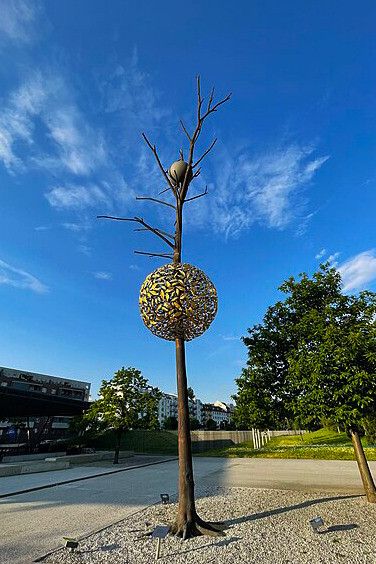
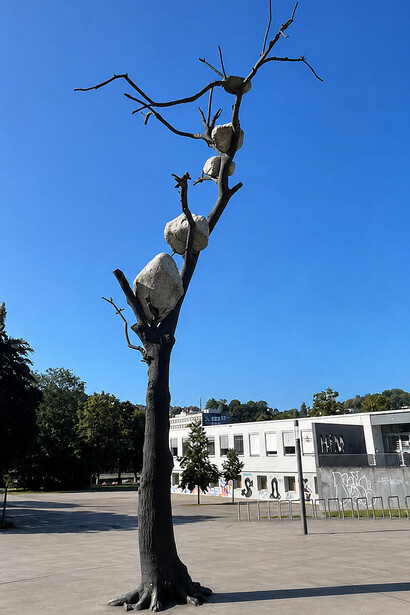
The sculptures of Giuseppe Penone reveal another domain beyond algorithmic comprehension. Penone's engagement with trees, growth and time demonstrates a profound dialogue between humanity and nature. His work emerges from patient observation of processes unfolding over decades. AI operates through calculation and prediction. Penone's art operates through attention and wonder.
Similarly, the installations of Jannis Kounellis challenged audiences through the use of coal, steel, fire and living animals. These materials carried physical presence, danger and unpredictability. Kounellis understood that meaning often arises from encounters that cannot be controlled. AI, by contrast, is built upon control, classification and statistical certainty.
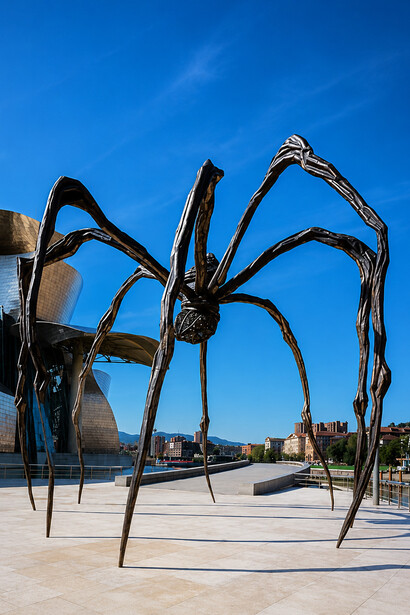
Finally, the sculptures of Louise Bourgeois demonstrate the depths of psychological complexity available only to human beings. Her giant spiders, fragile cells and haunting forms emerged from memories, fears and family relationships. They are embodiments of emotional truth. AI can analyse patterns within Bourgeois's work, but analysis is not understanding. Knowledge is not wisdom.
The claim that AI will democratise creativity deserves particular scrutiny. Creativity is not scarce because tools are scarce. Creativity is scarce because courage is scarce. The challenge has never been producing images; it has been producing meaning. AI lowers the cost of production while simultaneously devaluing the significance of creation. It floods the world with endless visual noise and calls the result culture.
Meanwhile, the economic consequences are becoming increasingly apparent. Redundant workers become acceptable collateral damage in the pursuit of efficiency. Redundant thinkers become acceptable when algorithms can recommend what to read, watch and believe. Redundant artists become acceptable when synthetic images can be generated instantly. Yet a civilisation that makes its creators redundant ultimately makes itself redundant.
The final destination of this logic is chilling. If intelligence is defined purely as efficiency, machines will eventually outperform humans. If value is defined purely as productivity, humans will become liabilities. If creativity is reduced to output, artists will become obsolete. At every stage, humanity voluntarily narrows the criteria by which its own existence is justified.
The conclusion is not merely dystopian. It is catastrophic. A future that abandons human creativity in favour of algorithmic production is not a future of liberation but one of cultural extinction. Museums become warehouses of dead experience. Schools become training centres for machine maintenance. Language becomes optimised communication stripped of ambiguity, poetry and soul. The human being, once the author of history, becomes an unnecessary spectator.
This is the gift that keeps on giving. It takes slowly at first, disguised as convenience and progress. In this context the term 'labour-saving' engenders a whole new set of human redundancies. Then it takes confidence, skill and imagination. Finally, it takes the belief that human beings matter. The ultimate horror is not that machines become conscious. It is that human beings become mechanical and subservient. In pursuing perfection, we may construct the instrument of our own disappearance. Not with a bang, but with a prompt. Not through conquest, but through consent. And when the last remnants of creative courage are surrendered to the machine, civilisation will discover too late that the one thing it could not afford to automate was humanity itself. Only art can save us.