English
 Español
 Français
 Deutsch
 Italiano
 Português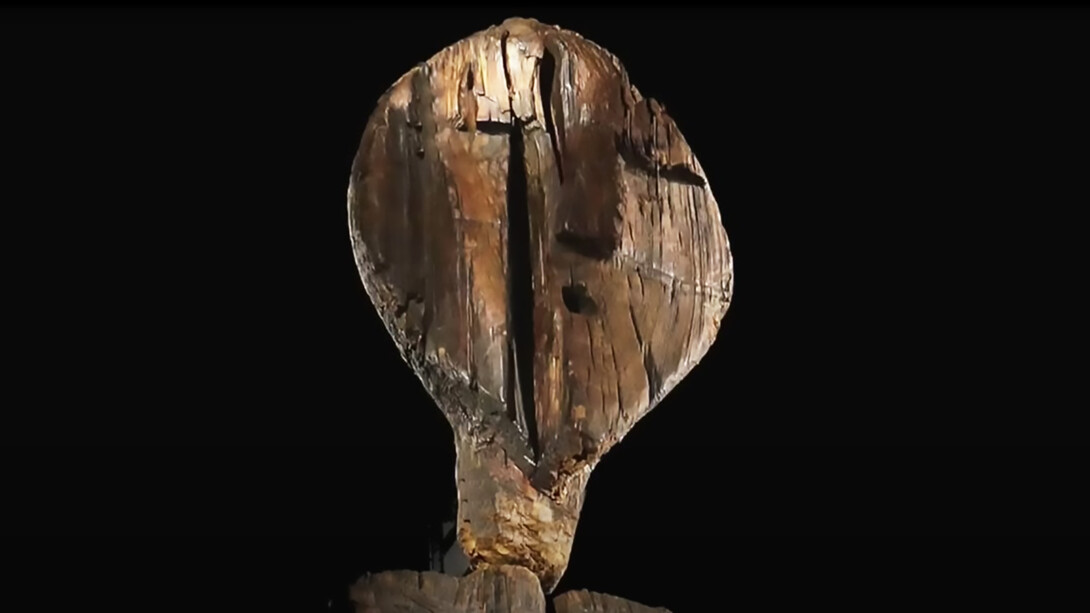
The first time I saw an image of the Shigir Idol, I was stunned, not by its age (though that alone is enough to shift the axis of our understanding of early art), but by its eyes.
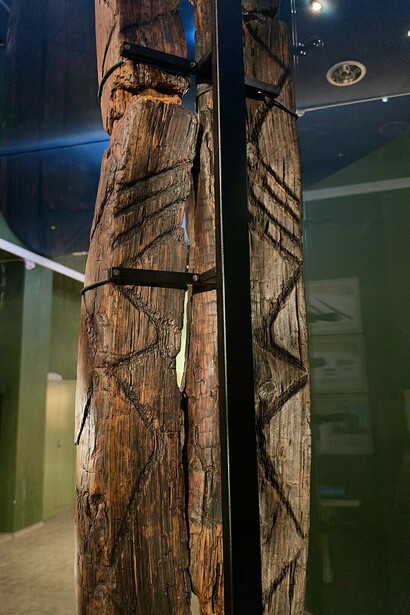
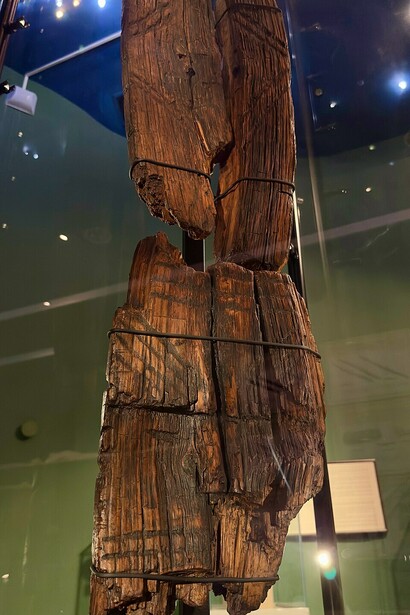
Not the literal eyes, of course, but the feeling that it sees us. The idol stands tall, over five metres in its original form, and is carved from larch wood, preserved for more than 12,000 years in the Shigir peat bog of the Ural Mountains.
It is the oldest known wooden sculpture in the world. And perhaps, one of the first attempts by humankind to materialise the intangible: belief.
From cave walls to wooden monuments
To grasp the significance of the Shigir Idol, I had to step back and place it within the timeline I’ve been exploring in this series. We’ve journeyed through cave walls lit by torchlight, painted with ochre symbols and animal forms. We’ve seen the rise of figurines like the Venus of Hohle Fels, small, palm-sized icons of fertility and life.
But the Idol is different. It doesn’t fit neatly into categories. It’s not purely decorative nor functional. It’s monumental, abstract, and shrouded in mystery.
To me, it feels like a turning point, when art began reaching beyond the visible world into the spiritual.
Discovery and dating: a timeline redefined
Discovered in 1890 by gold miners digging through the peat, the Shigir Idol was initially thought to be just a few thousand years old. But modern dating techniques, including accelerator mass spectrometry, placed it at around 11,600 years old, possibly older.
This predates the Egyptian pyramids by over twice as long. It was carved just after the Ice Age, during a time when our ancestors were thought to be living simple, nomadic lives. And yet, this sculpture challenges that assumption. It tells us that these people not only had tools and artistic ability but also the cognitive space for belief systems, symbolic expression, and perhaps even ritual.
The language of symbols
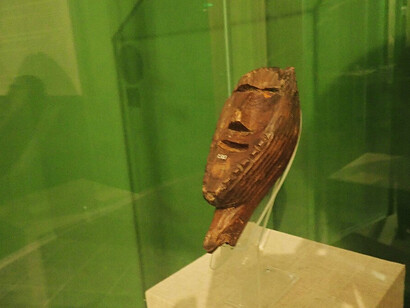
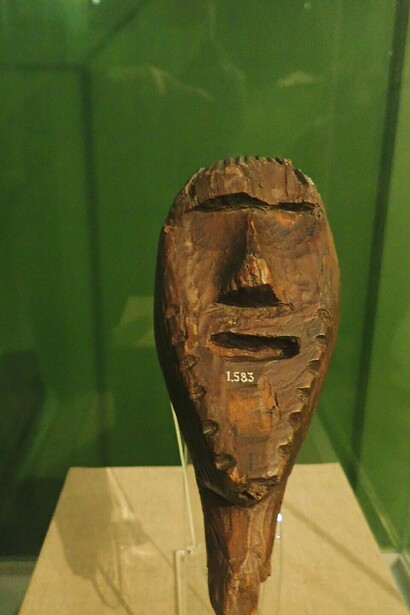
The carvings on the idol are what fascinate me most. It is covered in geometric patterns, zigzags, chevrons, herringbones, and faces stacked vertically. There’s no written language here, but the repetition and structure suggest meaning.
Some researchers believe the carvings may be an early form of storytelling or a symbolic code. Others suggest that it represents a spiritual hierarchy, worlds stacked atop one another, or a genealogy of ancestral spirits. In my own reflection, I wonder if the idol served as a totemic link between the people and the forces they couldn’t explain: death, weather, fertility, or the spirits of animals they depended on.
Toward the sacred
Standing before something like this, I can’t help but ask: why did they make it?
Why did they go through the immense effort of carving it from a tree, preserving it in such detail, and placing it upright in the ground?
There’s no practical answer. This wasn’t for shelter or survival. It was for something deeper. Perhaps the idol marked a sacred space. Perhaps it was meant to watch over the land, to embody a spirit, or to communicate with unseen forces. This is where we begin to see the contours of religion, not yet as a structured system but as an intuitive search for meaning beyond the physical world.
Monumental mystery
Art and spirituality have always been entwined. In earlier articles, we saw how cave paintings may have emerged from shamanic rituals, or how figurines were buried with the dead. But the Shigir Idol is different in scale and intention. It’s not just an object; it’s a presence. Its very height demands reverence. Its features are impersonal, yet hauntingly familiar. When I look at it, I don’t see a human trying to represent another human. I see a human trying to represent something else entirely: the sacred.
Echoes of lost traditions
What’s remarkable is that the idol stands alone in the archaeological record. Wooden objects rarely survive millennia, especially not in regions like the Urals. So we must imagine that there may have been others, structures, idols, and carved markers lost to time and decay.
What survives is a singular echo of a much broader cultural movement, one we can barely glimpse.
In some indigenous Siberian cultures, totem poles are used to represent ancestral spirits and spiritual guides. Though separated by time, I find it tempting to draw a line from those traditions to the Shigir Idol. Not as direct descendants, but as expressions of a common human urge: to reach upward, to remember, and to revere.
The idol may have been part of a ceremony, a marker of transition, or a guardian of place. We can’t know for sure. But in the absence of certainty, we find space for wonder.
Conclusion: a mirror to the sacred impulse
This, I believe, is the true power of ancient art: not only to inform us about the past, but to reconnect us with something primal in ourselves.
The Shigir Idol forces us to reconsider what it meant to be human at the dawn of the Holocene. These were not people merely surviving; they were contemplating. They were wondering what lay beyond death or what forces controlled the wind and the game. They were carving symbols into wood to make sense of the invisible.
In today’s world, where art is often commodified and spirituality boxed into dogma, I find solace in the raw mystery of the Shigir Idol.
It reminds me that the need to express, to revere, and to make meaning is older than any recorded history. It is etched into us, just like those zigzag lines etched into ancient wood.
We may never decipher the full meaning of the Shigir Idol. But maybe that’s not the point. Maybe its purpose was never to be understood intellectually but to be felt, to evoke reverence, to hold space, to remind those who stood before it that they were part of something vast and unseen.
In that way, the Shigir Idol is not just a relic of the past. It is a mirror. It shows us the sacred impulse that still lives within us, if we’re quiet enough to hear it.