English
 Español
 Français
 Deutsch
 Italiano
 Português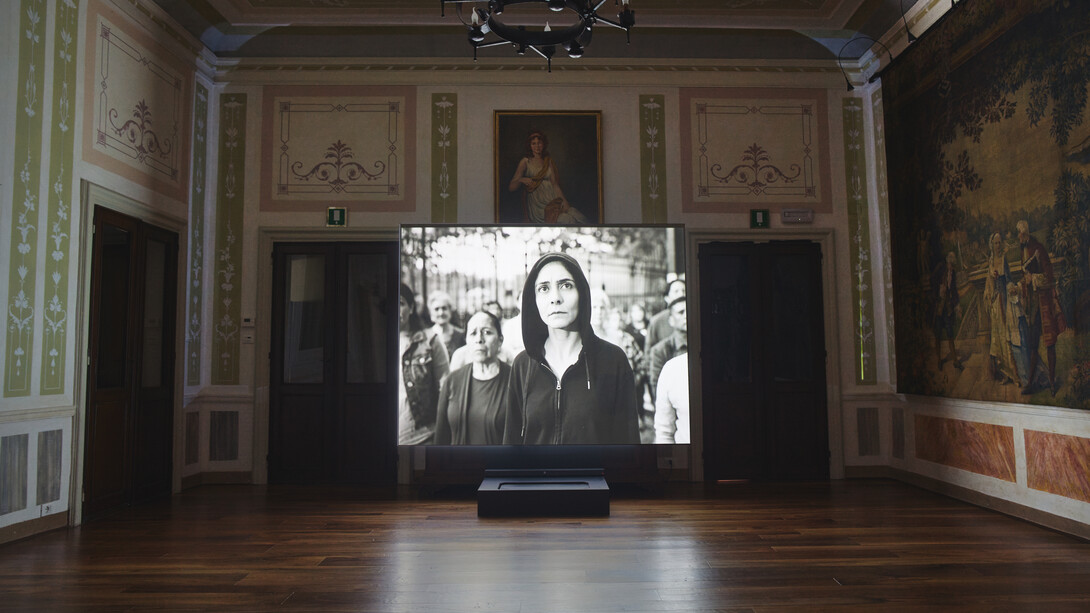
There are lives that seem to belong to the margins of history until an artist looks at them and reveals that, hidden within their apparent singularity, there is something that concerns us all. Nasim Aghdam’s life was one of them. Iranian by origin, raised in the United States after her family fled persecution connected to their Bahá’í faith, she inhabited that difficult territory between one identity that was gradually being lost and another that never entirely became home. She created videos, sang, danced, dressed herself as different characters, transformed her body and her image, entered the immense theatre of the internet and asked, in every possible way, to be seen.
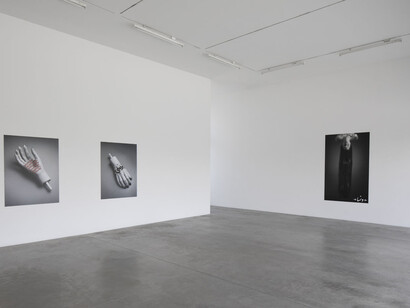
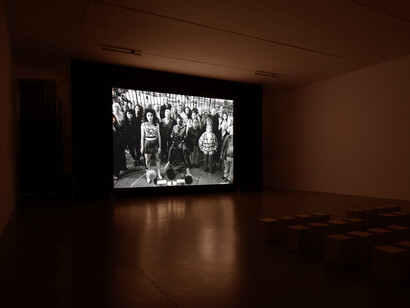
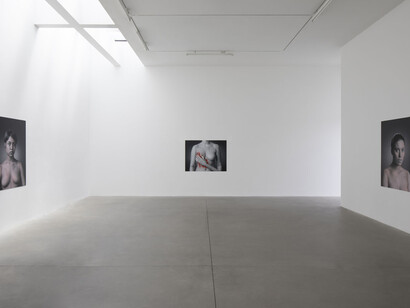
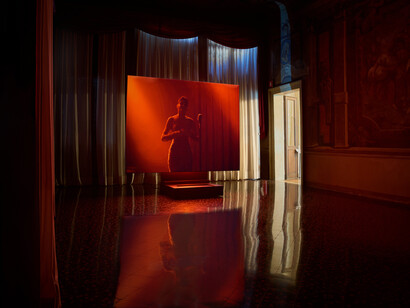
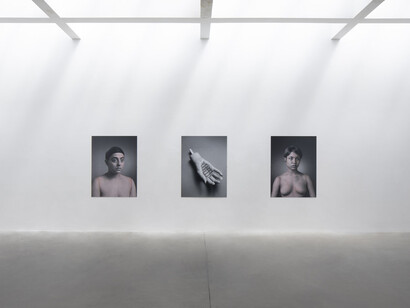
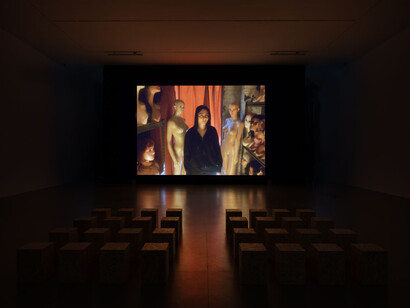
Millions watched her, and yet being watched did not save her from feeling invisible. When her YouTube account was shut down, an event she interpreted as an act of censorship, her story moved towards its terrible conclusion: in 2018 she entered YouTube’s headquarters armed, wounded several people and then took her own life. It would be easy to allow the violence of that ending to swallow everything that came before it. Shirin Neshat does something much more difficult. In Do U Dare!, her trilogy of films presented at Palazzo Marin in Venice and curated by Ilaria Bernardi and Bartolomeo Pietromarchi, she returns to the human being before the event, to the loneliness before the explosion, to the images before they became evidence of a tragedy.
Neshat does not absolve Nasim, nor does she reduce her to the final act through which the world came to know her. She looks instead into the unstable space where exile, anger, imagination, performance and the desire for recognition begin to contaminate one another. Perhaps this is why Do U Dare! feels so unsettling. Nasim is distant from us in the extremity of what she eventually did but disturbingly close in what she wanted. She wanted someone to look at her and, through that gaze, to confirm that she existed. There is something almost unbearably contemporary in this desire. We live in a civilisation that has never produced so many images of human beings and perhaps has never made human beings so uncertain about whether they are truly seen.
Every day we photograph ourselves, narrate ourselves, measure the reactions to our existence, count followers, views, likes and comments. We have transformed visibility into a numerical language and, little by little, allowed numbers to enter territories that once belonged to intimacy. Nasim’s tragedy cannot be explained by social media, nor should it be turned into a convenient allegory of our digital lives. But Neshat understands that her obsessive self-representation touches something larger than one individual biography. The screen promises presence while constantly threatening disappearance. It tells us that anyone can become visible while creating an almost infinite competition for attention. It gives us an audience without guaranteeing that anyone will actually recognise us. And perhaps the deepest wound explored by Do U Dare! lies precisely here: in the distance between being watched and being seen. The three films move through different socioeconomic landscapes of New York, and each becomes less a setting than a psychological state. In the first, Nasim walks through an immigrant neighbourhood in Brooklyn, among poverty, bureaucratic indifference, exclusion and cultural alienation.
The American dream is still there, somewhere, but it is observed from its edges, from the place occupied by those who arrived and nevertheless continue to experience arrival as a form of suspension. Neshat has spent much of her artistic life inhabiting such thresholds. Iran and America, East and West, belonging and exile, the female body and political power have never appeared in her work as simple oppositions. They are wounds that remain open precisely because neither side can completely explain the other. In Nasim she finds another displaced woman but also a disturbing mirror. Both are Iranian women living in America; both construct images; both use performance to negotiate identity; and both understand that the female body is never simply a body once it enters the public sphere. Yet where Neshat has transformed displacement into an extraordinarily disciplined artistic language, Nasim’s relationship with representation becomes increasingly unstable.
This proximity and distance make the trilogy emotionally complex: the artist seems to approach her subject not from the safety of judgement but from the dangerous territory of recognition. Then comes Wall Street. Nasim moves from the margins of the immigrant city to one of the symbolic centres of global power, among men and women absorbed in repetitive movements, surrounded by wealth and yet emotionally disconnected. A mysterious voice interrupts the choreography of productivity; the crowd follows it and discovers Nasim as its source. Suddenly she is a performer. People stop. They listen. They are moved. For a moment the impossible has happened: the invisible woman has become the centre of the image. It is a beautiful and cruel fantasy because it contains the seductive promise on which so much contemporary culture is built: perhaps, if enough people look at us, our loneliness will disappear. Perhaps visibility can become love. Perhaps attention can become belonging. But an audience is not a community, and recognition cannot ultimately be measured in views.
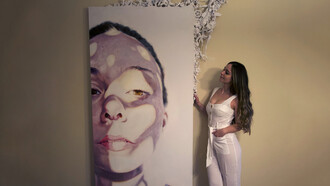
Neshat seems to understand this with particular tenderness. The camera does not merely show Nasim wanting fame; it asks what emotional hunger fame has been asked to satisfy. In the final film, we enter Nasim’s domestic space and encounter the private factory of her public identities. She sings, dances, changes characters, costumes and attitudes, parodying the images through which America represents power, wealth, freedom and desirability. The female body becomes central again: aestheticised, sexualised, fetishised, and transformed into an object to be circulated and consumed. Here, do you dare! reconnects with one of the most persistent questions in Neshat’s practice. Who owns the image of a woman?
For decades her work has investigated bodies subjected to cultural, religious and political systems of representation. Yet the America encountered by Nasim presents another possibility of control. The body does not have to be hidden in order to be regulated; it can be endlessly exposed. It can be encouraged to reveal itself, reinvent itself, sexualise itself and circulate itself until exposure begins to resemble another form of captivity. Between concealment and hypervisibility, apparently opposite cultural regimes can unexpectedly touch. In both, a woman may discover that the image of her body has become a territory negotiated by forces larger than herself. What makes Do U Dare! What is particularly powerful is that Neshat refuses to resolve these contradictions through realism alone.
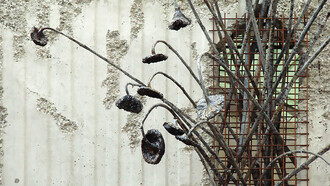
Across the trilogy, black-and-white social observation gradually gives way to magical and surreal dimensions; reality becomes porous, imagination enters experience, and the distinction between what happens and what is desired begins to tremble. This formal movement is essential because Nasim’s story cannot ultimately be contained within a biography. Neshat is not making a documentary reconstruction of a life. She is entering its emotional architecture. She is asking what exile feels like when the country one has reached does not become home; what creativity becomes when it is asked to carry the entire burden of identity; what happens when the desire to communicate encounters silence; and what remains of the self after years spent transforming oneself into images for strangers. And this is where Nasim’s story becomes difficult to keep at a safe distance. Not because her violence can or should be made ordinary—it cannot—but because the longing that preceded it is ordinary.
We all need recognition. We all need, at some moment, another human being to tell us through their attention that our presence matters. What has changed is the architecture surrounding that need. An intimate human necessity now inhabits an economy of attention designed to quantify it. We offer fragments of ourselves to platforms and wait for the world to respond. Sometimes it does. Sometimes millions of people respond. And still a person can remain alone. Perhaps this is the terrible paradox at the heart of Do U Dare! Nasim Aghdam succeeded in becoming visible. She was watched millions of times. After her death, she was watched even more. Yet visibility was never the same thing as being held in another person’s gaze with care.
Neshat’s trilogy therefore speaks about exile in a sense that extends far beyond migration. There is geographical exile, certainly, the painful condition of belonging completely neither to the place one has left nor to the place in which one lives. But there is also an exile from others, an exile from one’s own image, perhaps even an exile from oneself. In this sense, the question contained in the title begins to change direction. Do U Dare! At first it seems to belong to Nasim: how far do you dare to go to make yourself visible? How many identities can you inhabit? How much of yourself can you expose? But slowly the question turns towards the spectator. Do we dare to look? Not merely to watch, consume and move on, but to remain in front of another human being long enough for an image to become a presence.
Do we dare to see the loneliness behind a performance, the vulnerability behind provocation, and the person behind the profile? Art cannot undo what happened to Nasim Aghdam, and Neshat never pretends that it can. What art can do is resist the speed with which an individual life becomes a headline, an algorithmic trace, a judgement or a number. It can return complexity where the world demands simplification. It can make us remain. And perhaps this is why, after leaving Do U Dare!, what stays with us is not simply the story of a woman who desperately wanted the world to look at her. It is the much more uncomfortable realisation that ours is a world in which everyone is looking, all the time, and yet being truly seen may have become one of the rarest forms of human experience.