English
 Español
 Français
 Deutsch
 Italiano
 Português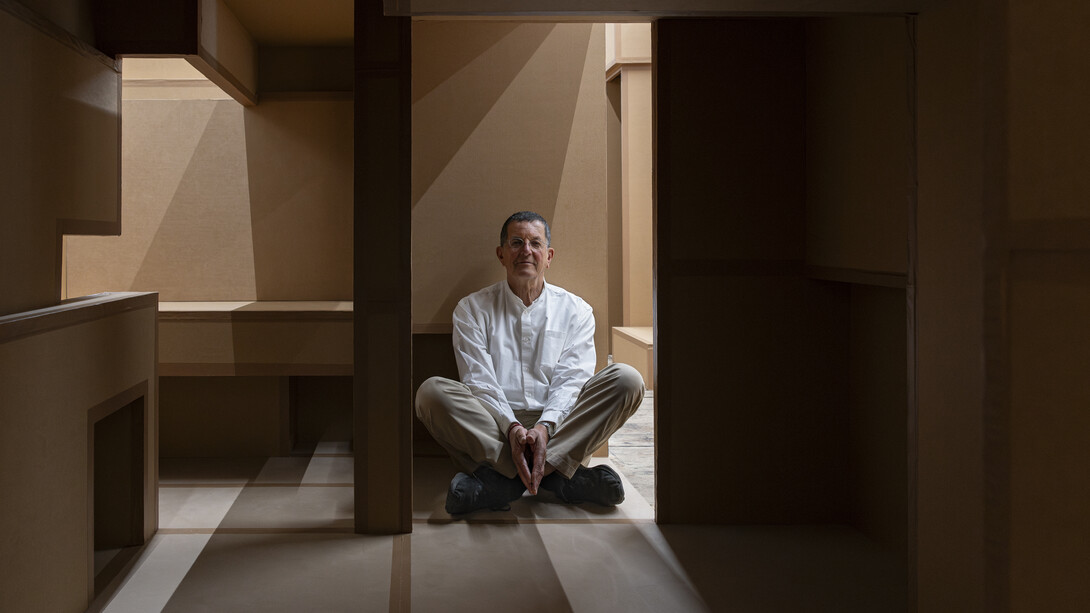
What holds us together?
It is a deceptively simple question. One that, at first glance, appears almost self-evident. Yet in a historical moment defined by instability, fragmentation and acceleration, it acquires an unexpected urgency. What sustains us as individuals? What allows communities to endure? What structures support our lives, and which of them are far more fragile than we are willing to admit? These are the questions that resonate throughout What Holds Us, Antony Gormley's exhibition at Galleria Continua in San Gimignano, on view from 9 May to 13 September 2026. More than a survey of recent works, the exhibition unfolds as an existential investigation into the human condition.
It asks us to reconsider our relationship to the body, to architecture, to matter and to the systems that shape contemporary life. In doing so, it reveals Gormley not simply as one of the most important sculptors of our time but as an artist who has consistently used sculpture as a means of thinking about what it means to inhabit the world.
Few contemporary artists have returned as persistently to the body as Gormley. Yet the body in his work has never functioned as portraiture. It is not biography. It is not identity. It is not self-expression. Rather, it is a place of experience. A measure of existence. A shared condition. Throughout his career, Gormley has transformed the human body into a universal instrument through which to explore perception, vulnerability and our relationship to space. From Angel of the North to Another Place, his figures have stood not as monuments to individual achievement but as invitations to recognise ourselves in others. In What Holds Us, however, something shifts.
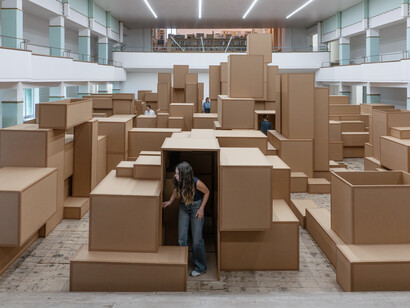
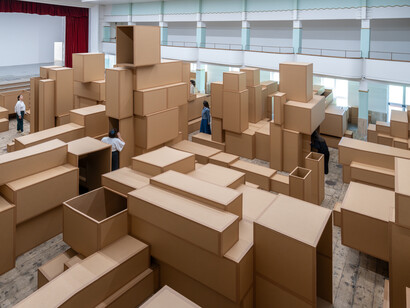
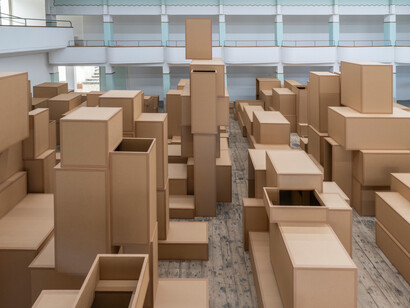
The body becomes architecture. The exhibition's central work, Innercity (2026), occupies the gallery's former cinema theatre in its entirety. Fifteen giant "body buildings", constructed from cardboard, form an urban labyrinth through which visitors must navigate. Some structures remain inaccessible, denying entry. Others invite viewers to crawl inside them. Together, they reinvent the anatomy of the body through the language of architecture. It is a remarkably powerful image. We no longer simply inhabit cities. We become them.
Our bodies are transformed into structures of passage, containment and exclusion. The distinction between private and public space begins to dissolve. What emerges is an unsettling portrait of contemporary urban existence: a condition in which proximity does not necessarily generate intimacy, and density does not automatically create community. Yet Innercity is not dystopian. There is playfulness here. Curiosity. A sense of rediscovery. Gormley describes the installation as a "re-enchantment" of environments that have fascinated humanity since the origins of cities: spaces that promise shelter, safety and permanence. But these dreams of stability are rendered in an unexpected material. Cardboard. The same material used by Amazon to deliver more than six billion packages worldwide each year.
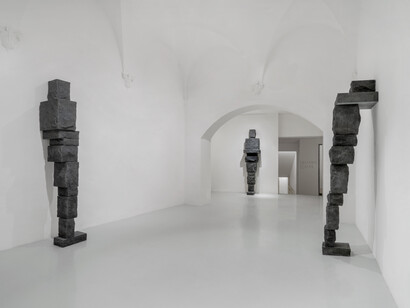
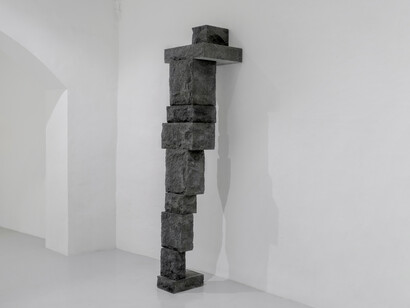
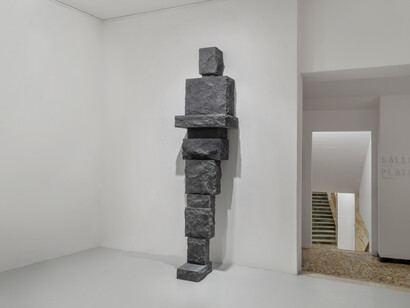
The choice is brilliant. Cardboard is ubiquitous yet disposable. Functional yet fragile. It speaks of logistics, consumption and global networks of exchange. It carries the traces of desire and convenience that define contemporary life. By using it to construct monumental architectures of the body, Gormley exposes the paradox at the heart of our civilisation: we seek permanence through systems built upon impermanence. Perhaps the structures we trust most are also those most susceptible to collapse. Indeed, collapse runs throughout the exhibition as both threat and possibility. At the entrance, basalt blockworks rely upon the gallery's fourteenth-century walls for support, reversing the traditional logic of the caryatid. Rather than architecture resting upon the body, the body depends upon architecture. The sculptures convey a profound sense of interdependence while simultaneously embodying the potential for failure.
Dependency replaces autonomy. Support replaces mastery. The myth of self-sufficiency begins to unravel. Elsewhere, monumental terracotta Slabworks combine two bodies "like a house of cards", creating precarious structures that nevertheless suggest intimacy and connection. This may be one of the exhibition's most moving gestures. Human relationships emerge not through certainty or invulnerability, but through mutual reliance. We hold one another up. Not despite our fragility. Because of it. Material itself becomes one of the exhibition's principal protagonists. As Gormley writes, "As a sculptor, I speak in the language of stuff: matter, in the belief that all matter has meaning." The exhibition traces an extraordinary journey through materials: primordial basalt, terracotta, iron, concrete and cardboard. It feels almost like an archaeology of civilisation. Stone evokes origins.
Clay recalls touch and making. Iron speaks of industry. Concrete of modernity. Cardboard of contemporary circulation and consumption. Together, these materials tell a story not of technological progress but of shifting ways of inhabiting the world. The exhibition's title acquires an increasingly layered significance. What holds us? Gravity. Architecture. Social structures. Relationships. Beliefs. Habits. Economic systems. Bodies. The question remains deliberately unresolved. Perhaps because the answer cannot be singular. In an age increasingly shaped by virtual interactions and digital abstraction, Gormley insists on returning us to embodied experience. Weight. Mass. Void. Threshold. Enclosure. Exposure.
The visitor does not simply observe these works. One moves around them. Between them. Alongside them. Sometimes against them. The exhibition becomes less an object of contemplation than a choreography of awareness. This emphasis on experience recalls a statement. Gormley makes in the press release: he hopes the exhibition allows us "to experience [the built world] as if for the first time – a point of view shared by the newborn and the artist." There is something profoundly hopeful in this proposition. To encounter the world anew. To suspend a habit. To rediscover wonder within the ordinary. At a time when familiarity often breeds indifference, Gormley asks us to become attentive once again. To notice the spaces we occupy.
To question the structures we inherit. To reconsider the assumptions that support everyday life. San Gimignano provides an especially resonant setting for such reflections. The mediaeval Tuscan town, defined by its towers and stone architecture, has long embodied humanity's desire to build permanence into the landscape. Against this backdrop, Gormley's precarious constructions acquire additional meaning. History itself becomes part of the exhibition. Ancient walls support contemporary forms. Past and present lean upon one another.
Even permanence reveals itself as provisional. Perhaps this is the exhibition's deepest insight. The question is not whether we are fragile. We are. The question is whether fragility should be understood solely as weakness. What Holds Us suggests otherwise. Fragility may also be the condition that makes empathy possible. Dependency may be what allows community to exist. Openness may be what enables transformation. In this sense, Gormley's exhibition offers a subtle but powerful response to the anxieties of contemporary life. It does not promise stability. It does not provide definitive answers. Instead, it invites us to inhabit uncertainty differently. To recognise that strength is rarely a matter of rigidity.
That what truly sustains us may be less solid than we imagine. And that perhaps the most enduring forms of support are not those built to resist change but those capable of adapting to it. What holds us? The exhibition leaves the question suspended. But perhaps that suspension is itself the answer. We are held not by certainty, but by relationships. Not by permanence, but by care. Not by the illusion of independence, but by the countless visible and invisible structures through which human life becomes possible. And in reminding us of this, Antony Gormley offers something increasingly rare: not an escape from vulnerability, but a way of understanding it as the very foundation of our shared humanity.
Three questions for Antony Gormley
Throughout your career, the body has functioned less as a representation of identity than as a place of experience and shared humanity. In What Holds Us, however, the body seems to become architecture itself. What does this transformation reveal about the way we inhabit the contemporary world?
I have always considered the body principally as a place rather than an object. The unknowable and constantly changing nature of the body is the universe closest to us. I want us to accept its intimacy as the threshold to infinity.
The exhibition moves from basalt and terracotta to concrete, iron and ultimately cardboard—the material of contemporary logistics and global consumption. Was this trajectory conceived as a kind of archaeology of civilisation, revealing both the resilience and fragility of the systems we depend upon?
It was a practical decision, but with it came many practical and environmental benefits and some very useful metaphorical resonances.
The title asks a deceptively simple question: What Holds Us. In a time marked by social fragmentation, political polarisation and technological acceleration, what do you believe still has the power to hold us together—not only as individuals, but as a community?
You will have noticed that there is no question mark in the title, so it could be an assertion rather than a question. What I am suggesting is that the first thing that holds us is our bodies and the second is our connections to place and others. I believe in sculpture's ability to reinforce our firsthand physical experience and then to help us recognise the relationships that support us, whether they be persons or places.