English
 Español
 Français
 Deutsch
 Italiano
 Português
In our age of algorithm-generated and digitally manipulated images, the reconsideration of the elemental relationship between light, space, and object suddenly looks refreshing. For the Ukrainian-born, London-based photographic artist Yeva Kholopova, this relationship lies at the centre of her artistic practice, which revisits radical Modernist visual experiments while developing a distinctly contemporary language of abstraction.
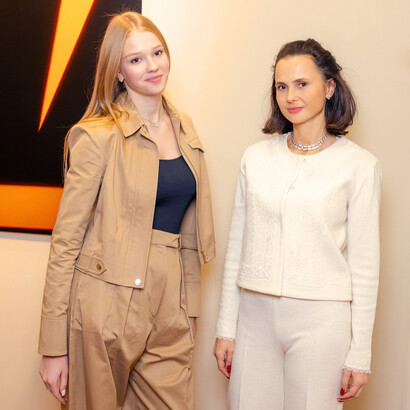
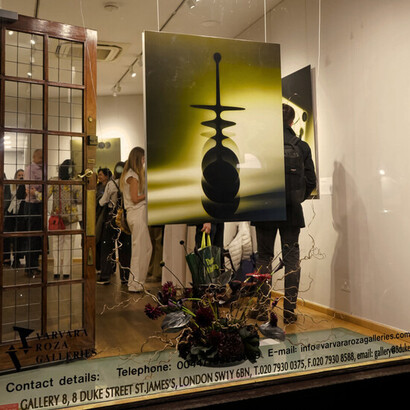
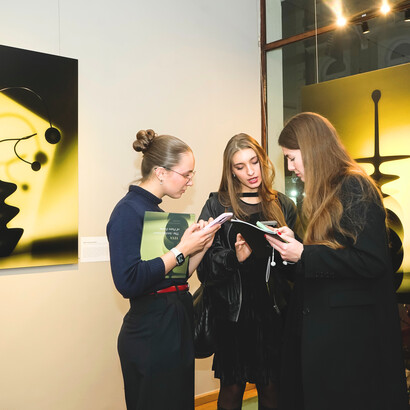
On 22 October 2026, Kholopova, who turns 18 this year, presented her first solo photographic exhibition, The Architecture of Pure Form, at Gallery 8 in London's St. James’s district. The exhibition marked an important moment in the development of a young artist whose work moves between photography, geometric abstraction, and optical experimentation.
Curated and managed by Tetiana Bairaka, the exhibition reflected the growing visibility of Ukrainian artistic voices within London's cultural landscape. Bairaka was instrumental in bringing The Eye of the Storm to the UK: the landmark exhibition of Ukrainian avant-garde art held at the Royal Academy of Arts in London in 2024. Since then, she has successfully undertaken a series of curatorial projects aimed at strengthening cultural ties between Ukraine and the United Kingdom. She has developed a distinctive programme of curatorial initiatives that bring contemporary artistic practices into unexpected public spaces, creating new opportunities for artistic dialogue and cultural exchange.
Bairaka’s projects include a joint exhibition featuring works by British artist Anthony Kelly and Ukrainian painter Alina Pyatnova, as well as a series of exhibitions and cultural events held at Christie's Auction House and the Pavilion Club in London. Throughout these initiatives, she has consistently introduced fresh artistic perspectives and original talent to the British art scene. The Architecture of Pure Form is among her most recent curatorial initiatives.
Despite this fact, Kholopova's work resists interpretation solely through the lens of nationality or her biography. The artist explores the principles of visual perception, namely, how objects occupy space while shadows redefine their outlines, or how light can become an independent agent of artistic representation. Rather than using photography to record the visible world, Kholopova employs it to question the conditions under which that world becomes visible.
When light becomes architecture
At the heart of The Architecture of Pure Form lies a deceptively simple proposition: light does not merely illuminate objects, but constructs, builds, and shapes them.
In Kholopova's photographs, geometric structures, sculptural arrangements, and botanical specimens undergo a process of visual transformation. Their physical identities are destabilised through carefully controlled lighting, overlapping projections, multiple exposures, and unexpected chromatic relationships.
A shadow may appear more substantial than the object producing it. A stationary structure may suggest movement. A familiar flower may dissolve into an abstract constellation of lines and colours. Thus, the viewer encounters paradoxical images that are simultaneously tangible and ephemeral, sculptural and vague, static and mobile. These effects are not accidental. Kholopova constructs meticulous studio environments in which objects and light sources are positioned with considerable precision. The resulting compositions do not simply reproduce arranged compositions of objects, but propose alternative visual realities in which the ordinary laws of spatial perception appear temporarily suspended.
A dialogue with Modernism
Kholopova's artistic vocabulary enters into a dialogue with some of the most influential experimental movements of the 20th century, particularly Suprematism, Constructivism, and the Bauhaus. The geometric reductions of Kazimir Malevich, the investigations of light and photographic experimentation undertaken by László Moholy-Nagy, and Alexander Calder's exploration of sculptural movement offer important historical points of reference.
For Malevich, geometric abstraction represented a departure from the depiction of recognisable objects towards an autonomous visual language. Moholy-Nagy, working within the experimental environment of the Bauhaus, approached light as a material capable of generating new spatial experiences. Calder, meanwhile, challenged the traditional immobility of sculpture by introducing movement, balance, and shifting relationships between forms.
Kholopova revisits the discoveries made by these masters through the possibilities of contemporary photographic practice. However, her work is not an exercise in stylistic revival. Rather, she returns to fundamental Modernist questions, such as: can geometric form communicate without representing an identifiable subject? Can light function as a constructive medium? Can movement be perceived in an image that is physically still?
In her photographs, these historical inquiries acquire new relevance, particularly at a moment when the distinction between the physically constructed image and the digitally fabricated one has become increasingly uncertain.
Three investigations into form and perception
The exhibition brought together three interconnected bodies of work—created in 2022, 2024, and 2026—each approaching the transformative properties of light from a different perspective.
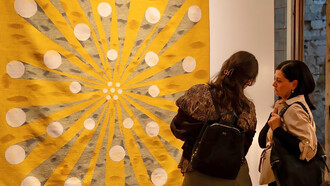
In Spatial Experiments (2024), Kholopova investigates the expressive possibilities of elementary geometric forms. Squares, triangles, and intersecting planes emerge, flash-like, from dark backgrounds in intense shades of red, amber, and orange. The compositions appear at once flat and volumetric. Illuminated surfaces seem to advance towards the viewer, while darker areas suggest recesses or invisible architectural structures. The relationship between figure and ground becomes ambiguous. What initially resembles a two-dimensional arrangement of coloured planes gradually reveals an illusion of depth.
Here, Kholopova approaches photography as a form of spatial construction. Geometry is no longer simply a system of shapes, but a means of organising visual experience. The saturated colour palette intensifies this effect, lending the compositions an almost theatrical presence. Their apparent simplicity conceals a carefully negotiated relationship between illumination, proportion, and the position of the viewer.
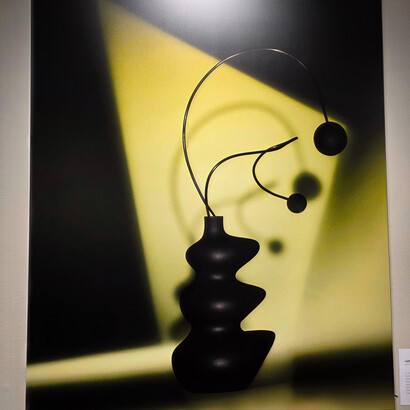
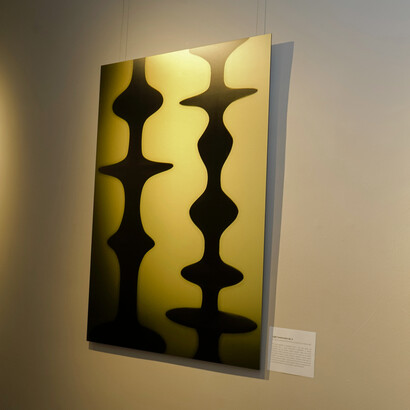
If Spatial Experiments examines the architecture of space, Light. Phantom Kinetics (2026) turns towards the architecture of movement. Working with sculptural constructions, curved wires, and directional lighting, Kholopova produces overlapping shadows and repeated silhouettes that imply motion without requiring the photographed objects themselves to move.
Lines appear to vibrate, multiply, or trace invisible trajectories. Delicate structures become visual records of movement that has never physically occurred. The series raises a fundamental question about photography's relationship with time. Traditionally associated with the freezing of a moment, photography here becomes a medium through which movement can be suggested, reconstructed, or imagined.
The effect recalls the experiments of kinetic art, yet Kholopova achieves her illusions through the interaction of stationary objects and carefully staged light. This leads to the understanding that movement does not necessarily exist within the object but within the viewer's perception.
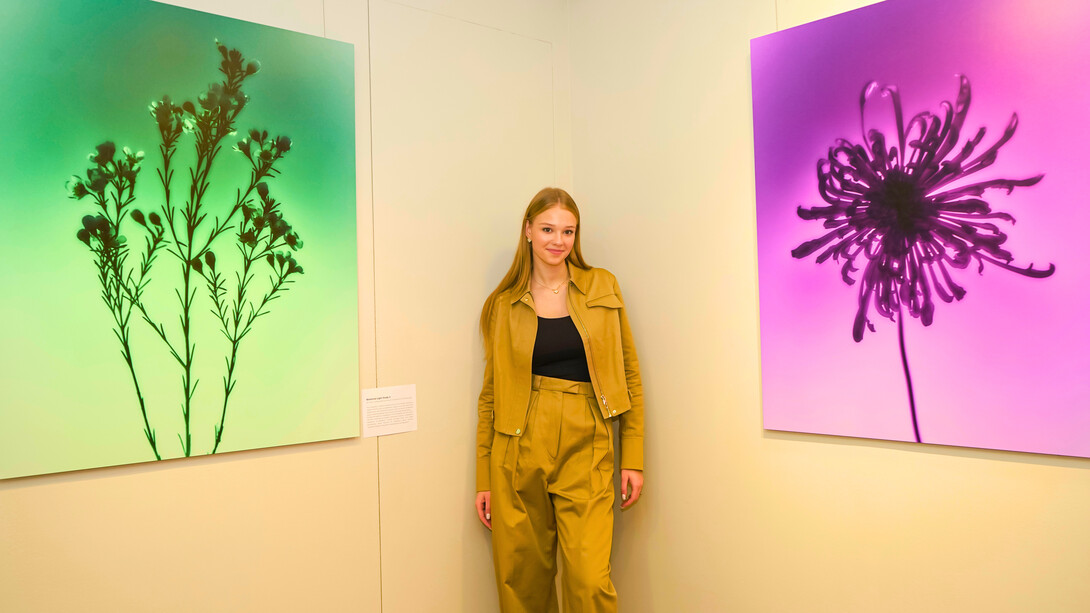
The third series, Nature: Artificial Botany (2022), introduces organic structures into this experimental vocabulary. Flowers, stems, and botanical arrangements are transformed through artificial coloured lighting, producing images in which natural forms assume unfamiliar sculptural identities. The botanical forms are recognisable yet strangely displaced from their familiar context. Delicate stems may resemble architectural drawings, while illuminated petals suggest abstract constructions or celestial formations. Organic structures appear to follow geometries that connect them with the inorganic world.
The distinction between nature and artifice becomes increasingly difficult to sustain. Rather than presenting flowers as decorative subjects, Kholopova investigates their underlying structures, revealing relationships between growth, rhythm, symmetry, and spatial organisation. Their photographic transformation encourages the viewer to reconsider the visual systems through which nature is ordinarily perceived.
Across all three series, the same conceptual principle remains constant: the photographic image is not a passive record of matter but the result of the artist’s vision and her ability to transform the object through light.
From the moving body to the photographic image
Kholopova's sensitivity to space and movement has roots in an artistic discipline that preceded her photographic practice: contemporary dance. Growing up in Ukraine, she undertook years of physical training that developed an intuitive understanding of balance, rhythm, proportion, and the relationship between the human body and its surrounding environment. Dance also introduced her to the dramaturgical possibilities of theatrical lighting.
On stage, a change in illumination can radically alter the appearance of a body. A gesture may become monumental through its projected shadow; a moving figure may appear fragmented or abstract under sharply directed light.
These experiences contributed to Kholopova's understanding of light as an active participant in visual composition, rather than a neutral means of making things visible. Although the human figure is largely absent from The Architecture of Pure Form, the influence of dance remains perceptible.
The rhythmic arrangement of lines, the tension between balance and instability, and the suggestion of movement within static structures all reflect an awareness of choreography.
In this sense, her photographic compositions can be understood as choreographies of objects and light.
An artistic journey across borders
Kholopova's personal trajectory has also shaped the circumstances of her artistic development. Born in Ukraine in 2008, she experienced displacement from her home country due to war and subsequently continued her education in Switzerland.
She attended Collège du Léman, an international school near Geneva, where she completed her studies. During this period, she encountered an artistic mentor whose guidance contributed to the development of her creative direction. The transition between countries, educational environments, and cultural contexts formed part of her journey towards an independent artistic practice.
Eventually settling in London, Kholopova established her own photography studio, providing a dedicated environment for increasingly ambitious visual experimentation. The studio has become central to her working method. Her practice begins with the deliberate construction of the conditions from which an image will emerge. Objects are selected, assembled, illuminated, and repositioned. Shadows are studied as carefully as physical structures. This experimental approach may lead to unexpected optical results.
The perceived tension between material surface and perceptual illusion is central to Kholopova's work. Her images encourage viewers to move between two modes of looking: recognising the physical arrangements from which the compositions originate, and surrendering to the abstract worlds they appear to create. She maintains a sustained interest in the possibilities of photography beyond conventional representation.
Reconsidering the act of seeing
The relevance of The Architecture of Pure Form extends beyond its dialogue with the historical avant-garde. Kholopova's reliance on physical objects and experimental lighting offers a different understanding of how unfamiliar visual worlds can be produced. This approach also reopens questions concerning the relationship between an object and its image.
What do we actually see when we look at a photograph? The object itself, the light reflected from it, a composition constructed by the photographer, or an interpretation shaped by the conditions of our perception? Kholopova offers no definitive answers. Instead, she creates images in which these possibilities coexist. The Architecture of Pure Form presents photography as a field of inquiry in which nature, object, movement, and abstraction intersect. Ultimately, the exhibition is concerned with the extraordinary transformations that occur between object, light, and image. Light here becomes the very substance of artistic creation.
In any case, I hope that these first, not-so-timid experiments by a young talent will grow into ambitious new experimental projects and thrilling artistic discoveries. At least, taking into account that she already participated in Art Basel and was included in Liste Art Basel in 2024, this success sets the bar of expectation quite high.