English
 Español
 Français
 Deutsch
 Italiano
 Português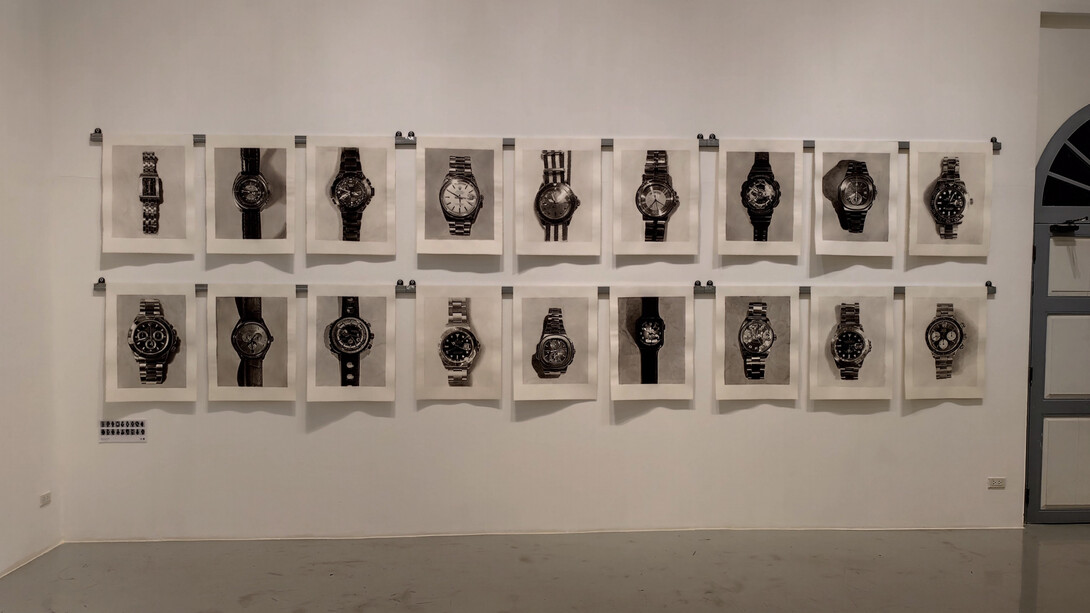
Awareness of one’s mortality can infuse time with meaning, with creative potential. The nature of time can change and deepen as it allows for the creation of something that will soften or extinguish the sting of death due to the nature of the work made possible. Death both disappears as a fear and reappears as a way to cultivate a deep desire to serve others through creation, while one has that blessing.
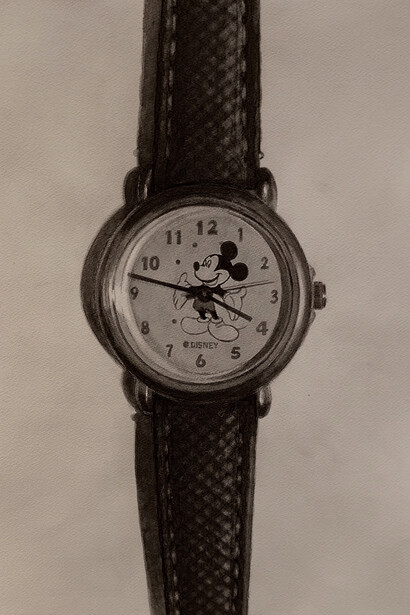
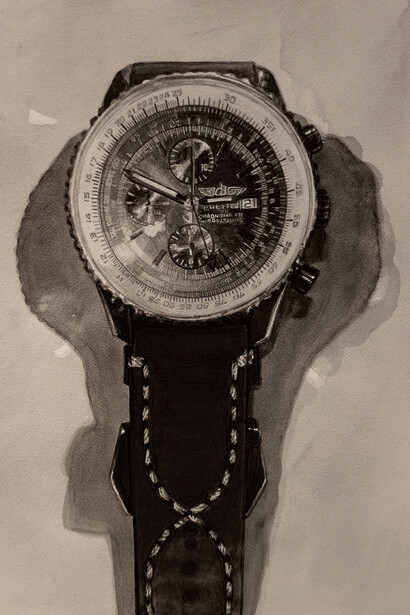
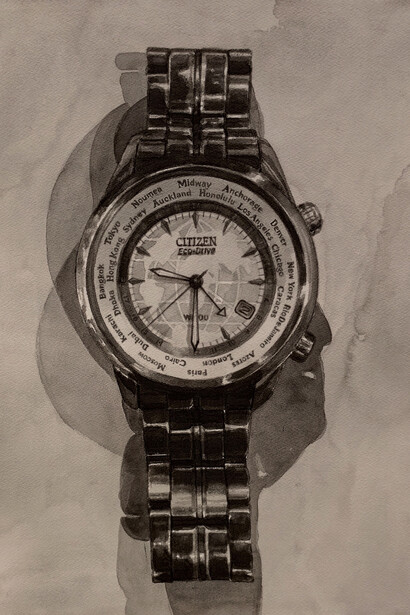
At the National Gallery of Thailand in Bangkok, one could read these curious sentences on a wall in Gallery 7: “The more my paintings increase, / The more my time in this world decreases.” The quote is from A.T. Apichart, a Thai artist whose one-man show “Four Twenty PM” was recently in that gallery. The show was chiefly comprised of black and white watercolor paintings of numerous individual wrist watches.
I have a hunch that Apichart is painting time that does not provide transformative pressure... a less sacred and more secular time. These are timepieces that make time look and feel benign. A watch makes time look eternal, circular, divorces time from the body and makes it completely external and putatively objective.
This type of time helps one forget one’s mortality to focus on schedules and chores and deadlines. If these watches mean any type of pressure, it is the pressure to survive and compete and meet the most basic of obligations and goals in the world.
Apichart seems to assess his continual diminishment. His output increases; his remaining hours shrink. Ostensibly, though, this is a very dispassionate description. You can imagine him shrugging and saying, jovially, “Yeah, that painting cost me x days of my life.”
He describes a situation where his work is an expenditure of time, which leaves him less time for life and future work. His output increases; his remaining hours shrink. Does he implicitly yearn for a sense of urgency? Is he implying that his output is as mechanistic as the objects he is depicting?
Perhaps he is just stating the obvious that each of us faces in our work, e.g., “The more I teach, the less time I have for the rest of my life.” It seems a description without judgment, without emotional response. The quote makes him a type of Caravaggio and Jerome rolled into one, both the artist and the subject of the art.
Is art, in this exchange, of equal value to the time expended? Is it of greater value? Is the key for each of us to use time to create that which is of greater value than time itself?
What is of greater value than time? Family love, a search for justice, meaningful labor, acts of kindness, humane development, creative output…? Surely the use of time is redeemed through art. Maybe Apichart is saying that the real core of human life is our striving to find actions that are more valuable than our time and which should seamlessly be a part of life instead of a frantic gallop toward the finish line.
Literally, Apichart is painting wrist watches, human-made mechanisms that provide our illusory sense of time, a mechanized metaphor for the ephemeral, something that gives the ephemeral practical impact, a more concrete assessment of the ephemeral to make the ephemeral look rational and orderly.
But art is a sort of quid quo pro; you give life some time, some chunk of your mortality, and get back something permanent and meaningful to share with others. Of course, Apichart is also a Thai artist, so I am tempted to say there might be a subtle political message as well. All of these watches are frozen at a moment, different moments per watch. Democracy has also been frozen for a long time in Thailand. He might be saying that political life in Thailand is like these beautiful and finely crafted watches, which have stopped.
Yet, inherent in his quote is the irony that his paintings are overwhelmingly of wrist watches, and painting the measurement of time brings him closer to death. But why would a person paint one watch after another, knowing it just pushes him closer to death?
Well, perhaps it’s a demonstration of the inner development that translates into technical, creative skill. Watercolor paints are the most accessible, non-elitist of painting material and so this seems a perfect medium for the subject, as everyone can have some kind of a watch. Still, to master this most egalitarian of mediums takes well-developed inner qualities of patience, focus and resolve in order to produce the amazing visual results Apichart does.
Watercolors are unforgiving. A single misplaced stroke can dissolve an entire form. You are basically guiding colored water around on a piece of paper with horsehair and letting it get absorbed and dry. To render the gleam of metal, the distortion of glass, the crisp edge of a dial hand requires the most extreme control. Watercolor demands patience, steadiness and restraint tantamount to being in a trance. A perfectly clean line in watercolor is not merely a technical achievement, it is evidence of a demanding inner composure.
So Apichart may be asserting that intense self-development might allow for breathtaking artistic technique and this is his redeeming of time. This insight resonates with certain traditions in Asian art, where technique is not separate from the discipline of the self. In literati painting, the brushstroke is not just representation but revelation, it betrays the moral and spiritual condition of the painter.
One cannot fake equanimity, it appears in the line. It is an image in which the viewer recognizes the inner state that allowed the image in the first place. It is not just that the artist has a high degree of self-possession, it is self-command with the capacity for engagement.
So a type of heightened level of being could be demonstrated in this series of paintings, and this allows us to reinterpret Apichart’s two lines. He is filling his time at a higher level of attention and focus and perhaps this is an amazing way he can fill his time at this higher level of focus and awareness. His quote, after all, does not betray a sense of horror – it is a dispassionate assessment.
By painting watches, the artist may be staging a confrontation with measurable time itself. The discipline required to render the watches becomes a form of self-mastery, an existential choice. The “price” of the work is time, offered up deliberately. The watch, a device that measures duration but cannot measure meaning, becomes ironic. In perfecting its image, the artist converts mechanical time into something that gestures beyond time. What cannot account for creation or transcendence becomes the very instrument through which creation or transcendence is attempted.
Apichart’s watches, then, may be less about horology than about his own self-control. Each painting demonstrates mastery over light, reflection, surface and time-bound material. A watch is a difficult subject precisely because it is reflective. It validates the existence of the world while measuring its passing. To paint a watch is to paint reflected reality - a reality already mediated by glass and glare.
The artist is not painting a watch so much as he is painting the limits of what can be seen: how light reveals, how it penetrates, how it fractures on polished surfaces. Apichart is painting light, over and over again, and the wristwatch is a type of canvas for light on the watercolor paper.
The repetition of a single object inevitably recalls the conceptual practice of Peter Dreher, who painted an empty glass each day for decades, or On Kawara, who painted the date every day for decades. Kawara’s works were not about the date as information; they were about survival. The painting testified: I was alive on this day.
Is this artist thus similar to On Kawara? Each watch records not just time in the abstract but the artist’s continued existence. The viewer, confronted with dozens of nearly identical timepieces, begins to sense what is not being represented: inner turmoil, spiritual growth, meeting the needs of life. The watches simply indicate continuation. They are merely watches, not intended to express an inner state, yet they are imbued with the artist’s interior life and self-mastery. We recognize our desire or craving to see that in works of art. We don’t want mere paintings of watches.
But these watercolors also reveal something about the wearers. The different types of watches clearly reveal the existence of a social and economic order. We look at a Rolex that might be far beyond our economic capacity to ever buy…do we see injustice in this? Opportunity? The wonders of consumerism? The waste of luxury items? The empty desire to wear prestige on one’s wrist?
Watches are not neutral objects. They are chosen, they are worn. They signal taste, aspiration, wealth. A luxury watch can announce economic power; a cartoon watch can signal nostalgia or irony. The wrist becomes a small stage for self-presentation.
By painting a range of watches, from elite brands to playful, inexpensive ones, Apichart also quietly maps a social hierarchy. The exhibition becomes a gallery not only of timepieces but of economic identities. Each watch implies a wearer. Each wearer implies a position within a stratified world. To what extent can we predict what the person is like just by looking at their watch?
In painting the same type of object repeatedly, the artist also creates a confrontation with the economic reality of the world and how it fragments human experience and unfairly allocates resources. Thus, the works operate on multiple levels: as secular memento mori, as exercises in self-discipline as documents of social order.
In Apichart, the watches assert that one must continue without thought of death. Continue working. But Apichart continues exchanging hours for form. He continues documenting both his self-possession as well as a world where time is universal but lived unequally. Apichart, like all artists, converts disappearance into presence.
Finally, “420” was/is a code word for marijuana, originally used so American stoners could talk about drugs without the cops understanding. By calling the show Four Twenty PM, Apichart introduces a subtle, subversive layer. The watches themselves are hyper-disciplined, meticulously measured, and created depictions of objects, symbols of mechanized time and mortality dominated by a denial of death. The title, by contrast, evokes secrecy, indulgence and subjective experience, a time dilation, a countercultural time in which ordinary time loosens its grip.
The exhibition becomes a meditation on competing temporalities: the strict, visible time we live by, and the hidden, coded time of perception, play, ritual and the creativity of action. Like Jerome confronting the skull, Apichart confronts time itself, but in his studio, discipline and subversion coexist: each painting measures life while simultaneously acknowledging the freedom beyond the clock and, perhaps, even the possibility for positive change in the social structure revealed on a person’s wrist.