English
 Español
 Français
 Deutsch
 Italiano
 Português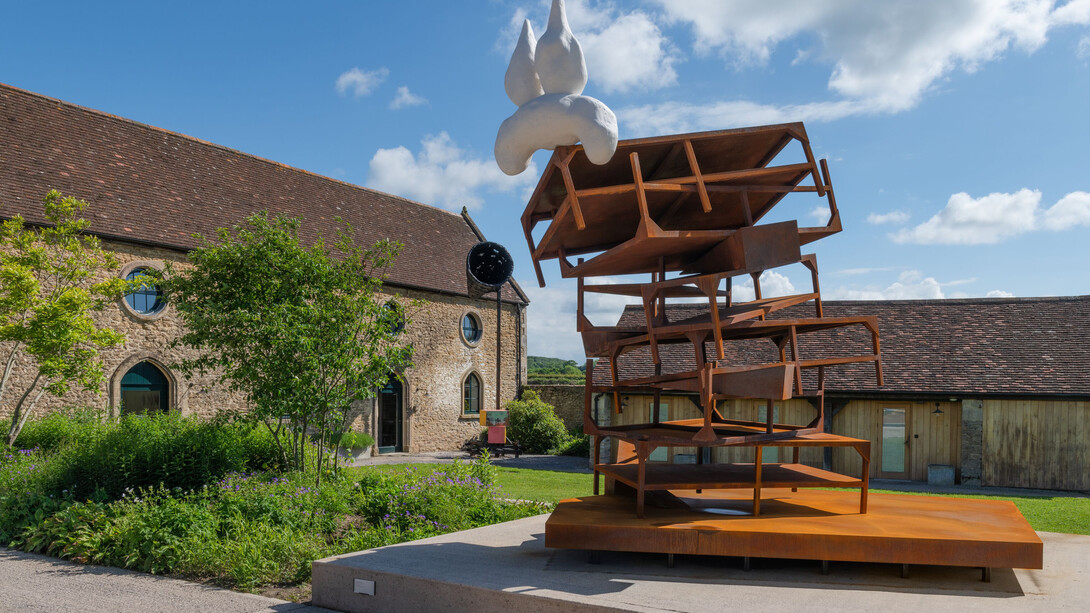
The pairing of exhibitions by Phyllida Barlow and Daisy Parris at Wolterton Hall offers an ambitious attempt to place two very different artistic sensibilities into dialogue with one of England's most assured Palladian country houses. Presented under the titles 'Disruptor' and 'Fist Full of Dreams', respectively, the exhibitions occupy different physical and conceptual territories within the house, yet both seek to establish a productive friction between contemporary making practice and inherited architectural authority.
Barlow's exhibition, Disruptor, brings together more than seventy works spanning five decades. Throughout her career Barlow occupied a singular position within British sculpture. As much an influential teacher as an exhibiting artist, her long tenure at the Slade School of Fine Art shaped generations of younger practitioners. Her reputation rested not simply upon the objects she produced but upon a pedagogical commitment to experimentation, risk and material honesty. Her sculptures consistently rejected notions of finish, permanence and monumentality. Constructed from plywood, plaster, scrim, cement, cardboard and tape, they foregrounded process rather than resolution; they appear provisional, unstable and often deliberately awkward.
Within the context of Wolterton, however, the exhibition raises questions that the title itself cannot entirely resolve. Much has been made of the notion of disruption in recent years to the extent that for some this has now become a ‘no-go’ word or shorthand for a myriad of sins/achievements in an expanded entrepreneurial field. Here, one is compelled to ask precisely what is being disrupted. The curatorial framing proposes a confrontation between Barlow's anti-monumental sculptural propositions and the architectural certainty of the eighteenth-century house. On paper, this opposition should generate productive tension; in practice, the relationship proves more ambiguous.
Barlow’s interventions undoubtedly create moments of visual collision. The artist’s clunky accumulations, exposed joins and rough surfaces abrade against marble, plasterwork and carefully proportioned interiors. Yet the house itself remains overwhelmingly dominant. Rather than destabilising Wolterton's authority, many of the sculptures seem absorbed or exposed by it at a level of craft. Their deliberately temporary and unfinished character can sometimes appear diminished by the grandeur of surroundings, but then the world of curation on this scale often does produce unintended consequences. The works retain integrity, but their very provisionality becomes aestheticised, perhaps even neutralised, by the setting.
This is not a failure of Barlow's work so much as a demonstration of its intentional vulnerability. Unlike much modern sculpture, it is not presenting the monumentalised magnum opus that cows its audience with sheer materiality, scale or spectacle. Rather, Barlow’s sculptures depend upon an entirely human encounter with manual contingency and instability. Wolterton, by contrast, communicates endurance, wealth and permanence.
There is, however, at least one notable exception: The large external work, positioned within the landscape, finally achieves the disruptive force promised by the exhibition's title. Outside, liberated from the constrictions of the interior, Barlow's language of imbalance and interruption can engage directly with the estate's formal vistas. Here the work punctures the landscape rather than decorating it. The encounter feels less like an insertion and more like a challenge. For once, disruption genuinely occurs.
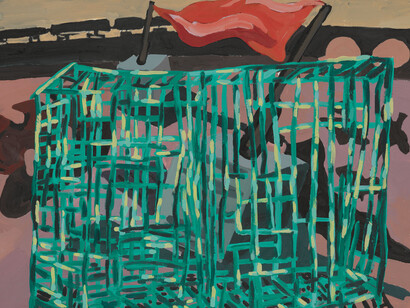
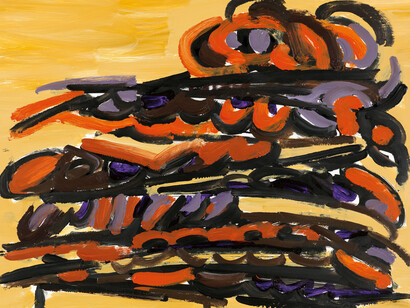
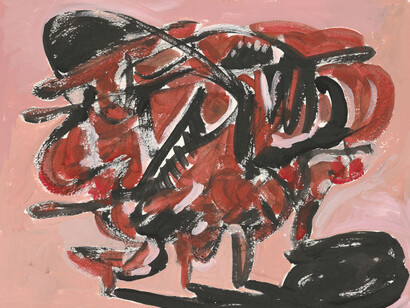
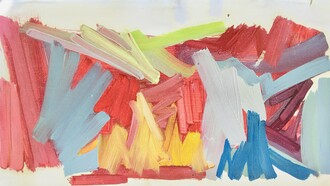
If Barlow's exhibition prompts questions about the efficacy of contemporary intervention within historic settings, Daisy Parris's Fist Full of Dreams operates according to a different emotional and aesthetic register altogether. Parris emerges as a thoughtful and intelligent maker whose practice combines painting, poetry and textile work with considerable sensitivity. Their paintings possess an immediacy that is both expressive and psychologically charged. Thick surfaces, gestural marks and fragmented textual interventions offer works that oscillate between confession and abstraction by turns, fugitive and mercurial.
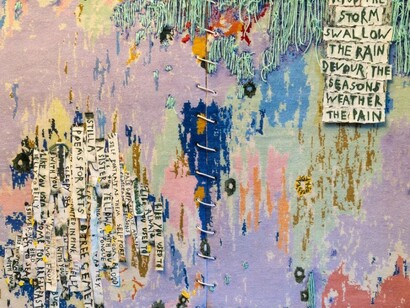
Particularly striking are the poetic elements embedded within the paintings. The fractured texts resemble cut-up compositions, evoking comparisons with the techniques of William S. Burroughs or even the unsettling visual language of anonymous ransom notes assembled from disparate fragments. Language appears simultaneously revealed and obscured. Meaning emerges in flashes before dissolving again into painterly gesture, and instability generates much of the work's emotional force and is strangely endearing.
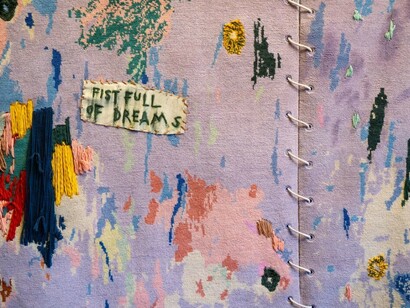
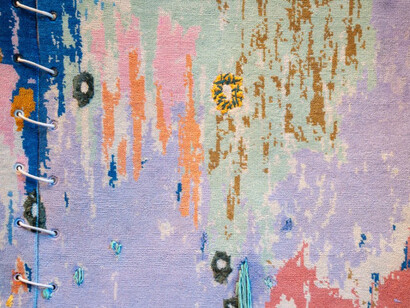
Parris's greatest achievement within the exhibition is undoubtedly the large-scale tapestry installation. As an object, it possesses remarkable visual and tactile presence. The translation of the artist's gestural vocabulary into textile form creates a compelling tension between spontaneity and labour. The woven surface accumulates meaning through texture, scale and material density. It becomes the emotional centre of the exhibition.
Yet even here certain complications emerge. For me, the decision to present the tapestry upon a scaffolding structure proves aesthetically and conceptually problematic. The support system introduces an unnecessarily heavy-handed industrial vocabulary that distracts from the subtlety and power of the textile itself; rather than enhancing the work's physical presence, the scaffolding tends to flatten it.
More significantly, the work introduces a series of ethical and conceptual tensions; the tapestry was produced over an eighteen-month period by artisans in India before being further worked by the artist. This collaborative process inevitably complicates the emotional and political content expressed through the textual components of the piece. The work speaks of vulnerability, intimacy and personal experience, yet its production seems to depend upon a global network of skilled labour that remains partially obscured within the gallery context.
This is not necessarily a criticism, but it does generate a productive discomfort and a somewhat pointy ethical moment for the reader. Viewers are invited to consider questions of authorship, labour, craft and cultural translation alongside the work's emotional content. Indeed, there is more than one form of discomfort operating throughout Fist Full of Dreams. Unlike Barlow's material confrontations, Parris's work unsettles psychologically. The paintings and poems expose emotional states without offering easy resolution; they invite empathy while simultaneously resisting sentimentality, with the resulting experience being nuanced and often affecting.
Together, the exhibitions reveal two distinct approaches to contemporary artistic practice. Barlow's work remains rooted in material experimentation and sculptural hands-on making; Parris's practice explores emotional vulnerability through an expanded language of painting, text and textile production, and while the dialogue between the two exhibitions is not always fully realised, each offers valuable insights into distinctly different generations of (very) British art-making.
Ultimately, visitors may find themselves disagreeing with aspects of both presentations. The rhetoric of disruption occasionally exceeds what is actually achieved, and some curatorial decisions invite legitimate scrutiny. Nevertheless, these tensions are precisely what make the exhibitions worth seeing. Neither show seeks easy consensus. Both encourage viewers to think critically about materiality, labour, architecture, emotion and artistic process.
For that reason alone, a visit to Wolterton is strongly recommended; the exhibitions are ambitious in ways that provoke reflection, the setting is magnificent, and the conversations generated by their encounter are likely to linger long after one leaves the house.