English
 Español
 Français
 Deutsch
 Italiano
 Português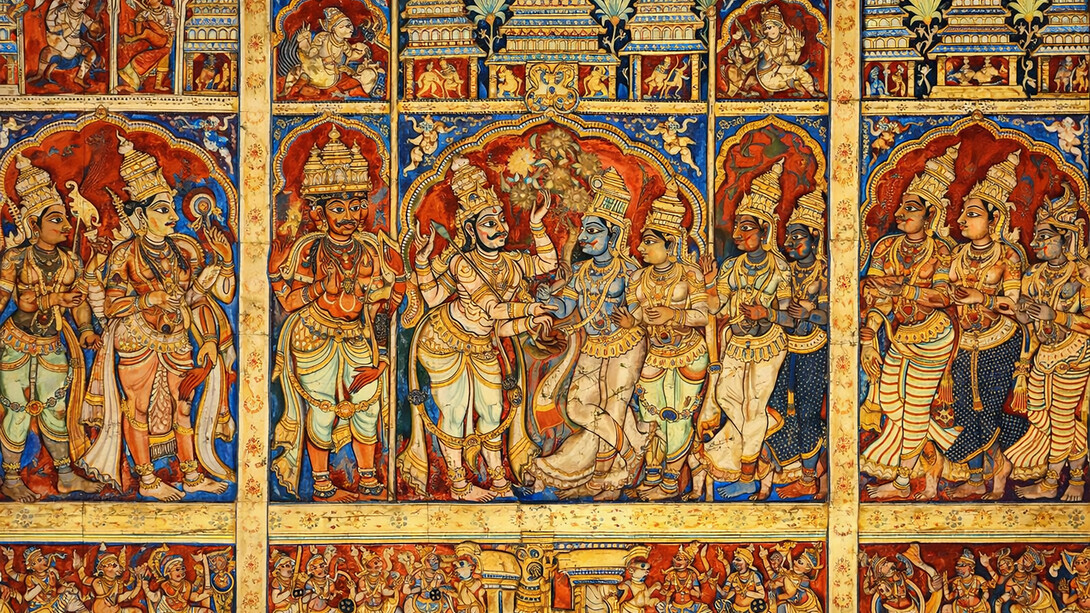
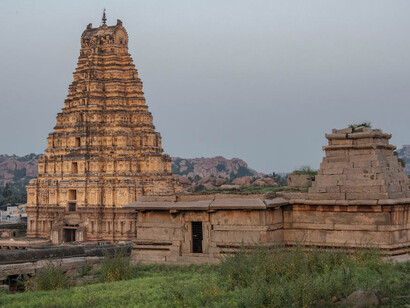
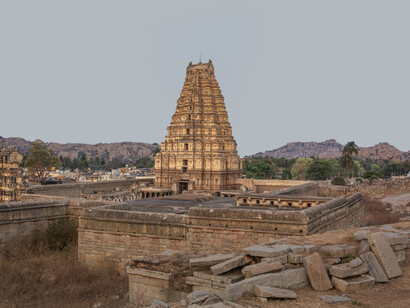
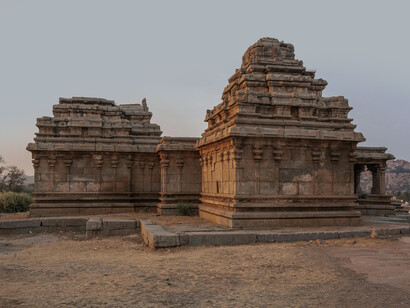
The Virupaksha Temple in Hampi1, part of the UNESCO World Heritage Site, is celebrated for its towering gopuram and intricate stone architecture. But most visitors miss something equally remarkable: rare ceiling murals from the Vijayanagara Empire.
These 16th-century paintings, hidden on the temple's ceilings, represent one of the few surviving examples of South Indian mural art from this period. When I visited the Virupaksha Temple murals in February 2026, I found them tucked away in dim light, largely ignored by the crowd below.
For anyone interested in Indian art history or the cultural legacy of Hampi, these paintings offer an irreplaceable window into Vijayanagara artistic traditions.
Overview of the Virupaksha Temple ceiling paintings
The most significant murals at Virupaksha Temple2 are located on the ceiling of the Ranga Mandapa, a central pillared hall constructed during the reign of Krishnadevaraya in the 16th century.
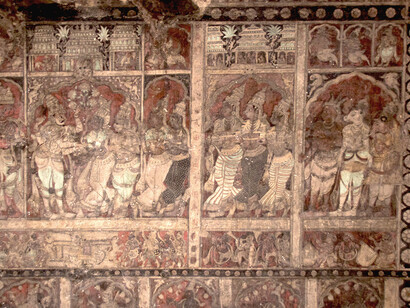
These Hampi ceiling paintings are among the few surviving examples of 16th-century Vijayanagara mural art, making them critical for understanding the empire's visual culture. Unlike the more widely known frescoes at Ajanta or Lepakshi, the Virupaksha murals use a more limited color palette but deliver rich narrative detail.
Each panel is positioned to guide viewers through interconnected themes—from divine legends to earthly kingship. What struck me most was the layered symbolism. These decorations communicated religious authority and imperial legitimacy to everyone who entered.
Key themes and mythological narratives
The Virupaksha Temple murals are carefully selected narratives that communicate both religious doctrine and imperial identity. The ceiling paintings focus on four major themes: divine weddings, Vishnu's incarnations, epic battles, and historical processions. Each theme served a specific purpose for 16th-century devotees and continues to offer insight into Vijayanagara cultural priorities today. (There are more.)
The divine wedding: Girija Kalyana (Shiva and Parvati)
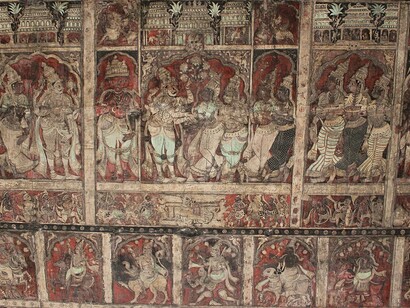
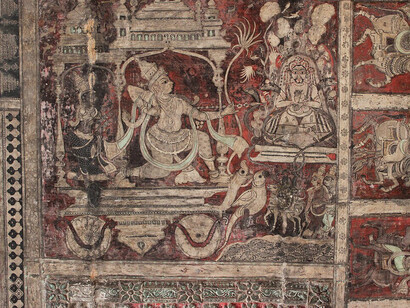
The Girija Kalyana mural in Virupaksha depicts the celestial marriage of Lord Shiva and Goddess Parvati, one of the most elaborate panels in the Ranga Mandapa. The paintings have faded due to exposure to centuries of smoke damage and fading pigments. Thanks to my guide during my visit in February 2026, whose sharp pen torch outlined the various characters of the story. I wouldn’t have deciphered them clearly on my own.
What makes this mural distinctive is the inclusion of Manmatha (the god of love) riding a parrot-drawn chariot—a playful detail that symbolizes desire and divine romance. The scene reinforces the temple's identity as a sacred space celebrating cosmic balance and marital harmony. Try to spot on your own if you are there.
The Dashavatara: ten incarnations of Vishnu
A series of panels illustrates Vishnu's ten incarnations (Dashavatara), from Matsya (the fish) to Kalki (the future warrior who hasn't yet appeared). Each avatar is shown mid-action—Varaha lifting the earth, Narasimha slaying the demon Hiranyakashipu—reinforcing the theme of divine intervention to restore cosmic order.
These panels functioned as visual theology, teaching devotees about Vishnu's protective role across different cosmic ages.
Epic battles: Arjuna and the Matsya Yantra
One rarely discussed panel depicts Arjuna retrieving weapons using the Matsya Yantra (fish device) during a pivotal Mahabharata episode. The scene captures an archery contest with warriors, spectators, and flying arrows arranged in a dynamic composition. Nearby, a three-headed Nandi appears as a divine guardian, connecting the epic narrative to Shiva's presence.
This theme reflects the Vijayanagara Empire's self-identification with dharmic warfare and righteous kingship.
Historical realism: the procession of Saint Vidyaranya
Unlike the mythological scenes, one mural depicts an actual historical event: the Vidyaranya procession mural's significance lies in its documentation of the sage who spiritually guided Harihara and Bukka, the empire's founders. The panel shows kings, courtiers, musicians, and attendants in ceremonial order, processing toward a sacred destination.
This mural is politically charged. By placing Vidyaranya on the temple ceiling alongside gods and epic heroes, the Vijayanagara rulers claimed divine sanction for their empire. The painting treats the empire's founding as a sacred event.
For modern viewers, it's a rare example of 16th-century Indian art recording real historical figures with the same reverence given to deities.
Artistic style and technical mastery
The Virupaksha Temple murals belong to the Vijayanagara School of Painting, a tradition that prioritized narrative clarity and devotional impact over realistic representation. Understanding these Vijayanagara-style painting characteristics helps explain why the figures look the way they do—and why they've survived for over 500 years.
Technically, artists applied natural pigments to a soft lime plaster base prepared on the ceiling surface. The color palette relies on mineral and plant-based sources: ochre from iron oxide, madder red from plant roots, and lamp black from soot. Again, thanks to the temple guide, I understood the origin of the colors.
Compositionally, the murals use horizontal registers that guide viewers through sequential narratives from left to right. Bold black outlines ensure visibility from the floor of the Ranga Mandapa, roughly 20 feet below.
These techniques reflect a deliberate artistic philosophy: the murals were meant for the entire community of devotees, not just scholarly elites. The Virupaksha ceiling paintings achieve this balance between artistic sophistication and accessible storytelling, making them exceptional examples of functional temple art.
Visitor tips: Hhw to see the murals
The Virupaksha Temple murals are located on the ceiling of the Ranga Mandapa. There is no lamp to light up the ceiling, making them challenging to view properly. When I visited in February 2026, I found the interior lighting inadequate for ceiling observation—many visitors walked through without ever looking up.
The temple allows photography without flash. Visit early morning (7-9 AM) when crowds are lighter and you can stand still beneath the panels.
Hiring a local guide costs ₹300-500 and is worthwhile—they'll point out specific details like the parrot chariot in the Girija Kalyana panel or the three-headed Nandi that are nearly impossible to spot on your own.
References
1 Group of Monuments at Hampi.
2 Virupaksha Temple Hampi: Architecture and Mysteries (2026 Edition).