English
 Español
 Français
 Deutsch
 Italiano
 Português
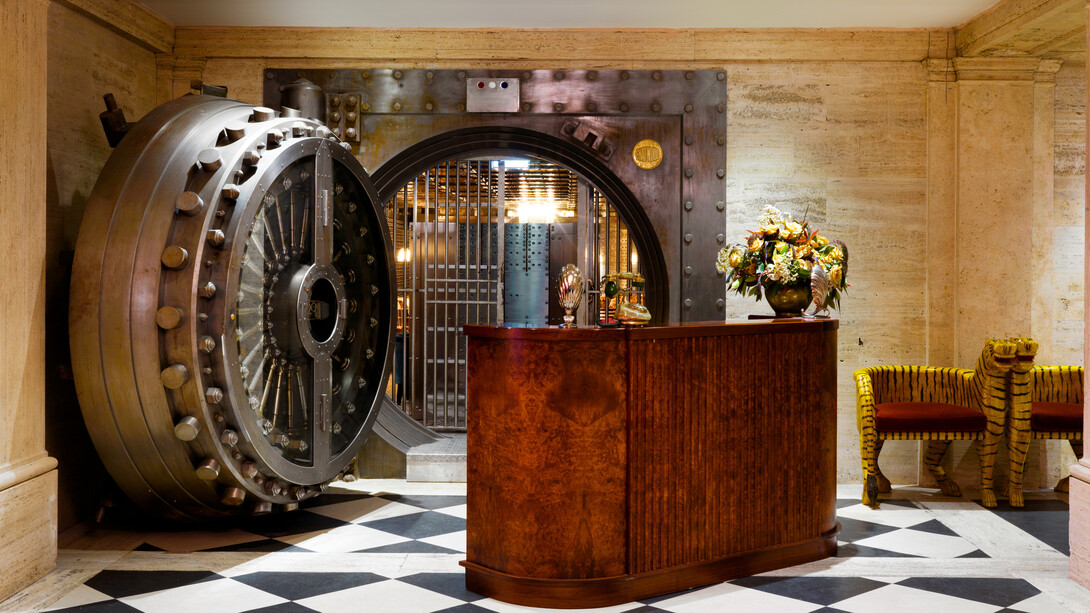
An overnight stay in the former Midland Bank headquarters reveals a different side of the capital, where banking history, American-style glamour, and the unfamiliar streets of the city come together.
Of all the capital cities I visit, London is probably the one whose hotels I know least. Living within easy reach of the capital, I rarely have reason to stay overnight. When I do, my usual choice is Dean Street Townhouse in Soho, part of the Soho House group. I know the bedrooms, the restaurant, and the neighbourhood. It is familiar territory.
On a particular Saturday in October, however, the Townhouse was fully booked. We were attending a late-night party in Islington and wanted somewhere to stay rather than face the journey home afterwards. The Ned, which could also be booked through the Soho House website, seemed an interesting alternative.
I knew the building, or at least its reputation, but had never stayed there. I was also curious about its relationship with Soho House, which is rather more complicated than the booking arrangement might suggest.
The Ned was conceived by Soho House founder Nick Jones in partnership with the American hospitality company Sydell Group. Today, the two businesses remain closely connected through their ownership, but they operate as separate clubs. Membership of Soho House does not provide access to Ned’s Club, nor does membership of The Ned give you access to Soho House.
As I discovered, there are nevertheless aspects of the experience that feel very familiar.
From banking to hospitality
The Ned occupies the former headquarters of Midland Bank at 27 Poultry,1 close to the Bank of England. It is a remarkable building, designed by Sir Edwin Lutyens, one of Britain’s most distinguished architects, whose work includes the Cenotaph in Whitehall and considerable contributions to the design of New Delhi.
Commissioned in 1924, the bank’s headquarters was completed in stages, with Lutyens returning to extend the building during the nineteen-thirties. It was intended to express the power, confidence, and permanence of one of the world’s largest financial institutions.
The building takes its present name from Lutyens himself, known to his friends as Ned.
Following Midland Bank’s acquisition by HSBC in 1992, the headquarters eventually became redundant. Its conversion into a hotel and private members’ club, which opened in 2017, preserved much of the original architecture, including the extraordinary banking hall.
This is the first thing that distinguishes The Ned from almost every other Soho House-related property.
The scale is immense. A great expanse of floor is punctuated by 92 green verdite columns, beneath a high ceiling that allows daylight into what was once the centre of the bank’s operations. Original walnut banking counters remain, but the business of finance has been replaced by restaurants, bars, and places to meet.
It is an unusual arrangement, with several restaurants occupying different parts of the same enormous room. You can move from Italian cooking at Cecconi’s to the American diner-inspired Electric Bar & Diner, or to Millie’s Lounge for something more traditionally British.
Rather than dividing the hall into smaller rooms, the designers have allowed its original scale to remain apparent.
The effect is part grand European railway terminus, part New York hotel lobby. There is an almost cinematic quality to it, particularly when viewed from the entrance.
It is difficult to imagine a less conventional setting for a hotel reception.
Upstairs, a familiar world
The bedrooms belong to a different aesthetic.
Where the banking hall is monumental and distinctly British, the rooms have something of the atmosphere of a nineteen-thirties Manhattan hotel. Dark polished wood, patterned fabrics, carefully chosen furniture, and generous bathrooms recall an age when hotel rooms were designed for extended stays rather than the efficient accommodation of overnight guests.
They also feel unmistakably connected to the Soho House style.
Our bedroom overlooked one of the building’s internal courtyards. There was very little to see beyond the opposite windows, and anyone hoping for a London panorama might have been disappointed.
In practice, I found the arrangement rather appealing. The room was exceptionally peaceful throughout our stay. Despite being in the heart of the city, there was little sense of the activity taking place beyond the building.
Some of the most successful details were also the smallest.
The bathroom was stocked with bath gels and shampoos carrying the Soho Farmhouse name, a familiar reminder of the wider Soho House world. There was also an attractive little collection of travel essentials, including moisturiser, toothpaste, a toothbrush, and a razor.
I have always appreciated this aspect of Soho House hotels. They seem to understand that even the most organised traveller occasionally forgets something, and there is something particularly pleasing about finding everything you might need already waiting in the room.
It is a small gesture, but a generous one.
Breakfast above the city
The rooftop is another reason to visit The Ned, although access requires some explanation.
Ned’s Club Upstairs is principally reserved for members of Ned’s Club and their guests. Unlike the ordinary restaurants downstairs, it is not generally available simply because you have booked a hotel room or belong to Soho House.
We were fortunate to experience it during our stay.
Here, more than anywhere else in the building, the Soho House influence becomes obvious.
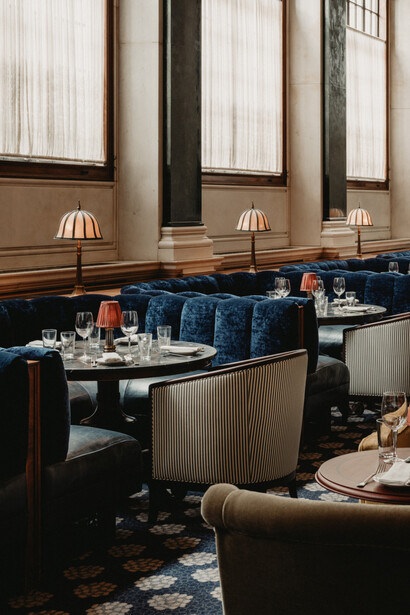
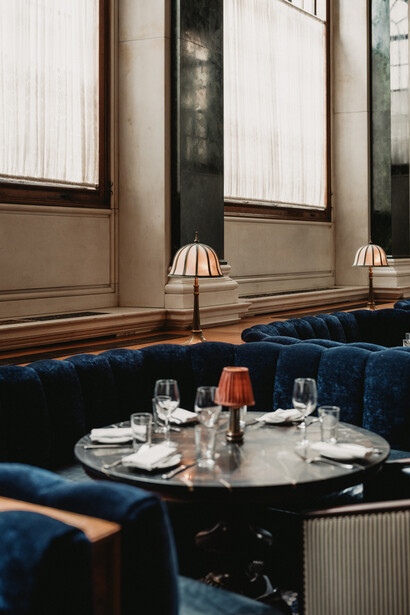
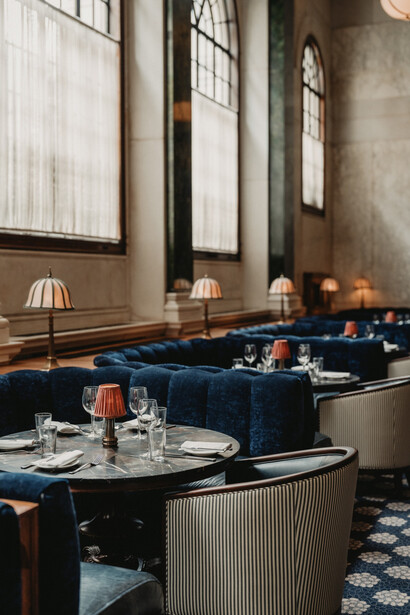
The furniture, fabrics, and relaxed arrangement of sofas and tables could belong to several of the group’s other properties. Even the outdoor swimming pool, with its distinctive proportions and familiar surrounding loungers, seems immediately recognisable.
The difference is the setting.
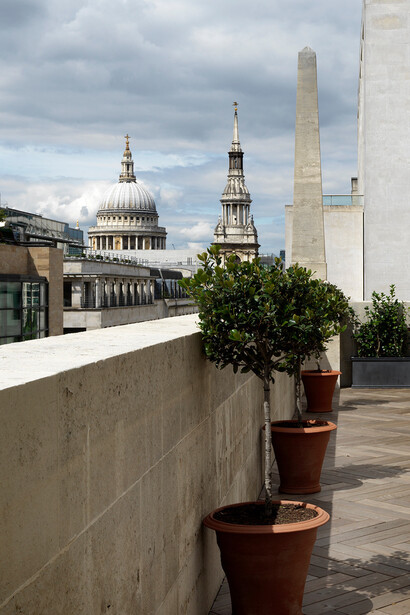
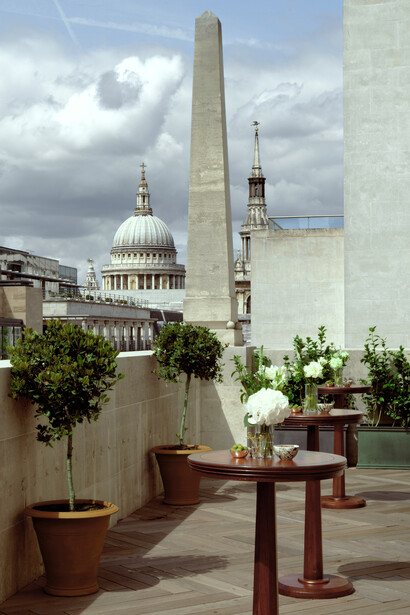
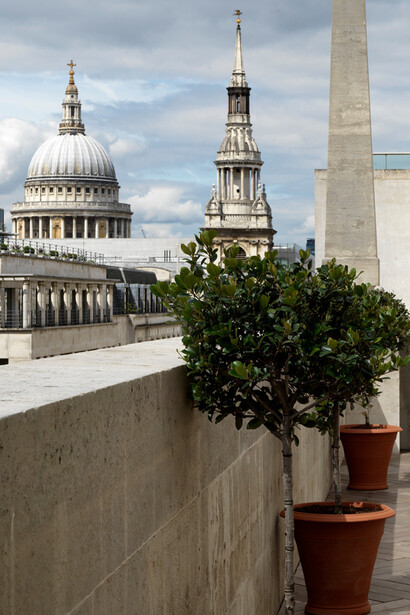
Instead of a country estate or a fashionable residential neighbourhood, you are surrounded by the rooftops, domes, and towers of the city of London. St Paul’s Cathedral appears above the surrounding buildings, offering a reminder of the architectural history of this part of the capital.
Breakfast was delicious and distinctly American in character. The menu offered familiar transatlantic favourites, including vanilla pancakes with bacon and maple syrup, eggs Benedict, and scrambled eggs with smoked salmon.
There is something appealing about this style of breakfast, particularly when it is served without ceremony in a comfortable room high above the financial district.
We returned on Sunday around midday to entertain friends for lunch.
The menu continues much the same international, slightly American approach, with oysters and tuna crudo alongside chopped salads, cheeseburgers, grilled fish, and lobster. There is sufficient variety to make it an easy place to invite friends, particularly when everyone has different ideas about what they want to eat.
What surprised me was how empty the rooftop felt over the weekend.
We had the luxury of space, a choice of tables, and an atmosphere very different from the crowded London restaurants I normally associate with Saturday and Sunday.
I suspect that during the working week the experience would be quite different.
The London I don’t know
One of the unexpected pleasures of staying at The Ned was discovering how unfamiliar I was with the surrounding streets.
I have lived in and around London for much of my life, and there are areas of the capital I know extremely well. Soho, Mayfair, Bloomsbury, Chelsea, and parts of the East End all have their own associations and memories.
But the streets around Bank, Poultry, and the Royal Exchange belong to another London.
Unless you work in the city, there is surprisingly little reason to spend time here. The great institutions of finance dominate the landscape, and much of the area has traditionally been organised around the working day.
At weekends, the character changes.
The pavements are relatively empty, the office buildings largely deserted, and the grand architectural statements of successive generations become easier to appreciate.
Walking around, I kept encountering buildings and streets I barely recognised.
Some had clearly been redeveloped or refurbished since I last spent any time here. Others may have been there for decades without my ever properly noticing them.
There was something curious about feeling like a visitor in a city I know so well.
The city has a particularly interesting architectural character. Medieval street patterns survive beside Victorian commercial buildings, imposing early 20th-century banks, and contemporary towers of glass and steel.
Unlike the more familiar parts of central London, where shops, restaurants, galleries, and residential life tend to overlap, this district has historically existed for a particular purpose.
That purpose is changing. Financial institutions still occupy much of the Square Mile, but hotels, restaurants, and cultural spaces are gradually introducing different reasons to visit.
The Ned is a particularly successful example of that transformation.
A building originally designed to keep the public at a respectful distance from the operations of high finance has become a place where people come to eat, sleep, meet friends, and enjoy themselves.
And it has achieved this without losing the extraordinary architecture that gave the building its authority in the first place.
A different reason to stay
I had booked The Ned for the most practical of reasons. We needed somewhere to sleep after a party, and our usual hotel was unavailable.
Instead, we discovered a hotel with a character entirely its own, a rooftop that recalled some of our favourite Soho Houses, and a part of London I had spent very little time exploring.
I would happily return, particularly at a weekend, when the city seems to belong to a different population.
Dean Street Townhouse remains a favourite. But The Ned has given me another reason to spend a night in London, and introduced me to a neighbourhood I had never really considered as a destination.
Sometimes the most interesting discoveries are surprisingly close to home.
Notes
1 27 Poultry on Google Maps.
Here is the website for the hotel: The Ned.