English
 Español
 Français
 Deutsch
 Italiano
 Português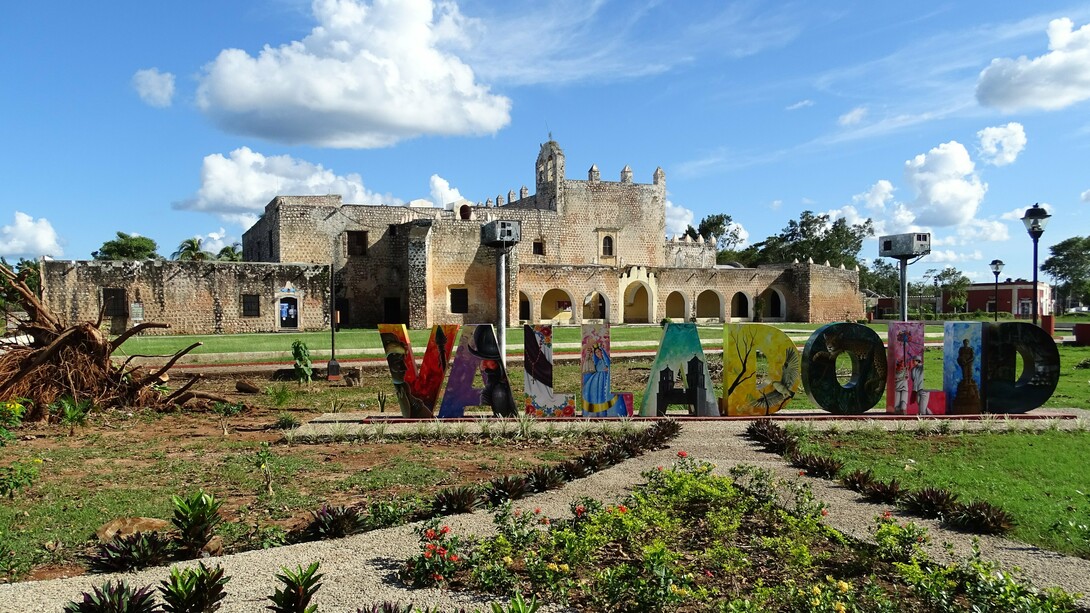
Winter months of 2025. As the virus of the season went around town wreaking havoc in Toronto, there was another contagion spreading faster and wider – the Cancun fever. Every single person I know was going there between February and April.
The lure of Cancun is understandable for any Canadian who needs a burst of sunshine and humidity to soothe the winter-weary soul. Destinations with a similar climate in the southern parts of the USA had drastically lost their appeal due to recent political developments. So, eager Canadian tourists were brushing up on their tourist Spanish: hola, gracias, caliente, por favor.
I added the phrase “comidas vegetariana?” to my vocabulary and booked my tickets.
But what was I going to do? An openly sun exposure-averse geek with a ravenous appetite for learning new things when I travel, the all-inclusive wasting-away-on-a-chaise-under-the sun-with-endless-cocktails is not my idea of a dream vacation.
The Yucatan Peninsula
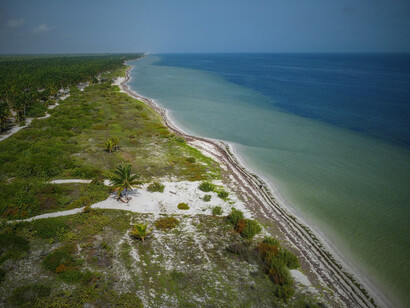
If geographical regions of the world were made into TV shows, the Yucatan peninsula would be a ratings raker. Starting from planet-shaking extinction events to prehistoric human societies, from awe-inspiring empire civilizations to the crushing colonization by European invaders – the YP has seen it all. Hidden under the foliage across the Quintana Roo, Yucatan, and Campeche provinces of Mexico, the nation of Belize, and northern Guatemala lies a web of rich history and pre-history that has attracted archaeologists, historians, and enthusiasts for centuries now.
Ruins and ruminations
The Yucatan Peninsula has been home to many civilizations that flourished and perished in the Americas - the Mayan civilization being one of the largest and best known to modern humans. There are Mayan ruins strewn all over the region, like scattered pages of a deeply personal diary that makes a stranger feel so familiar, far away in time but right ahead in eternity. If I could, I would live in Mexico for a year or two to collect all those pages and take in the joys and sorrows, gains and losses of the lifetimes of a people whose posterity continues to live in the folds of the forests whispering the secrets of their ancestors.
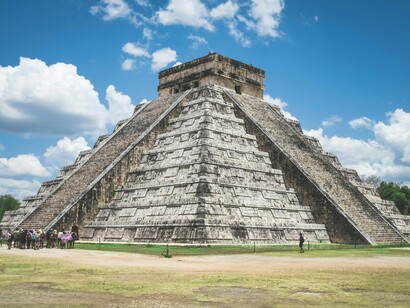
But I had to settle for a mere handful of them to fit into a 9-night trip of Quintana Roo and Yucatan: Ek Balam, Coba, and, of course, the mighty Chichen Itza.
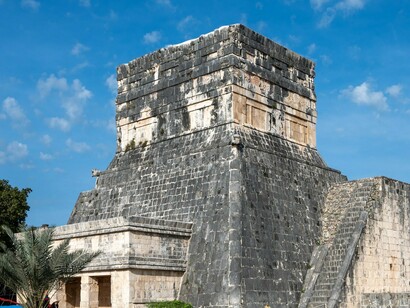
To best enjoy our time exploring the ruins at a pace that could accommodate rumination too, we stayed in the picturesque town of Valladolid for three nights instead of doing multiple day trips from Cancun that would have cost us several hours in car rides alone. On day one, we explored the magnificent Chichen Itza with its various structures and features that inspired awe and offered the comfort of familiarity. As someone who grew up in the southern part of India and visited ancient temple complexes every summer and term break, the concept of a massive spiritual gathering place with accommodations for weary travelers and grand stages for performances was only too recognizable. The delight of experiencing cultural affinity with a civilization so far away from the one I grew up in is insurmountable.
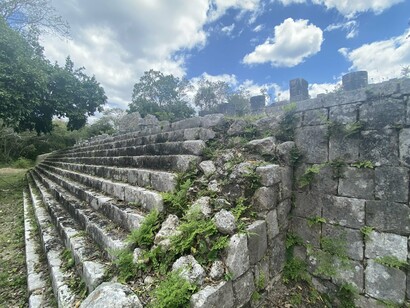
On day two, we visited the site of Ek Balam, a short drive north of Valladolid. In complete contrast to the scorching heat of Chichen Itza, Ek Balam could be explored in the cooling comfort of the forest canopy. With fewer touch-ups of our SPF 60 in requirement, we were able to stroll around the site and take in the remnants of the uptown life of an average Mayan as he/she/they walked those paths (‘sacbeob’) with purpose and climbed those steps with reverence. Imagination would have simply sufficed, but my travel companion was hell-bent on getting me to experience the Mayan mile in my very own shoes. So, after much deliberation and encouragement, I rolled my eyes, strapped on our Go-Pro, and began the (permitted) ascent of the Acropolis. My cramps and nausea were, however, rewarded with a beautiful view of the forest below as I admired the artwork outside ‘El Trono’ (the throne), where one of Ek Balam’s important rulers was buried.
It definitely got me thinking about the miracle of death and all the various ways in which different ancient civilizations have always celebrated it, seeing it as an ascension to a dimension beyond what we experience on the ground, versus the sorrowful ending of an industrial race to productivity that modern living observes.
On day three, we visited Coba en route to the Cancun leg of our trip. After the contrasting experiences of Chichen Itza and Ek Balam, both of which we undertook early in the morning, we adjusted our expectations to deal with the swarming crowds of the 10.00 AM tourist buses. All for naught. Coba is so massive, it absorbed the crowd of an average peak-season day and still had room left over for you to get lost in the woods. The truly enjoyable part of exploring the Coba site was having a local guide take us around on a tricycle with regaling anecdotes and perspectives of the modern-day Mayan. With a Hispanic first name and a Mayan last name, our guide impressively rode us around the wild terrain as he summarized the background of ‘stelae’ and ‘sacbeob’ in fluent English. He taught us about the ‘stelae’ - engraved/sculpted wooden/stone slabs - each of which highlighted the legacy of a Mesoamerican administrative officer.
As we strolled past the stelae and out into the forest path, our guide stopped us to show and explain the ‘sacbeob’ (plural for ‘sacbe’), translating to mean elevated “white roads” – a network that connected various important sites for the Mayans (including the Chichen Itza among other faraway places) and enabled them to find their way in the dark. But what really stayed with us from the wilder and swampier Coba site was the grounded remarks of our guide who struck a fine balance between reverence for his ancestors and the lessons their rise and fall offer humanity today. We left Coba feeling more aware of the cosmic insignificance of our existence and the profound irrelevance of our social conditioning.
Thrilling cenotes
While the blues and greens of the landscape do look amazing in photographs, the Yucatan peninsula part of Mexico can be a scorching shock to bodies that have escaped minus twenty degrees (Celsius), give or take. Sunscreens and hats can only do so much when the average day weather is around 40 degrees (Celsius), and you are roaming about exploring archeological sites till noon. Without cenotes (aka sinkholes), we would have perished just as well as the Mesoamerican natives who crossed paths with the conquistadors. One of our AirBnb hosts graciously informed us that there are nearly six thousand cenotes in the YP and less than three hundred of them are open to tourists in the region. We are indeed very grateful for the galactic events that created these sinkholes, as their cool waters and eerie dimness (of the underwater cenotes) soothed our soft-boiled internal organs.
No extent of hydrophobia could ever prompt me to regret the cenote experiences of our trip. We made time to visit three underground cenotes and one overground cenote. Each one transported us to a different world altogether. Most underground cenotes were difficult to get to and mentally challenging for me because of my gripping fears around tight spaces and deep waters. Yet, it was a spiritually expansive moment sitting under incredible cave formations and staring out at a dark, velvety body of water sprinkled with humans in life jackets. I congratulated myself on bringing my heartbeat down to a steady 100 as I sat on the banks and took in the sound bath of echoing waters.
A riotously colorful town
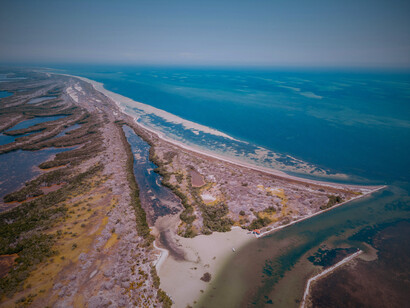
Despite the attractions that lured us out of our comfortable accommodations in Valladolid – be it Rio Lagartos with its flamingo-engraved homes, or Las Coloradas with its sparkling pink waters or even Calotmul as a delightful pitstop – driving back into Valladolid was always just as alluring. A postcard town that serves as a half-hour stop on popular day trip packages from Cancun to Chichen Itza, Valladolid deserves a lot more of your time. We were lucky to check in on the weekend preceding Ash Wednesday and were greeted by a joyous carnival at the town square. Every meal we had in Valladolid was a festival of flavors that equally catered to both my vegetarian diet and my husband’s carnivorous one. A daytime drive past its narrow, cobbled, and numbered streets was like gliding through a gallery of houses in myriad colors.
The streets were decorated with rainbow streamers and vintage automobiles, especially the old-time Fiat 500s, which seemed to be the jewelry of choice for Lady Valladolid. We spent glorious hours doing nothing in the courtyard pool of our Airbnb Casa Moore - a gorgeous yellow Spanish colonial villa. Every single minute, frame, meal, and walk through the town was a delicious feast for the senses. To see home-like colors after spending the best part of a decade living in pastel town, the hues of Yucatan, Mexico, were life-affirming to our Canadian eyes. And I cannot wait to take in more of it next time.