English
 Español
 Français
 Deutsch
 Italiano
 Português
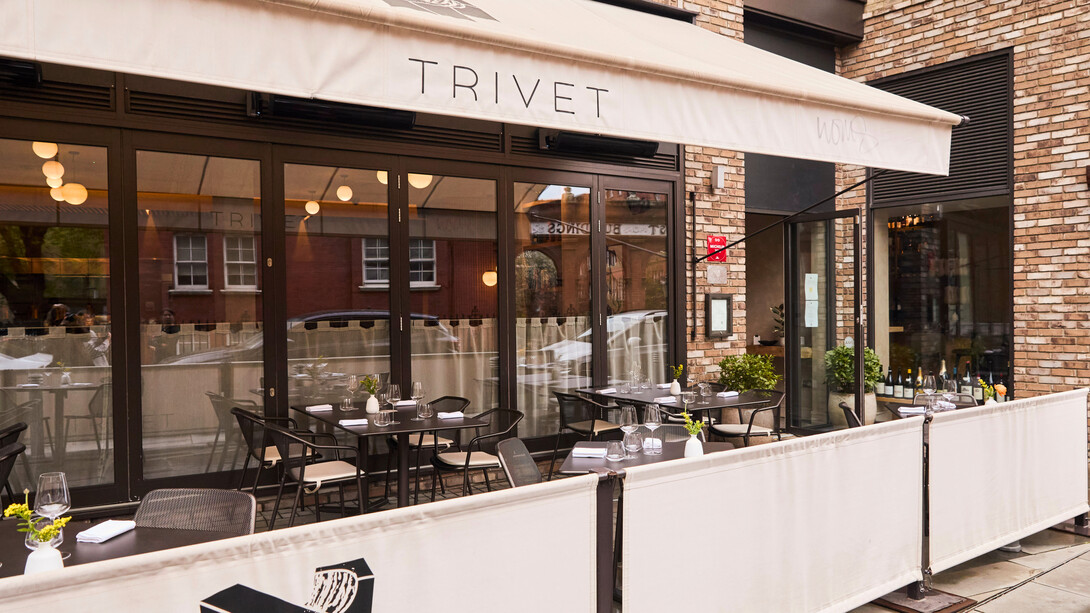
There is a particular kind of London neighbourhood that exists mainly as a place people pass through on their way elsewhere, and Snowsfields, tucked into the tangle of streets behind London Bridge station, has long been one of them. For centuries, this was Bermondsey's working edge, with tanneries and hop warehouses, then hospitals and rail arches—the kind of area whose chief civic function was to absorb the overflow of a grander city next door.
Guy's Hospital looms over one end of it, a concrete-and-glass reminder that this is a place of transit and repair rather than leisure. Borough Market, a few streets off, sells the idea of gastronomic London to tourists in paper cones. London Bridge station itself, rebuilt at vast expense over the past decade, funnels some 50 million commuters a year through a concourse that resembles an airport more than a railway terminus. The Shard punctures the sky above all of it, a glass exclamation point on a neighbourhood that has spent the last 15 years trying to decide what it wants to be when the trains stop running. It is not, by any reasonable accounting, where one expects to find a restaurant with two Michelin stars.
I had wanted to go to Trivet for some time. This is partly because everyone I trusted on the subject of food kept mentioning it with the slightly proprietary tone people use for a restaurant they feel they discovered. It was also partly because I was curious about what happens to a chef once he is finally permitted to stop cooking someone else's ideas. Jonny Lake spent the better part of two decades at the elbow of Heston Blumenthal, first at the Fat Duck and later as head chef, steering the ship in an extended and highly public apprenticeship in culinary theatre. The natural assumption is that a chef who emerges from that world will bring the theatre with him—the liquid nitrogen, the dry ice, the 15-minute preambles about the provenance of a single scallop. Trivet does none of this, and the absence is, in its way, the whole point.
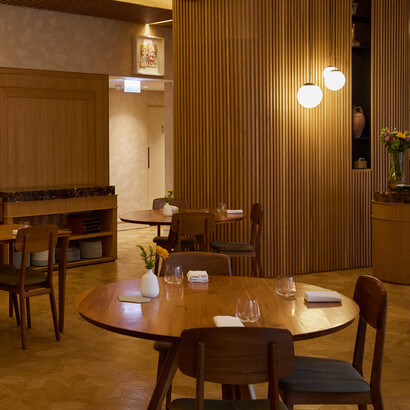
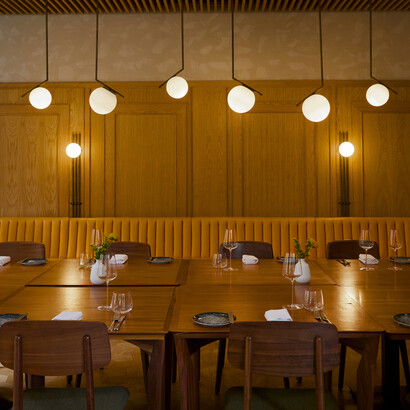
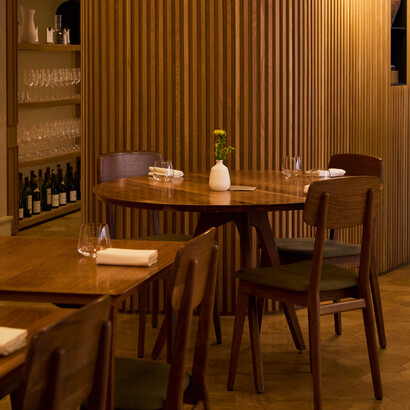
The room itself gives little away. It is cool and handsomely understated, more like a well-appointed private members' club than a shrine to gastronomy, and it manages the difficult trick of signalling its seriousness without insisting on it. Nobody hovers. Nobody performs. The service—and this deserves saying plainly, because it is rarer than it should be at this level—has the unhurried confidence of people who know exactly what they are doing and see no need to make a show of it. Someone appears the moment you want something and vanishes the moment you don't, which is either an extraordinary feat of choreography or the result of a restaurant that has simply decided not to bother you.
Trivet was opened by Lake alongside Isa Bal, a sommelier of the sort other sommeliers speak of with a certain wariness, and the partnership is evident in almost everything that arrives at the table. At Trivet, food and wine are not two departments filing separate reports; they are in continuous conversation.
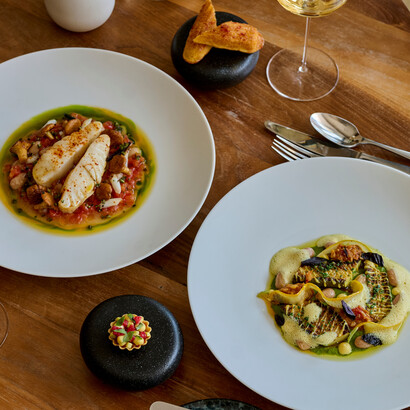
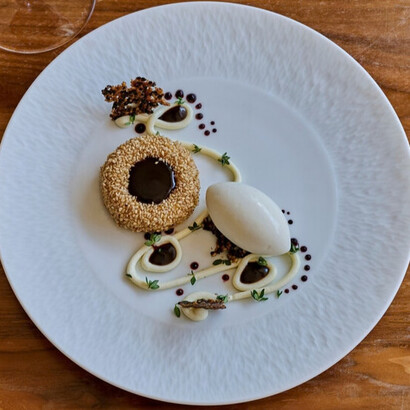
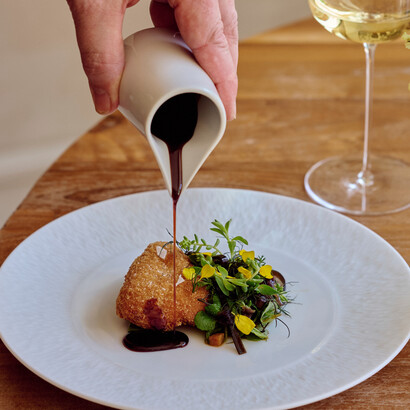
The wine list dispenses with the usual grand tour of France and Italy in favour of something closer to an argument about wine's own migrations; bottles from Georgia, Armenia, and Turkey sit where a more conventional list would put a second page of Burgundy. It is, among other things, a quietly polemical document, and it maps almost exactly onto what Lake is doing in the kitchen. Dishes draw on Mediterranean and Turkish traditions without ever collapsing into the kind of fusion cooking that treats a plate as a summit meeting between cuisines that have never met. The technique is considerable—you sense it in the margins of nearly everything—but it is never presented for inspection. You are not being asked to admire the cooking. You are simply asked to eat it and to want another bite.
What Lake has notably resisted is the temptation to turn two stars into an ordeal. Trivet still serves à la carte, an increasingly countercultural gesture in a landscape where the tasting menu has become the default liturgy of fine dining, complete with its own ritual of "just a few bites" that somehow add up to a four-hour commitment. There is something almost old-fashioned about being handed a menu and simply choosing your dinner, rather than surrendering the evening's narrative arc to someone else's 15-course thesis statement.
The restaurant's second life, Labombe by Trivet, opened at the COMO Metropolitan on Old Park Lane—a deliberate move in the opposite geographic direction, from Bermondsey's rail arches to the manicured hush of Mayfair. It is a looser, wine-forward sibling, Pan-Mediterranean in style, with Evan Moore running the kitchen alongside Lake and Bal. It earned its first Michelin star in 2026, a rapid turnaround for such a young restaurant, and one that suggests whatever Lake and Bal are doing together is not confined to a single postcode or a single register.
But it's Trivet's postcode, oddly, that I like. London Bridge has always been defined by what runs beneath and around it rather than by what sits still within it. The river, the railway, the endless churn of people moving from one side of the Thames to the other without much reason to linger. Southwark Cathedral keeps its counsel a few minutes' walk away, dwarfed now by glass towers that would have seemed like science fiction to those who built it. You can read Trivet's presence here as an accident of real estate, or as exactly right: doing serious work without asking anyone to notice how hard it's working.
I arrived with expectations shaped by reputation and Lake's résumé, and what surprised me most was how little effort the evening seemed to require of me, at any rate, and whatever effort was concealed in the kitchen. The cooking was intelligent without being self-congratulatory; the room was warm in a way that had nothing to do with lighting design. By the time I stepped back into the rush at London Bridge, I realised that was exactly why Trivet works. It gives you all the precision of serious dining without ever making dinner feel like work.
Two Michelin stars, no drama, and a very good reason to miss your train.
Notes
Here is the website for the restaurant: Trivet.