English
 Español
 Français
 Deutsch
 Italiano
 Português
Born in Rizziconi, Reggio Calabria, Saverio Ungheri (1926-2013) had settled in Rome at the end of 1947, while the artistic debate was focused on instances of alignment with the European avant-garde. Here, having obtained his diploma from the art high school, he enrolled in the Scenography course taught by Sante Monachesi at the Academy of Fine Arts.
This friendship with the Futurist master, combined with the suggestions drawn also from realities far from the capital (Spatialism in Milan), and from some figures of the Roman scene, such as Giulio Turcato, Alberto Burri, Ettore Colla, had favored that experimental approach that substantiates the most significant part of Ungheri’s experience, from the end of the 1950s until his death.
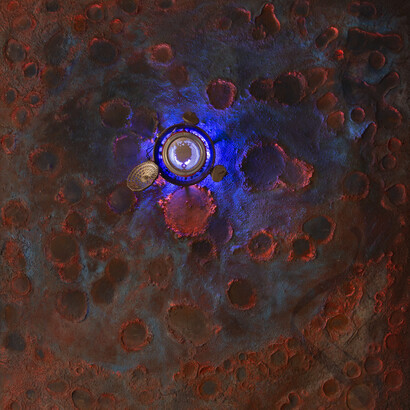
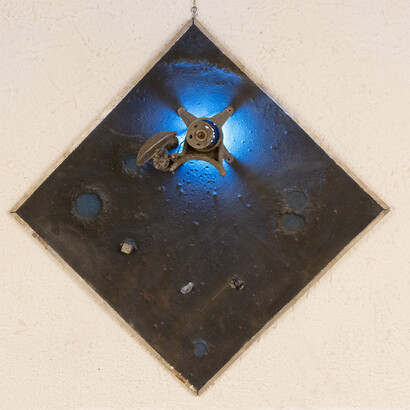
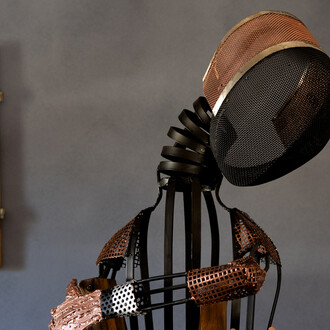
From 1959, in fact, the Calabrian artist, among the signatories, with Monachesi and others, of the founding manifesto of Astralism (inspired, in the same year, by the USSR’s lunar exploration program, Lunik), would initiate the most authentically personal line of investigation. A line that would also mark the passage from the two-dimensionality of the painting to a sculptural three-dimensionality characterized by a vaguely macabre and disturbing irony. The latter result was obtained through the assemblage of everyday objects, to which shaped parts in foam rubber would be added, imitating animals, fantastic creatures, and anatomical organs, not infrequently inserted inside shells, sacred pyxides, helmets, animated by electric motors.
These artifacts, which document the most original contribution of Ungheri’s activity — which also included commissioned works of sacred art — can cautiously be placed within the heterogeneous international macro-context of kinetic experimentation. A kineticism that, however, in the case under examination, seems to carve out its own area, without cohabitations. It is in fact evident already in the intentions, expressed in programmatic texts and interviews, as well as in the works, the distance separating Ungheri’s works from those of the contemporary Kinetic and Programmed Art that were becoming established between Europe and the American continent.
The “cold” kineticism — the result of pure planning that aspired to seriality, the democratization of the work, and the downsizing of the figure of the artist — could not find Ungheri’s approval. His was, in fact, a “warm” kineticism, in its own way prophetic and functional to the idea of vitality expressed by the movement of his creations, which, in a romantically delirious manner, aspired not to the erasure of the demiurge artist but to his substantial exaltation.
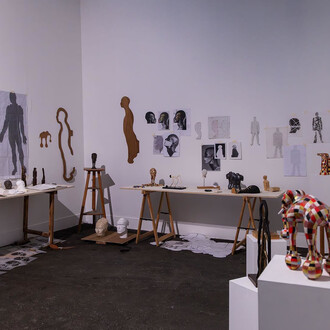
The exhibition, divided into sections presented in chronological succession, documents the various stages of Saverio Ungheri’s research, from his beginnings to Bionika Art, without excluding some commissioned projects of sacred art and the activity as a cultural animator carried out from the 1970s in the studios on Via Nomentana and, subsequently, Salita del Grillo (the studio called Polmone pulsante).