English
 Español
 Français
 Deutsch
 Italiano
 Português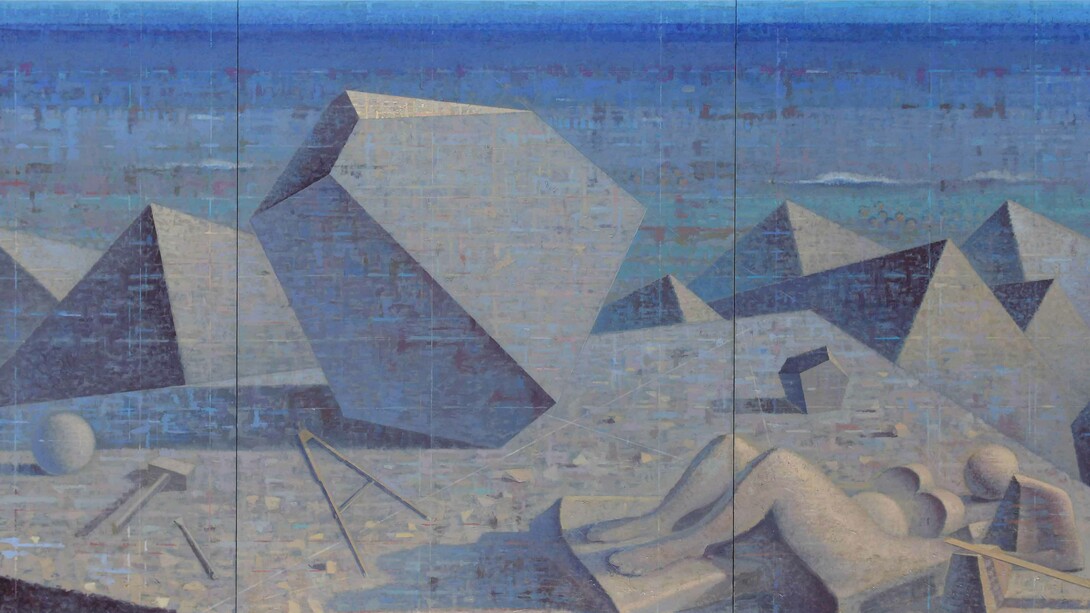
Giuseppe Modica is one of the most significant representatives of the New Metaphysics, as defined by Maurizio Fagiolo dell’Arco, an artist with a research activity of over fifty years and with a highly significant exhibition history in private galleries, museums, and public spaces in Italy and abroad.
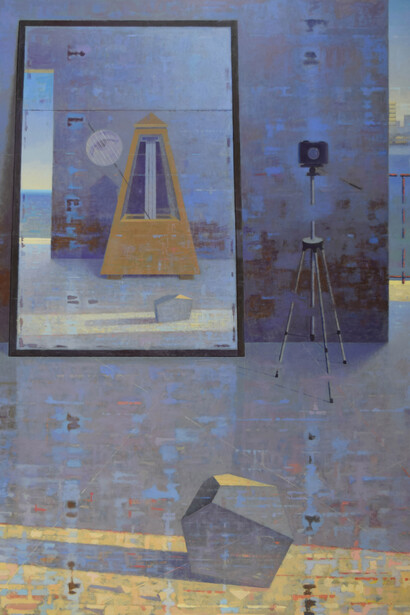
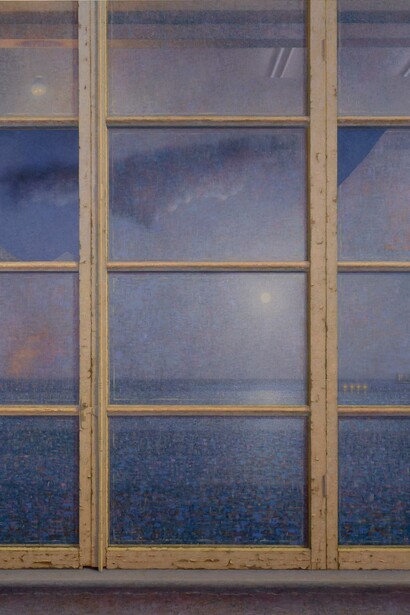
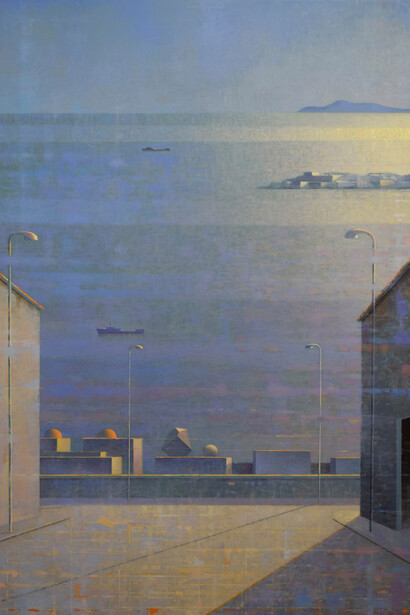
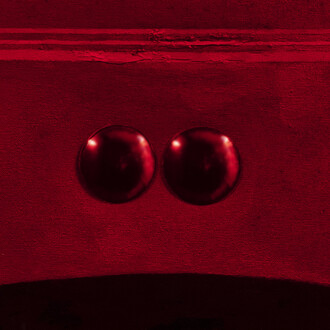
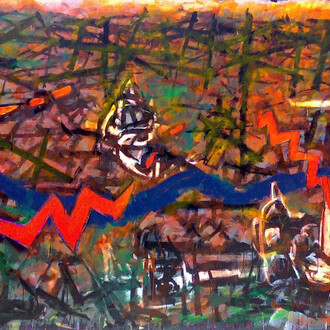
In the exhibition, forty large-scale works, created between 1997 and 2026, will be displayed. The exhibition is not retrospective, it is a traversal through Modica’s work. A journey into a painting on the borderline between presentation and representation, a painting that pursues light, geometry, rhythm, and harmony.
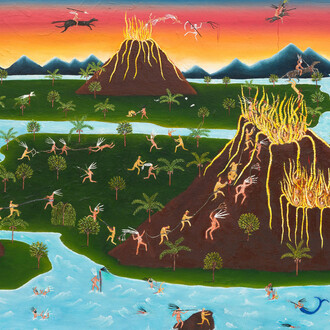
The title evokes Il fuoco nel mare, a Sicilian tale that Leonardo Sciascia published, in 1975, in a booklet for children, published by Emme Edizioni, with illustrations by Simone Sautier, and which gives its title to the posthumous collection Il fuoco nel mare. Racconti dispersi (1947-1975), published by Adelphi in 2010, a volume for which Roberto Calasso chose Giuseppe Modica’s Palatino (2007) as the emblem for the cover. Among its pages, the legend of Colapesce comes back to life: having descended into the depths of the abyss, he discovered that Sicily was supported by three columns, one of which, beneath Etna, was consumed by the fire of the volcano.
The paradox that brings together the two contrasting elements of fire and water is the same one that structures the dialectical relationship of antinomic elements in Modica’s painting: light and darkness, natural light and artificial light, dawn and sunset, inside and outside, surface and depth. The elements interpenetrate and each element gives strength to the other. Within this aporia, painting insinuates itself and its language is structured.
Il fuoco nel mare presents a selection of works that engage with various themes dear to the artist and that have as their common thread light in its broad articulation from daytime to nighttime, from natural to artificial; time, with its shifts and contaminations, which involves memory in its various meanings of individual, collective, and anthropological. A time also understood in the processual dimension of painting itself, which records the event in progress. And space, which is at the same time phenomenal and illusory and which involves the tactile dimension of surface and the elusive utopian dimension of depth.
A complex and antinomic painting, which reaches absolute simplification and synthesis through geometric and mathematical rigor. The works are linked by elements common to the subjects; there is no chronological order, but rather an internal affinity, a fil rouge that connects the works through the relationship between light and darkness, interior and exterior, fullness and emptiness, surface and depth.