English
 Español
 Français
 Deutsch
 Italiano
 Português
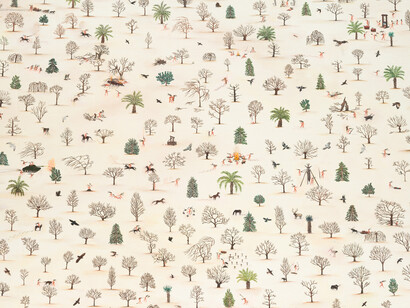
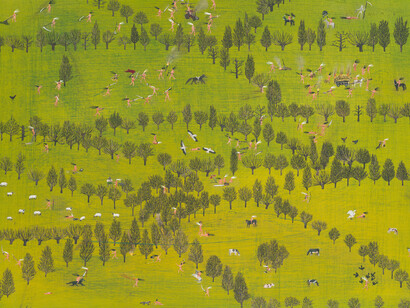
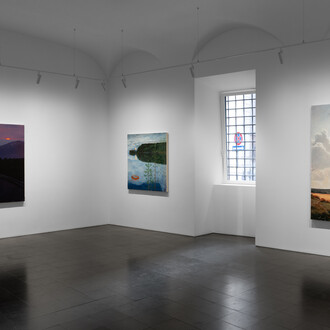
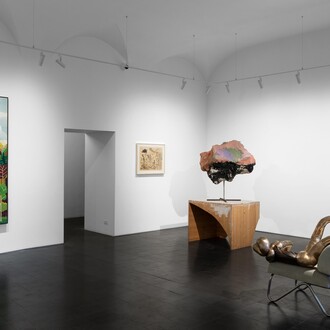
Tim Van Laere Gallery is pleased to present Under the shade of the Coolabah tree, the second solo exhibition by Eline Vansteenkiste. The exhibition builds on her previous solo show, in which Vansteenkiste unfolded her own Mappa mundi: a collection of landscapes from an imaginary, composite world. Whereas the viewer previously seemed to drift past these landscapes, the artist now invites us to move further inward. Vansteenkiste enters the landscapes between the trees, within the dark forest, and beneath the earth. The viewer is no longer positioned at a distance, but drawn into a terrain in which multiple events unfold. In works such as Landscape with holstein cow, the eye moves through the trees, encountering different scenes that continues beyond the boundaries of the canvas.
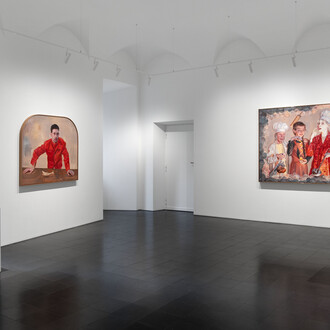
The exhibition’s title is drawn from Slim Dusty’s rendition of Waltzing Matilda, evoking a sense of wandering that runs throughout the paintings. Groups of women, solitary figures, and animals move through vast and shifting environments. Their destinations often remain unclear; what matters is the act of moving through the world and the unexpected encounters that occur along the way. Vansteenkiste does not begin with a fixed composition or predetermined narrative. Her paintings develop gradually, often beginning with the sustained act of painting trees. Images then enter from art history, books, films, newspaper articles, family photographs, memories, or chance encounters during a walk. These fragments are absorbed, transformed, and recombined until they become part of the artist’s own visual language. Greek mythology, historical painting, manuscripts, sculpture, cinema, literature, and personal experience coexist within this pictorial universe. Artists such as Patinir, Henri met de Bles, Bruegel, Goya, Hokusai, Géricault, and Caravaggio form part of its visual genealogy, alongside filmmakers including Andrei Tarkovsky and Werner Herzog. One particularly persistent presence in this series of works is Artemis, the Greek goddess of the hunt, animals, and the wilderness, whose associations with forests, movement, and the untamed world resonate throughout the exhibition.
Nature itself is central to these paintings, but Vansteenkiste’s relationship to it is far from idyllic. Walking through a forest can evoke both wonder and fear: trees become monumental presences, clouds gather, storms threaten, and unseen animals seem to inhabit the darkness beyond the path. At the same time, nature offers moments of extraordinary beauty: a bird, an animal, sunlight breaking through the canopy, or the changing colors of leaves and sky. The paintings inhabit this unstable territory, where admiration and anxiety continually coexist. Weather, light, and the passage of time have become increasingly important in this new body of work. A sudden gust of wind, shifting skies, changing seasons, and the transition from day to night animate the landscapes and introduce movement and uncertainty. This expanded sense of time is also informed by the Très riches heures du duc de Berry by the Limbourg brothers, whose detailed depictions of the months, seasons, weather, and human activity have been an important source of inspiration.
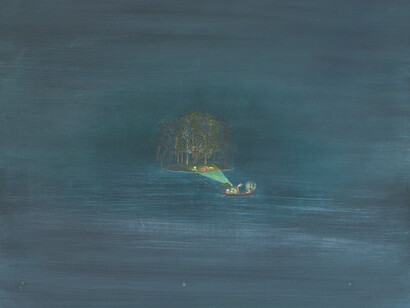
The structure of the paintings increasingly reflects the language of cinema. Some works are densely populated with simultaneous events, while others focus on a solitary figure or a single encounter. A Sudden gust of wind, in which a lone figure continues through the landscape with her horse, is one such concentrated moment. Animals - birds, cows, horses, and more elusive or imagined creatures - move through these landscapes alongside the human figures as companions, witnesses, threats, and mysterious presences. Light becomes another means of moving between revelation and concealment. In Selva oscura, Vansteenkiste draws on tenebrism, the dramatic use of light and darkness associated with Caravaggio. Parts of the scene emerge into illumination while the surrounding landscape remains obscured, reinforcing a central tension throughout the exhibition: the sense that every landscape contains something beyond what can immediately be seen.
Under the shade of the Coolabah tree presents a world in constant transformation. Landscapes grow over time, seasons shift, storms gather and pass, and figures continue onward without certainty about what lies ahead. Bringing together myth and memory, art history and personal experience, beauty and danger, Vansteenkiste invites the viewer not simply to observe the landscape from a distance, but to enter it and, somewhere between light and darkness, perhaps lose their way.