English
 Español
 Français
 Deutsch
 Italiano
 Português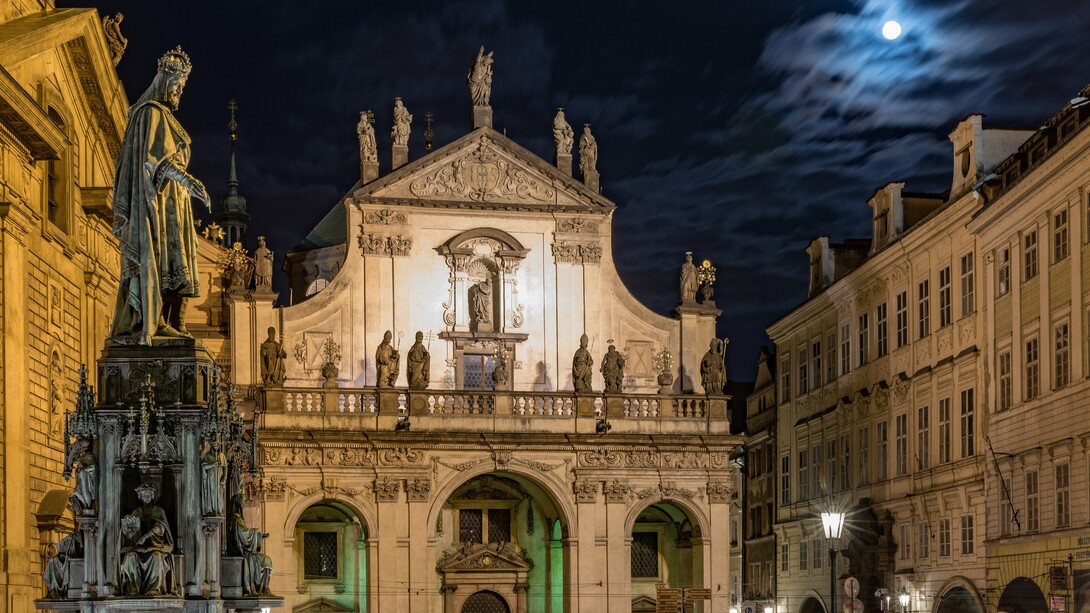
Prague has an extraordinary way of hiding its miracles where you least expect them. The city draws your attention with Gothic towers, moving clocks, and so many beautiful buildings that your camera can hardly keep up. Then, suddenly, you step through a simple door and find a whole new world.
That’s exactly how the Klementinum feels.
Before I visited, I had seen photos, but they made the place seem neat and orderly. The pictures show the gold and symmetry, but not the sense that the quiet books might start whispering once everyone is gone.
The Klementinum is close to Charles Bridge, right next to one of Prague’s busiest walkways. Outside, people weave through tour groups and try to get the perfect photo on their phones. Inside, everything gets extremely quiet; even your footsteps seem to quiet down.
People often say it’s Prague’s second-largest building complex after Prague Castle. That’s true, but it’s a bit like describing Mozart by how tall he was. Back then, people gathered books, debated theology, watched the stars, and used sunlight to tell the time.
What kind of place tries to understand God, time, and the universe all in the same building?
Inside the library
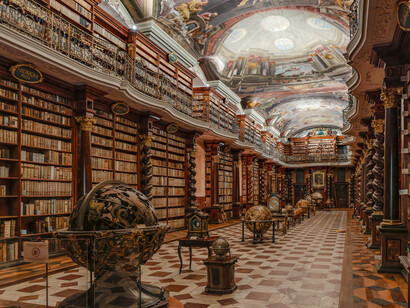
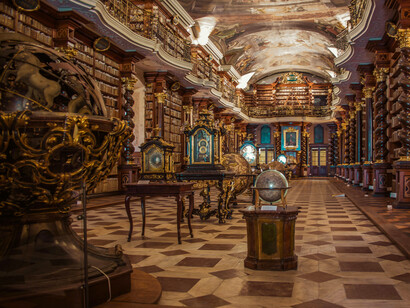
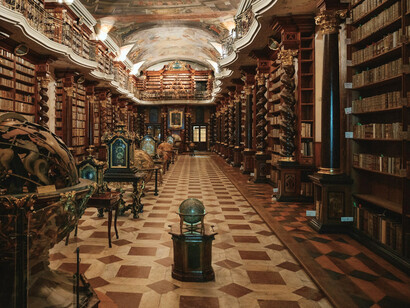
The first big surprise is the Baroque Library. Finished in 1722, it holds about 27,000 books, many on theology. Tall, dark shelves stand under frescoes about science and art. Old globes sit in the room, like travelers who arrived long ago and never left.
Visitors have to stay at the entrance to keep the room’s temperature and humidity steady. It’s a library that says, “Welcome, but please keep your breath, body heat, and curious fingers at a distance.”
For anyone who loves books, this feels almost unfair. It’s like serving a wonderful meal but giving the guest binoculars instead of a fork.
But keeping your distance adds to the feeling of the place. Who read these books before us? Which reader quietly disagreed with a theologian? Which student stared at the same page, worrying about an exam, a romance, or unpaid rent centuries ago?
Above, a painted dome shows the Temple of Wisdom from Greek mythology. Baroque artists didn’t want ceilings to be just ceilings.
Today, we read deep ideas while waiting for coffee or ignoring our phones. Here, learning came with frescoes, globes, and gold. Knowledge was treated as something special.
Legend says the Jesuits started with just one book, and the collection grew to about 27,000. Whether that’s true or not, it shows how books multiply. One book turns into a shelf, a shelf becomes a room, and soon someone builds a palace for all the questions.
If you want to visit the Klementinum, arrive early. The ticket office opens at 9 a.m. and sells tickets only for tours taking place that same day. I was already there by 8:20 a.m., and it was a good decision. Within minutes, a few people became a long line of visitors, all waiting for the doors to open.
When books reached for the sky
The Jesuits started building the Klementinum after they came to Prague in 1556. Over time, it included churches, classrooms, a printing house, a theater, a library, and an observatory. Faith and science walked the same halls.
We often think of religion and science as sitting far apart, like guests at an awkward dinner. Here, books on theology sit next to globes, star charts, and astronomy tools. Scholars explored religious ideas while also measuring stars and Prague’s place in the world.
Maybe this connection isn’t so strange. Both faith and astronomy start by looking up and admitting there’s something huge we don’t understand. One looks for meaning, the other for measurement. They ask different questions, but both come from our need to solve mysteries.
Jorge Luis Borges saw its potential for stories. In The Secret Miracle, he imagined a man dreaming inside the Klementinum, searching for God in a letter hidden among its books. It’s a wonderful idea, but the building already feels mysterious without any fiction.
From books to the stars
Visiting the Klementinum is also a climb. After the library, you head to the Meridian Hall and Astronomical Tower. The building seems to suggest starting with what people have written, moving through what we’ve measured, and ending by looking at what we still don’t understand.
The Meridian Hall used to work like a huge camera obscura. Sunlight came in through a small opening and hit a string on the floor to show when it was noon. Now, we just check our phones. Back then, the sun itself had to come inside and prove the time.
From 1842 to 1928, the tower was announced “noon”. A flag showed the time, and sometimes a cannon fired from Hradčany. Imagine everyone pausing (shopkeepers, students, professors, and people on the street) all getting the same signal from above. Noon wasn’t just a number on a screen in your pocket yet.
To reach the gallery, you have to climb 172 steps. There’s no elevator, so getting there is a bit of a workout. The stairs go on just long enough to make you wonder how much you really care about astronomy. Then, suddenly, Prague comes into view.
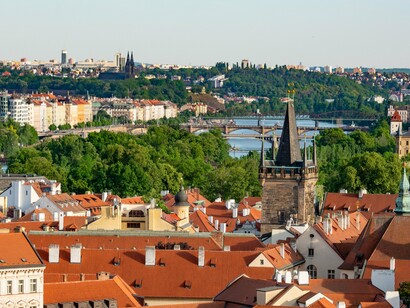
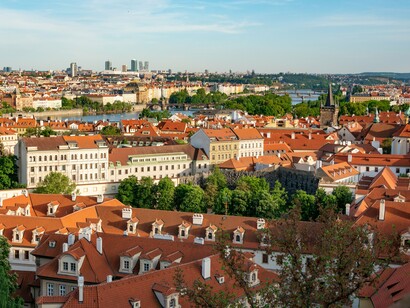
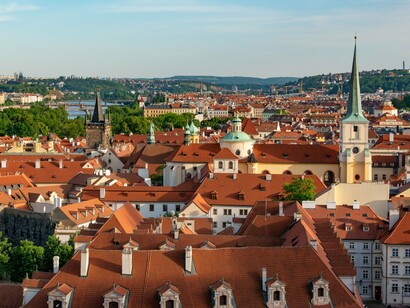
From the gallery, you see Prague spread out in red roofs, domes, towers, courtyards, and the Vltava River. The tangled streets start to make sense. The city is still busy, but its noise seems to fade away.
On top of the tower, Atlas holds up a celestial sphere. He has watched over Prague for about three hundred years, making him one of the city’s most patient residents. Governments have come and gone, but Atlas kept holding up the sky and never complained about the missing elevator.
The tower also keeps another kind of memory. People started recording the weather here in 1775 and never stopped. Someone wrote down the temperature, pressure, rain, clouds, wind, or storms every day. All those ordinary days added up to one of Europe’s longest weather records.
The miracle hiding in plain sight
Today, we carry a little Klementinum in our pockets. Our phones hold books, map the stars, predict the weather, and tell us the exact time. These are things that once needed libraries, observatories, special tools, and a lot of patience.
But when you stand inside the real Klementinum, your phone suddenly seems less amazing.
I left the Klementinum without touching an old book, finding a new planet, or figuring out how faith and science fit together. Honestly, the tour would have needed to be much longer for that.
But I did leave with better questions. Why do people keep looking up? Why do we save words from people who lived so long ago? Why do we always fill our search for knowledge with stories, symbols, and beauty?
Maybe that’s the real miracle of the Klementinum. It doesn’t promise final answers. Instead, it takes us from books to sunlight, from sunlight to time, and from time to the open sky. It reminds us that curiosity might be the oldest kind of faith we all share.
Notes
Clementinum: the mythical library in Prague where Borges imagined God in a Kafkaesque style. Radio Prague International.