English
 Español
 Français
 Deutsch
 Italiano
 Português
Since yesterday, Latin America (which I define as including Mexico, Central America, and the Caribbean) has served as a vast laboratory for the social, political, and economic experimentation of capitalism and colonialism. Until the United States gained independence, North America belonged to it. As the United States emerged as the world’s new capitalist power, it took the place previously occupied by European colonialism and turned South America into its laboratory.
This laboratory has two main departments: oppression and liberation. Both have remained active over the centuries, although their prominence varies depending on the historical period. It was here that the first genocides of the modern era were committed. After U.S. independence, it was here that the first great struggles against European colonialism took place, with Simón Bolívar standing out as a leading figure. Here, for the first time and in various forms, the contradiction between political independence and the continuation of colonialism beyond the end of historical colonialism manifested itself: internal colonialism, neocolonialism, and the Monroe Doctrine from 1823 to the present day. One need only consider the gap between Haiti’s independence in 1804 and that of all the other countries on the continent during the first half of the 19th century. It was the experience of some of these countries—Honduras foremost among them—that justified the coining of the term “banana republic” by the American writer O. Henry.
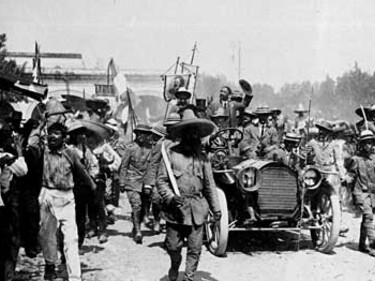
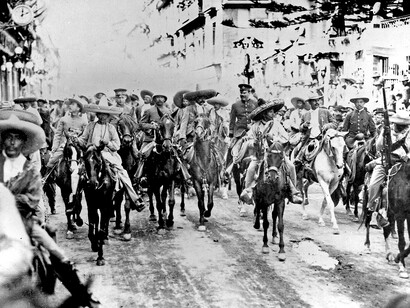
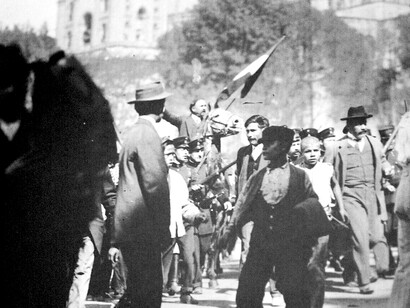
In a tragic partnership with Africa, the first major contradiction between the supposedly universal principles of European liberalism and the practices of European countries outside Europe erupted here. One need only recall the criticisms of the missionary Bartolomé de las Casas. It was here that the first revolution of the modern era took place—the Mexican Revolution of 1910–1920—which resulted in the first major agrarian reform, the slogan “la tierra es de quien la trabaja,” the guarantee of workers’ rights, and the first nationalizations of multinational corporations.
Closer to the present day, the revolution that unleashed the most revolutionary energy in the world during the early decades of the Cold War—the Cuban Revolution—took place here. A small country, 140 kilometers from the United States, almost within the “bowels of the monster,” in the words of José Martí, defied the imperial power, promised to expand across the rest of the continent, and was prepared to share its strength with anti-colonial movements on other continents—as Angola and Namibia eloquently attest.
Strengthened by the hope for social justice that the Cuban Revolution fostered, the progressive democratic forces in other countries on the continent attempted structural reforms in the following years, particularly regarding labor rights and land ownership. This was the case in Brazil under João Goulart (1961–1964). He was overthrown by a military coup orchestrated by the CIA and backed by Lyndon Johnson’s White House, with a naval force on standby off the Brazilian coast. With the military dictatorships that followed—in Chile between 1973 and 1990 and in Argentina between 1976 and 1983—the “department of oppression” within the Latin American laboratory was consolidated.
Since the Latin American laboratory has two departments, the intensification of oppression did not stifle the struggle for liberation. It was also in Latin America that, ten years after the Cuban Revolution, the first experiment in democratic socialism of the Cold War era took place. I am referring to the Chile of Salvador Allende, who was elected president in 1970. Unlike the Cuban Revolution, this experiment sought to achieve socialist goals through liberal democratic means and was not deterred by the failure of similar attempts in Europe, particularly in post-World War I Germany. It ended three years later with a coup d’état orchestrated by Henry Kissinger and the CIA—Latin America’s 9/11.
The department of oppression then launched in Chile the great experiment of the second half of the 20th century—an experiment that continues to this day and now extends throughout the capitalist world. At stake is the management of the contradictory relationship between neoliberal capitalism and democracy. The experiment operates on two hypotheses. The first is the total incompatibility between neoliberalism and democracy. The second is the compatibility of the two through the dismantling of all democratic instruments that constitute an obstacle to the advance of neoliberalism—an advance that is considered and desired to be unstoppable.
In a very brief summary, neoliberalism is the version of capital that responded to the most recent crisis of accumulation (recent until just a short while ago) with a handful of solutions. The market is the great social regulator, not only of economic relations but also of social and political relations. The privatization of the state-owned enterprise sector. The deregulation of economic activity—or rather, its “re-regulation”—to transform the state into yet another instrument of accumulation. The reduction of social policies to a minimum through the transformation of public goods into businesses, particularly in healthcare, education, the pension system, scientific research, and, more recently, the provision of religious services. All of this results in a massive transfer of income from the working and middle classes (where they exist) to various sectors of the capitalist-colonialist ruling class. Neoliberalism enshrines the dichotomy between the poor and the rich, when in reality this dichotomy pits large, impoverished majorities against the enrichment of small minorities.
The first hypothesis dominated the initial period of this experiment. Milton Friedman, the architect of the neoliberal economic reforms implemented by Chilean dictator Augusto Pinochet, acknowledged in a 1994 interview with a German newspaper that some of the desirable reforms could only be implemented under a dictatorship. The second hypothesis dominated the phase that began in 2009. I designate the two phases as follows: “Between dictatorship and advanced democracy or democratic revolution” and “Between decent democracy, hybrid war, or hybrid war.”
Between dictatorship and advanced democracy or democratic revolution
It is worth bearing in mind that the Latin American laboratory always maintains both departments and that the visibility of one or the other fluctuates over time. The military coups in Brazil in 1964, in Uruguay and Chile in 1973, and in Argentina in 1976 sought to confirm that capitalism is incompatible with democracy. Democracy raises expectations among the working classes for a better life—expectations that cannot be realized without challenging the unequal distribution of social wealth, a distribution that the capitalist class imposes to maintain and consolidate its economic, social, and political power. Repression, assassinations, disappearances, and exile did not prevent the liberation department from continuing to function, both in ideas and in practice.
On the intellectual front, the major theoretical innovation was dependency theory, proposed by intellectuals who were often in exile. I will limit myself to the Brazilian case. In education, the monumental work of Paulo Freire stands out. In the field of social sciences, the dependency theory of the early Fernando Henrique Cardoso, Theotônio dos Santos, Vânia Bambirra, and Ruy Mauro Marini. The latter coined a concept that remains in use today: subimperialism. With this term, Marini characterized Brazil’s role under the dictatorship within the regional context of U.S. imperialism.
On the political front, the Sandinista Revolution in Nicaragua, from 1979 to 1990, was the liberation movement that, after the Cuban Revolution, most inspired progressives across the continent and the world. It was an innovative movement with a strong component of progressive Catholicism rooted in liberation theology. After centuries of active complicity with colonialism, capitalism, and dictatorship, the Catholic Church took on the risks that Jesus of Nazareth faced by standing in solidarity with the poor and the oppressed. It was also a revolutionary process that unfolded amid intense imperialist intervention in the form of the Contras—the armed groups that the U.S. funded and trained to overthrow the revolution.
Popular opposition to the dictatorships in Argentina, Uruguay, Brazil, and Chile would lead to the return of democracy in 1983, 1985, 1985, and 1990, respectively. A weakened democracy emerged, sapped by years of dictatorship and, in the case of Chile, showing no commitment to addressing the social devastation caused by neoliberalism.
From the start of the new millennium, however, these countries sought, in various ways, to deepen democracy along social-democratic lines: less social injustice, greater state intervention in the economy, and more robust social policies. They drew inspiration from the post-World War II European tradition and from their own past—Peronism and Getulism. In Brazil, this process unfolded during the terms of the Workers’ Party, under the presidencies of Lula da Silva (2003–2010, 2023–) and Dilma Rousseff (2011–2016). In Argentina, the presidency of Néstor Kirchner (2003–2007) deserves special mention. In Uruguay, the presidency of Pepe Mujica (2010–2015). In Chile, the presidencies of Michelle Bachelet (2006–2010, 2014–2018) and Gabriel Boric (2022–2026). Let us not forget Paraguay and the progressive government of former Catholic bishop Fernando Lugo, who served as president from 2008 to 2012, nor Honduras under the presidency of Manuel Zelaya (2006–2009).
Fueled by progressive governments and encouraged by their relative successes, the popular movement gained strength across the continent beginning in the last decade of the millennium, particularly the indigenous movement, which became a major political force in countries as diverse as Bolivia, Ecuador, Colombia, Mexico, and Chile. In 1994, the great Zapatista uprising in southern Mexico captured the interest and sympathy of the entire progressive world and promised new forms of activism, moving beyond the old dualism between reform and revolution.
In 2001, the World Social Forum was founded in Porto Alegre, and I was a dedicated activist with it for fifteen years. It was a movement of social movements from around the world, headquartered in the Brazilian city because that was where the most innovative experiments in participatory democracy at the local level had emerged, through an initiative of the Workers’ Party under the inspiring leadership of Olívio Dutra and Tarso Genro.
In the wake of this multifaceted progressive mobilization, the first decade of the millennium witnessed three major political innovations. They constituted a particularly ambitious experiment in liberation—at least in terms of their objectives. They adopted the name “revolution” or its equivalent to underscore the determination to break with the injustice historically entrenched on the continent. I am referring to the Bolivarian Revolution in Venezuela, under the leadership of Hugo Chávez (1999–2013); the Citizen Revolution in Ecuador, under the leadership of Rafael Correa (2007–2017); and the Proceso de Cambio in Bolivia, led by Evo Morales (2006–2019), the first indigenous president of the modern era.
These were very distinct processes, but all presented themselves as a radical break with the recent past. The establishment of constituent assemblies symbolized this break and gave rise to new constitutions aimed at a genuine refounding of the state. In Venezuela, the 1999 Constitution. In Ecuador, the 2008 Constitution. In Bolivia, the 2009 Constitution. To make my position on them clear, I served as a consultant on both the Ecuadorian and Bolivian constitutions regarding the issues of plurinationality, the rights of indigenous peoples, and legal pluralism.
The transformative nature of these Constitutions is evident in Article 1 of each. I quote:
Constitution of Venezuela, Article 1: “The Bolivarian Republic of Venezuela is irrevocably free and independent and bases its moral heritage and its values of freedom, equality, justice, and international peace on the doctrine of Simón Bolívar, the Liberator. Independence, freedom, sovereignty, immunity, territorial integrity, and national self-determination are inalienable rights of the nation."
Constitution of Ecuador, Article 1: “Ecuador is a constitutional state of rights and justice; it is social, democratic, sovereign, independent, unitary, intercultural, plurinational, and secular. It is organized as a republic and governed in a decentralized manner. Sovereignty resides in the people, whose will is the foundation of authority, and is exercised through the organs of public power and the forms of direct participation provided for in the Constitution. The non-renewable natural resources within the territory of the State belong to its inalienable, irrevocable, and imprescriptible patrimony.”
Constitution of Bolivia, Article 1: “Bolivia is constituted as a unitary, social, rule-of-law, plurinational, and community-based state—free, independent, sovereign, democratic, intercultural, decentralized, and endowed with autonomies. Bolivia is founded on political, economic, legal, cultural, and linguistic plurality and pluralism within the framework of the country’s integration process.”
The legal and political nature of these constitutions was so innovative that it gave rise to a new conception of constitutionalism, known as “new Latin American constitutionalism,” “transformative constitutionalism,” or “constitutionalism of the South.” They proposed a new organization of the state, with additional organs of sovereignty beyond the traditional three (legislative, executive, and judicial); the radicalization of democratic participation beyond the liberal canon; and a strong conception of sovereignty, which included greater state intervention in the economy and national control over natural resources. In Ecuador and Bolivia, a strong constitutional presence of indigenous national identity was also proposed, with the adoption in the Constitution—for the first time in Latin American history—of concepts in non-colonial languages: Quechua and Aymara. Liberal-style democracy was maintained but radicalized through the introduction of forms of participatory and community-based democracy.
The socio-political nature of these processes can be described, using a concept coined by the Bolivian social scientist René Zavaleta Mercado, as national-popular movements, with a strong emphasis on progressive nationalism grounded in popular sovereignty and national control of natural resources. The political rhetoric that fueled them and the practices into which they were translated lent credibility to the recovery and reinvention of the historical memory of socialism, in the form of “21st-century socialism.”
Social and political experimentation in the “department of liberation” of the great Latin American laboratory did not occur solely at the national level. It was during this period that Latin American countries achieved their greatest capacity to organize themselves without the tutelage of their “big brother” to the North—that is, outside the Organization of American States, which had always been dominated by the United States. Largely on the initiative of Hugo Chávez, several regional cooperation organizations were created with an egalitarian logic, based on complementarity, the likes of which had never been seen before on the continent.
Thus emerged ALBA, UNASUR, the Bank of the South, and CELAC. ALBA, the Bolivarian Alliance for the Peoples of Our America, was founded as a bloc for political, social, and economic cooperation among Latin America and the Caribbean. Fidel Castro and Hugo Chávez founded it in Havana in 2004 as a counterpoint and alternative to the free trade agreement the U.S. sought to impose on Latin America (FTAA, Free Trade Area of the Americas), a project that had sparked strong political and social opposition across the continent.
UNASUR, the Union of South American Nations, was established in 2008 as an intergovernmental bloc for regional integration aimed at uniting the countries of South America through political coordination, social projects, and cooperation on infrastructure. Its first secretary-general was Néstor Kirchner.
The Bank of the South was established in 2009 as a multilateral financial organization with the goal of promoting the regional integration of South American countries and reducing their dependence on hegemonic multilateral institutions, namely the IMF and the World Bank. The agreement was signed by Argentina, Brazil, Paraguay, Uruguay, Ecuador, Bolivia, and Venezuela.
CELAC, the Community of Latin American and Caribbean States, was established in 2010 as a regional international organization covering Latin America and the Caribbean. The first meeting was held in Caracas in 2011.
This entire regional institutional framework was a response to the social devastation caused by neoliberalism in the 1980s and 1990s, when the United States imposed—with few restrictions—financial domination, unequal trade, and access to the subcontinent’s natural resources on the countries of the region. It was a bold alternative to the Monroe Doctrine and the resulting transformation of the subcontinent into the U.S.’s “backyard.” The strength of this alternative lay in the strength of the states that promoted it. It gradually faded away during the second decade of the millennium due to the convergence of three factors, which I mention in no particular order of priority: leadership errors, fifth columns within the ruling classes dissatisfied with their relative loss of power, and aggression and encirclement by U.S. imperialism, which, as Ruy Mauro Marini noted, was increasingly supported by the sub-imperialism of the European Union and Israel.
Between decent democracy, "ditanmole," or hybrid war
The department of oppression of the great Latin American laboratory—run by U.S. imperialism and its internal and external accomplices—watched with concern the advances of the department of liberation. During the first decade of the millennium, it had focused on the tragic events of its own September 11, 2001, and their aftermath, particularly the illegal war against Iraq in 2003. To some extent, it had paid less attention to what was happening on the subcontinent. Alarmed by the progressive and autonomist energy emerging in its own backyard, it decided to intensify its paternalistic interference. This interference, which continues to this day, has gone through two phases, corresponding to two complementary processes of undermining democracy and transforming it into a docile instrument of imperial interests.
The first phase consists of transforming, through soft coups, decent democracies into truncated, authoritarian ones. There is no violent rupture with democratic processes. Instead, the authoritarian components of democratic regimes are reinforced in order to achieve, at least in part, the same objectives that a dictatorial path would yield. To characterize this distortion of democracy, I draw on the concept of "ditamole," coined by political scientist Guillermo O’Donnell, as a counterpoint to dictatorship ("ditadura"). In fact, there is a transition from a decent democracy to an indecent, authoritarian, truncated democracy. The distortion can vary in intensity, depending on the “needs” of external interference and its internal allies.
The second phase intensifies the distorted democracy through openly anti-democratic and violent interventions, which may include assassination attempts, economic sanctions, embargoes, the confiscation of reserves held in international banks, and the expulsion of digital technology. Thus begins a hybrid war between democracy and dictatorship. The dictatorship creeps in slowly, drop by drop, until one day citizens wake up and realize they no longer live in a democracy. The goal is for the vast majority not to attach any importance to this discovery in the immediate term.
The idea of the two phases merely highlights the different emphasis placed on the means employed. In the first phase, the methods favored in the second phase may be used on an exceptional basis. This is the case in Venezuela, where President Hugo Chávez was the target of several assassination attempts from early on and where, to this day, the causes of his death remain unclear. Cuba is a particularly tragic case because the Cuban Revolution, for many reasons—including being too close to the “bowels of the beast"—did not adopt the liberal democratic shift seen in other countries on the subcontinent. For more than sixty years, it has been subjected to the most violent imperial interference, characteristic of the second phase. In addition to invasion attempts, embargoes, and sanctions of every kind, it is estimated that the CIA made 638 attempts to assassinate Fidel Castro.
The first phase (2009–2026)
The memory of the atrocities committed during the dictatorships and the new legitimacy that democracy had acquired on the subcontinent precluded the traditional recourse to coups d’état and the establishment of dictatorships with the active participation of armed forces trained at the infamous School of the Americas in Columbus, Georgia. The decision was made to resort to democratic instruments, manipulating their use until the desired results were achieved. Initially, these results consisted of removing leaders of progressive change and actively intervening in subsequent electoral processes so that “U.S.-friendly” governments would emerge from the polls.
This type of intervention was dubbed a “soft coup,” as it occurred without military violence and under a democratic façade, sometimes centered on the courts, sometimes on parliaments. The coups were “soft” only for those who carried them out. For those who suffered them, they were extremely violent. Thus followed the coup in Honduras against President Manuel Zelaya (2009); in Paraguay against President Fernando Lugo (2012); in Brazil against President Dilma Rousseff (2016); and, again in Brazil, the judicial coup aimed at decapitating the leadership of the Workers’ Party and disqualifying the front-runner for the 2018 presidential election, Lula da Silva. This soft coup—undoubtedly the most far-reaching on the continent—went by the name of “Operation Car Wash” and lasted from 2014 to 2021.
Also worth mentioning is the soft coup in Bolivia against Evo Morales in 2019 and the judicial persecutions against Argentina’s former president, Cristina Kirchner, and Ecuador’s former president, Rafael Correa, which have been ongoing for more than a decade.
This wave of soft coups has caused profound political and social damage to the targeted countries, as well as personal harm to the leaders who suffered them. I will limit myself to the case of Brazil. These coups led to the election of a far-right president, Jair Bolsonaro, who, among other harmful actions, adopted a policy of denial during the COVID-19 pandemic—a policy that, according to estimates by the WHO and Oxfam, caused between 120,000 and 400,000 preventable deaths had the globally recommended control measures been implemented. It would be difficult to enumerate the personal harms. Suffice it to say that Lula da Silva, the current president, was wrongfully imprisoned for 580 days.
Despite the prominent role played by the forces of oppression during this period, the forces of liberation were not inactive. The great Latin American laboratory remained true to itself. Three examples suffice to illustrate that imperial interference was not always entirely successful.
Brazil
In the case of Brazil, the soft coup against the Workers’ Party governments—and above all against its historic leader, Lula da Silva—did not achieve the success the coup plotters had hoped for. The judicial persecution against Lula was exposed; he was re-elected president in 2022 and is now a candidate for reelection in the October elections. One cannot, however, say that the soft coup failed entirely. The Brazil to which Lula has returned as president is a different country from the one that existed when he was arrested. And the difference is for the worse. It is a much more conservative country, with a parliament undermined by the coup-mongering and far-right strategies of the previous period, socially more unjust, and with far less room to maneuver to reverse the situation in favor of the working classes. It is far more subject to the conservative political exploitation of religion—especially neo-Pentecostal evangelicalism—and has a population that is more misinformed by social media and more vulnerable to the politics of hate. The work of the department of oppression over nearly a decade has not been in vain for the interests of U.S. imperialism and its internal allies.
The second and third examples refer to two countries that were absent from the progressive wave that swept across the subcontinent during the first decade of the millennium: Mexico and Colombia.
Mexico
Mexico, like Cuba, has a revolutionary past—albeit a much more distant one—and lies very close to the “bowels of the monster.” Unlike Cuba, it is a vast country with immense natural resources, rich cultural diversity, an impressive pre-colonial history, complex economic, social, and cultural development, and a political system that transitioned peacefully from a single revolutionary party to a multiparty system. It is also a country with high levels of both common and political violence—which are not always easy to distinguish from one another—and has perhaps the most diverse historical experience of relations with the U.S., marked by war and diplomacy, land theft and free trade agreements, political dependence on the Mexican diaspora, and the deportation of emigrants.
Mexico remained on the sidelines of the progressive wave of the first decade of the millennium. In 2018, however, Andrés Manuel López Obrador (AMLO) won the election. He had already won previous presidential elections, but electoral fraud successfully blocked—for some time—the project of change he had announced, the 4T. The 4T is the fourth transformation, the first three being the War of Independence (1810–1821), the War of Reform (1858–1861), and the Mexican Revolution (1910–1920). As AMLO himself put it, the 4T would bring the reform processes carried out by the previous transformations to an orderly and peaceful conclusion. The promised changes prioritized the fight against corruption, the strengthening of democracy through public referendums, freedom of expression and religion, constitutional reform, energy sovereignty, and the improvement of living conditions for the working classes in terms of wages, social rights—with special attention to public health and education—and pensions.
It was a social-democratic program that allies and opponents labeled as left-wing, center-left, or populist. The truth is that when he left the presidency in 2024, AMLO left behind a country better than the one he had found in 2018. The success of his policies is reflected in the political prominence of MORENA, the party that began as a movement and has always supported him. It was also this success, combined with the candidate’s own merits, that made possible the election of Claudia Sheinbaum, his successor and the one who carries on the 4T.
From this, we can conclude that AMLO’s progressive government flourished—despite unavoidable difficulties and ambiguities—during the period when U.S. imperialism had once again turned its primary attention to its own backyard. From the empire’s perspective, the strategy of interference in the first phase had not been entirely successful.
Colombia
Colombia was the other major country on the subcontinent absent from the progressive wave of the first decade of the millennium. Like Mexico, it is a vast country, extremely rich in natural resources, biodiversity, and cultural diversity. A country that, except for a brief period (1953–1957), has always been governed by a democratic regime but where, just as in Mexico, common and political violence has always dominated the lives of its citizens. In fact, organized political violence in Colombia has been far more intense than in Mexico, manifesting in the emergence of guerrilla groups that have shaped political life—and above all, the lives of rural communities—from the late 1950s to the present, despite successive peace processes, the most recent of which took place in 2016. In recent decades, the violence of the guerrillas has been compounded—ostensibly to combat it—by the violence of the paramilitaries, private far-right groups that call themselves “self-defense groups.” Colombia is one of the most unequal countries on the continent, where the wealthiest 1% controls 40% of the national wealth.
Colombia has traditionally been the United States’ most loyal ally on the continent. For this reason, and due to the volume of financial and military aid it receives, it has even been considered the “Israel of Latin America.” When, in June 2021, the UN General Assembly voted on a resolution calling for an end to the U.S. economic embargo against Cuba, Colombia did not vote in favor. It abstained, alongside Bolsonaro’s Brazil.
In 2000, Colombia signed an ambitious bilateral military and diplomatic agreement with the U.S., Plan Colombia. The plan injected billions of dollars to modernize the Colombian Armed Forces, combat drug cartels, and weaken insurgent groups. By 2015, $10 billion had been invested in the Colombian Armed Forces without achieving any of the objectives, except for strengthening the repressive capacity of those forces, which was directed at combating internal enemies rather than external ones, as was their original purpose. Measures that were highly problematic from the standpoint of human health and the environment were also employed, particularly the spraying of crops with herbicides banned in many countries, including glyphosate.
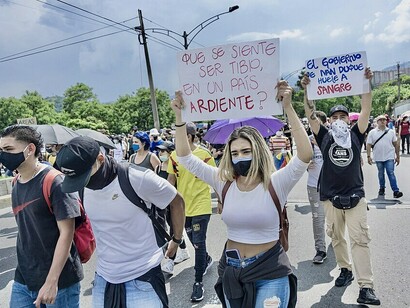
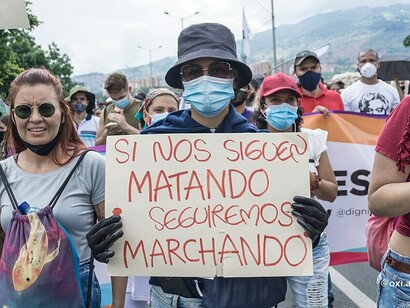
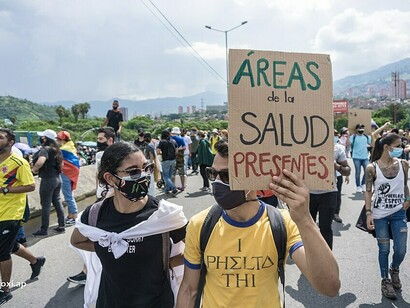
The goal of social development announced in Plan Colombia was never achieved. On the contrary, the country became more unequal; social unrest, precarious living conditions, and a lack of opportunities increased, and youth unemployment worsened. In April 2021, a popular uprising erupted in the outlying neighborhoods of Cali, with massive youth participation. Despite heavy police and military repression, the uprising persisted for months, occupying streets and squares. It gave rise to new forms of mobilization and intergenerational participation, such as community kitchens where the cooks were mostly the mothers of the young protesters, and “ecologies of knowledges,” such as the classes taught by university professors who identified with the struggle at a people’s university created to discuss topics of interest to the protesters. This was the Cali Commune, which is still evident today, among other things, in the magnificent ten-meter-tall collective sculpture titled “Resiste.”
This movement inspired other resistance movements in cities across the country, and the accumulation of forces culminated in 2022 with the election of the first left-wing president in Colombian history, Gustavo Petro. Petro committed himself to fighting for “total peace,” improving the living conditions of the working classes, and defending the country’s sovereignty and self-determination—especially regarding the management of its vast natural resources. From the outset, he revealed what his term in office would later confirm: he was the head of state who, in the contemporary world, most eloquently articulated the ecological consciousness that must guide future generations. The speeches he delivered at the United Nations and other international gatherings will go down in the history of the environmental movement.
Petro’s Colombia was yet another case in which U.S. imperialism was forced to conclude that the soft strategies of the first phase had failed or outlived their usefulness.
To be continued with Part 2: Today.