English
 Español
 Français
 Deutsch
 Italiano
 Português
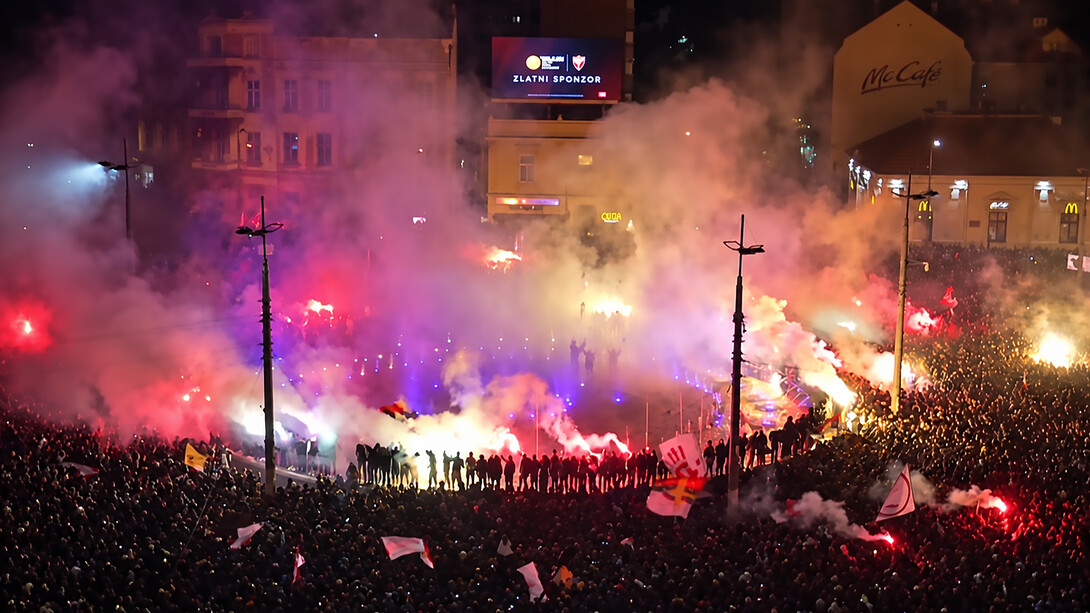
The Student List won the Serbian elections.
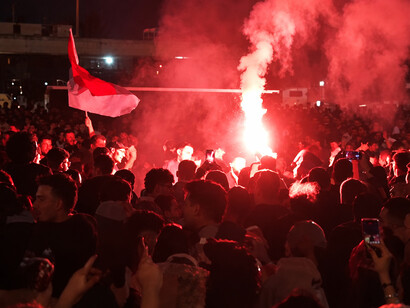
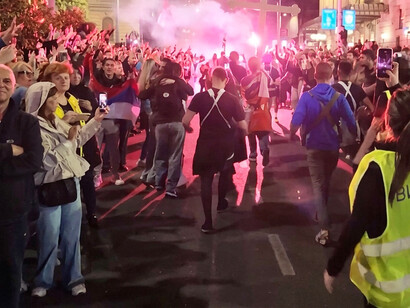
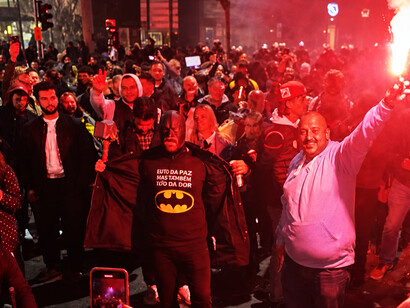
By now, I’m sure a lot of the wider audience is at least familiar with the situation there, as the scenes of celebrations across the country spread to foreign media. There is something powerful in the hopefulness of these scenes.
In this article, I want to share a few perspectives on what’s usually not being portrayed by the media abroad.
I wrote previously here about why the situation in Serbia is reflective of all European democracies. To reiterate, I’ll try to be concise:
- Serbia was everything illiberal, autocracy-aspiring democracies strive to be. With a dictator elected by mimicking the democratic process and controlling every part of society through every relevant institution, Serbia was extorted, drained, abused, manipulated, subjugated, isolated, and humiliated for the profit of the ruling party.
While this is a pattern easily noticeable in the Balkan countries (in Croatia, we like to say that all the other countries have a mafia, but only in Croatia does the mafia have a country—sorry to say, we’re not that special), the same tendency is noticeable in other democratic countries as well—the USA being the prime example nowadays. This is to say, Serbia WAS an ideal type of such a democracy, and as such, it has great analytical value, even if the specific situations differ significantly among democracies.
The Student Movement, then, represents an ideal type to counteract these tendencies—it’s necessary to understand it as the means by which the very idea of a contemporary democracy can sustain itself. As a form of populist movement (despite not having a charismatic leader), the Student Movement understood very well the limits of Vučić’s regime.
It is some of these limits that I want to address here, and then the ways they were counteracted.
Limits of oppression
1,672,661 votes (39.22%) in 2026; 1,783,701 votes (46.75%) in 2023.
That’s the extent of Vučić’s power presented in numbers. There is a slight difference between them, and at this moment, I don’t want to guess whether it was because some supporters were disillusioned with his politics, because it was a lot harder to steal votes this year, or both.
However, to lose votes amid considerably higher voter turnout is telling. The Student List was led by the idea that, to win the election, they’d need voter turnout of at least 65%; almost 70% of Serbia participated this year, 12% more than in 2023.
Up until now, around 1,700,000 votes, out of 6,500,000 eligible voters, were enough to keep the country occupied. “How did Vučić’s party attract these 1,700,000?” is the crucial question.
Propaganda network
Media freedom was a consistent point of criticism the EU directed towards Serbia. But this says nothing about influence operations that were sponsored by the state’s budget. For reference, you might remember news related to something along the lines of “Twitter Axes Thousands of Accounts ‘Promoting Serbia’s Ruling Party.’1” The ruling party is Srpska Napredna Stranka (Serbian Progressive Party), with Vučić as its leader.
- Ocisti.net2 is an anti-propaganda and digital accountability initiative targeting (so far, still just alleged) pro-government bot networks in Serbia.
The webpage is a database of all the people who have been manipulating public spaces on the internet over the years (since 2012!). It contains a list of 1,400+ personnel working with fake social media accounts to comment on, share, and like pro-government posts and news and respond to “haters” of the regime. It has its people in all the news sections, on YouTube, Facebook, Instagram, etc. Besides that, it has a program that automatically upvotes positive (obviously fake) pro-government posts.
They used the platform's progress.rs to delegate tasks. The workers are organized by municipality and coordinated by a designated coordinator. The tasks were simple—each day, you were given an order on what to write, share, or like, and then you proved it with a screenshot. Of the 1,400 workers, some were employed in the state’s institutions, most likely as compensation for their work online and, presumably, offline (but at this point, we can only guess).
Everyone was aware of the existence of these bots, though perhaps not of the extent of the operation; the majority of the population was never convinced the ruling party was the good guy. But as ocisti.net states, “The goal of the whole progress.rs platform is not to convince you, the goal is to shut you up.”
I’d like to add one more thing: the goal is also to demonstrate that the ruling party is omnipresent, because it truly is, on the internet. I don’t want to get too theoretical here: post-truth, simulation and the implosion of meaning (Baudrillard), or manufacturing consent (Chomsky) are all demonstrable here. I want to emphasize something else: there is a limit to how these systems can function. The mass media/social media systems really are all-encompassing, but at a certain point, unmediated reality does come back into the discourse.
I think we take for granted that contemporary media are so powerful and influential in redefining what our reality is. Everyone now knows about the dead internet, or about Russian bot farms, and how Ukrainian drone strikes on Russian Yandex data centers caused a reduction in pro-Russian social media propaganda (they did not3, unfortunately; it’s another piece of “data centers are important” propaganda).
But in contrast, the Student Movement’s victory and whistleblowers/digital activists like ocisti.net do show that there’s really nothing glamorous or ingenious behind this power.
All of these operations were carried out by a low-skilled workforce dependent on the government. I don’t think these operations are specific to Serbia; I think they’re the norm, even if they’re financed by other sources. I wrote previously about far-right influencers using similar tactics. Developed by Curd B. Knüpfer, Yunkang Yang, and Mike Cowburn, The Logic of Connective Faction is an academic framework explaining how digital connectivity and hyper-partisan media ecosystems reshape internal party politics and drive ideological radicalization.
In other words, democracy is found outside digital media.
(Parallel) structures
When the canopy in Novi Sad collapsed in November 2024, decades of negligence, corruption, incompetence, and propaganda were summarized in one traumatic event that unified the remaining discursive field under one signifier. To this day, no trial has commenced, and in this respect, Serbia is still awaiting its catharsis. The justice system is corrupt to its core.
Every aspect of the public sector (with its 600,000+ employees) is compromised in its key positions. Tackling corruption is the primary promise of the Student List.
It’s not just the individuals who are corrupt: their will and interests have made the institutions corrupt. Corruption is the norm, and it forces unassociated individuals to play by its rules. And this applies to all institutions: schools, the police, the justice system, the media, the government, municipalities, and even the Church (allegedly4!) are closely associated with criminal organizations and state propaganda. It trickles down to everyone, and it corrupts everyone’s well-being.
Now, there is no exact figure for how many public sector employees voted or whom they voted for. But there is a general sentiment that all the key positions are occupied by SNS members who, to remain in their positions, must secure a number of votes for the party.
An anecdotal piece of evidence that indicates the limit of this system:
- Ana Brnabić, acting president and Vučić’s public vanguard, lamented in one of the public debates how unfairly the good principal of a prestigious school was treated in the media just because he loves Serbia and Aleksandar Vučić. What she didn’t mention was that 25 professors were forced to quit, were fired, or quit voluntarily out of solidarity with other professors. How come they were good for years but ceased to be so when they showed disdain for Vučić?
In other words, you may have a budget to bribe one person; you can’t bribe 25 more. (I’m referring to an economic/positional limit, not a moral choice.)
During the elections, occupied institutions were used to gather votes for SNS; ambassadors abroad did what they could to prevent people from voting; and public notaries (allegedly, of course) certified forged voter signatures for certain electoral lists.
Besides the public institutions that have all been occupied to maintain SNS in power, another important resource is the SNS thugs/criminal milieu. In the final hour of the elections, they were gathering at Ćaciland, the occupied main square in Belgrade. If Vučić decided to declare victory despite the results, they were ready for violence.
This is a whole other can of worms I don’t want to open right now, but it has been alleged time and time again that the ruling party and the criminal organization are working closely together. But since the justice system is so corrupt, allegations could never become anything more (or less) than that.
Propaganda narratives
There are thousands of reasons why, after the elections were won, people decided to go in front of the regime’s media houses to gloat. It’s not just that the discourse was all-encompassing, as I mentioned before, but that it was horrifically toxic.
This is because the reality the regime’s media had been showing for decades was, in essence, brainwashing.
- In this reality, Vučić personally tackled numerous attempts from outside to devastate Serbia; students were called Ustaše (a derogatory term for a Croat, a member of a Nazi-affiliated Croatian party); student protests were a “colored revolution” (which is a Russian propaganda textbook trick). For decades, this reality showed a version of Serbia that was developed, economically independent, and an “economic tiger,” as Vučić liked to say; next year, a flying taxi service was supposed to come to Serbia’s capital, I guess to pair it with a metro that was supposed to be built in 2018.
But it’s not just that the regime was shown as spotless and the opposition was demonized. Entertainment programming and crime journalism were blossoming, as was a strange symbiosis of the two. Known criminals attended reality shows; becoming a starlet was shown as a relevant job opportunity for young women; morbid, horrific stories of mobsters using meat grinders to hide human bodies captured the attention of the public for years.
I think this told two stories: those who believed these stories felt secure because Vučić was there to protect them from evil. Those who believed were mostly the elderly, whose monthly pensions were delivered by the savior Vučić. Below the poverty line, isolated, and dependent on the mercy of Vučić, these people consistently voted for him: according to a June 2026 public opinion estimate by Sprint Insight, more than 800,000 Serbian pensioners support Aleksandar Vučić, accounting for approximately half of his total voter base.
To those who were more realistic and knew that Vučić was (allegedly) affiliated with the criminals, the grotesque murders signaled a completely different message: it can happen to you too.
- Following the Vladislav Ribnikar school shooting in May 2023, in which a 13-year-old killed nine other children and a security guard, and the mass shootings in Mladenovac and Smederevo the following day, in which a 21-year-old killed nine more people, a series of protests in Serbia placed blame on media outlets accused of normalizing violence and glorifying criminals.
Protesters specifically called for the revocation of the national broadcasting licenses held by several pro-government television channels, particularly TV Pink and TV Happy. None of these demands was fulfilled.
There is a limit to how much poison a human body can take. Something was terribly corrupt in the fabric of Serbian society, and I don’t know how much darker anecdotal evidence can get.
But I do know that it was the Student Movement that faced that darkness.
How did the Student Movement achieve victory?
While this can by no means be an exhaustive analysis, I think some points are visible. The Student Movement, and the Student List that won the elections, unified a number of different political struggles under one banner. What I used as anecdotal evidence are just some of the thousands of struggles the Serbian population faced every day.
Moreover, the Student Movement understood fully well what the limits and strengths of Vučić’s regime were.
Human touch
First and foremost, the Student Movement worked with the fact that there’s an underlying social reality found outside digital media. They were not shut down by the omnipresence of Vučić’s bots. Instead, a lot of the attention was on actual human, living, offline experience.
These initiatives included:
“Student in every village,” in which student activists marched through rural areas to speak directly with locals about environmental, economic, and political issues. Ahead of the October 2026 elections, these multi-day walking campaigns covered hundreds of kilometers, connecting students with villagers to build grassroots political awareness and bypass mainstream media censorship.
Cycling students organized extensive northern and southern routes across Serbia, visiting cities like Sombor, Novi Sad, and Niš to promote their civic message. Prior to this, in April and May 2025, they completed an ambitious international relay marathon, cycling all the way to Strasbourg and Brussels to engage with European institutions.
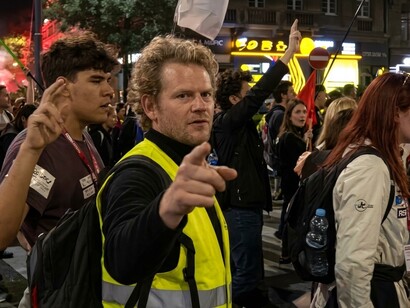
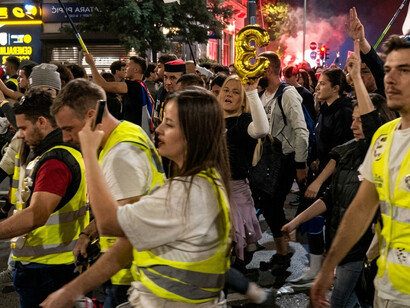
And, of course, massive protests on the streets of every major city in Serbia. These protests were not just a bunch of random people walking around for a single cause. A lot of these protests were more than that—an engagement with the community, shared hospitality, and solidarity. They reminded people how unnatural isolation really is for a human being, and they demonstrated how massive the movement is. Allow me to be cynical for a moment, but quantity is a quality on its own, right?
I believe this willingness to sacrifice one’s body and time, to put real effort into cycling or walking for miles, highlights the strength of conviction among the Student Movement’s participants. The corporeal realness of these activities made them something tangible, even if, online, this was just another form of content suppressed by the regime.
And I know it’s silly to be petty right now, but contrast this with pro-regime youth activists attempting to mimic these student marches by organizing a solidarity walk for the government, only to be caught by independent journalists boarding buses and cars shortly after taking their promotional photos. This is the difference between the two explained in a nutshell.
Structures of solidarity
When the regime realized these protests would not be a typical, ignorable nuisance, it started to utilize the power of the institutions it held. Professors supporting the students were forced to quit or were left without salaries; police and thug brutality was reported on numerous occasions, and regime media called out specific individuals by their first and last names, calling them scum, etc.
The Student Movement’s candidates for election were selected by the student plenum and then kept secret until the very end of the electoral process. That was the way to protect them from bots and institutional abuse.
This also maintained the focus on the collective nature of the movement—it didn’t need a charismatic leader for the general public. This was, again, in stark contrast to the omnipresent Vučić.
Students ensured that there was a voting committee at every voting location, monitoring the elections.
Frequent solidarity activities to collect funds that were distributed to those who lost their jobs because they supported the students ensured that the struggle would be manageable for some time.
Web pages like Vote BnB5 enabled people abroad to organize and vote, despite the regime doing everything to hinder voting.
And there were hundreds of other examples that connected people through a mutual ideal.
Utopia, not ideology
The transformative power of ideals is considered naive and has consistently been pushed out of public discourse on that basis. On the other hand, the transformative and katechonic (a term used just to make fun of Peter Thiel, but it oddly fits too) power of capitalism, manifested in corruption, murders, and the alienation of an individual from society, sounds reasonable, and it’s okay to believe in it.
We should normalize the idea that both are equally real.
Žižek, in one of his recent interviews, mentioned that people are not desperate enough to act for change. I think he has a point, demonstrable by the Student Movement. To counter everything the regime’s media spawned for decades, a different approach was needed.
- Protests highlighted the importance of non-violence. For the first time in a public speech, I heard a proud nationalistic sentiment that called for coming to terms with the state’s responsibility during the war in the ’90s. Politics was regarded as a way not to accumulate and redistribute capital but to be responsible for the well-being of one’s kin.
These are all in stark contrast to the regime. And this was something the people needed to remind themselves of what a human being is and what it can be.
Final thoughts
I don’t want to waste time on cautionary, preachy tales; there’ll be time for that. What I want to do instead is reflect on what my country, Croatia, could and should do.
This is because the biggest losers outside Vučić’s party were the hard-right influencers/politicians in Croatia. They are trying to shift the narrative to suggest that the Student Movement still represents the same aggressive Serbia, mainly because of one (1) clip of a student praising the genocidal commander Ratko Mladić.
The truth is that a revolutionary youth movement realized it doesn’t care about the problems of the past if, in the present, people are dying. It disrupts the status quo and the purpose of the hard right in Croatia too. If the Student Movement vouches for peace and coexistence, how can the hard-right influencers exert influence here? They’ll take their jobs!
And as I’m writing this, I’m reading the news about how Ivan Penava, a member of the ruling party in Croatia, organized an emergency news conference about Josip Broz Tito. As the feeling of cringe started to find words, the first sentence my brain mustered was about how puny, irrelevant, and boring his political agenda is; how sad his political existence is; and, finally, what did Croatia do to deserve this humiliation? For the likes of him, I’ll use the wise words of Michael Jeffrey Jordan: “Stop it. Get some help.”
Croatia is the country better positioned and set to be an example. I hope we’ll be able to support and learn from the Student Movement. With so many global challenges, our countries will need to cooperate, and I hope this moment will spill into a future in which people hold the power.
References
1 Twitter Axes Thousands of Accounts ‘Promoting Serbia’s Ruling Party’.
2 Ocisti.
3 Is Zelensky right to say data centre strikes have taken down Russian bots?
4 A Patriarch Chosen Beneath the Devil’s Gaze.
5 Vote BnB.