English
 Español
 Français
 Deutsch
 Italiano
 Português
A pattern is emerging across industries that is difficult to reconcile at first glance: companies are reducing headcount while increasing investment in AI systems at the same time.
A recent example makes this visible. Snap cut roughly 1,000 roles, about 16% of its workforce, while shifting more aggressively toward AI-enabled operations. Internal figures referenced in company reporting show that AI now generates over 65% of its new code and is already handling large volumes of support queries, allowing smaller teams to deliver comparable output. What Snap’s leadership emphasised in its internal memo was not just cost reduction but the ability of smaller teams to operate more efficiently as AI takes over repetitive work.
This pattern is not confined to a single firm. A broader wave of corporate announcements shows organisations cutting roles while expanding spending on AI infrastructure such as compute capacity, data systems, and internal automation tools. Reporting across markets indicates that companies are increasingly linking workforce reductions to efficiency gains enabled by AI, even when the connection is framed cautiously or indirectly.
So the direct answer is clear: AI is contributing to layoffs.
But stopping there misses what is actually changing.
What these signals point to is a shift in cost structure. Labour, traditionally treated as ongoing operating expense, is being partially replaced by AI systems that function more like scalable infrastructure. As those systems become cheaper and more capable, firms are able to sustain, or even increase, output without expanding headcount at the same rate.
Seen this way, layoffs are not only a story about automation. They are a visible consequence of a deeper transition: companies are reallocating costs away from payroll and into AI-driven production capacity.
Why the AI layoff story feels inconsistent: three competing narratives that don’t connect
The confusion does not come from a lack of information. It comes from how the same information is separated once it is interpreted.
In most reporting and institutional analysis, the underlying shift is split into three different explanatory frames, each focusing on one part of the system while ignoring the others. What appears as inconsistency is often just fragmentation.
One narrative isolates layoffs as a direct consequence of automation. In this frame, AI is treated as the immediate cause of job loss, and workforce reduction is interpreted as a substitution event.
A second narrative treats AI investment as a standalone growth story. Spending on infrastructure, compute, and internal tools is analysed as a signal of innovation and competitiveness, without being structurally linked to labour decisions. This separation shows up clearly in financial reporting, where capital expenditure on AI is discussed independently of workforce changes, even when both occur in the same reporting cycle.
A third narrative reframes the situation as a labour-market transition problem. The emphasis shifts to reskilling and adaptation, positioning workforce change as a mismatch between existing capabilities and new technological demands.
Each of these narratives is internally valid. That is why they persist.
What is missing is the connection between them. These are not separate developments; they are different lenses applied to the same organisational decisions. The same restructuring can appear as a layoff event, an investment signal, or a skills transition depending on the context in which it is described.
Once those perspectives are separated, the story appears inconsistent. When they are brought back together, the pattern becomes coherent: companies are adjusting their cost structures and describing different parts of that adjustment in different ways.
Why this is not automation: it is cost structure reallocation
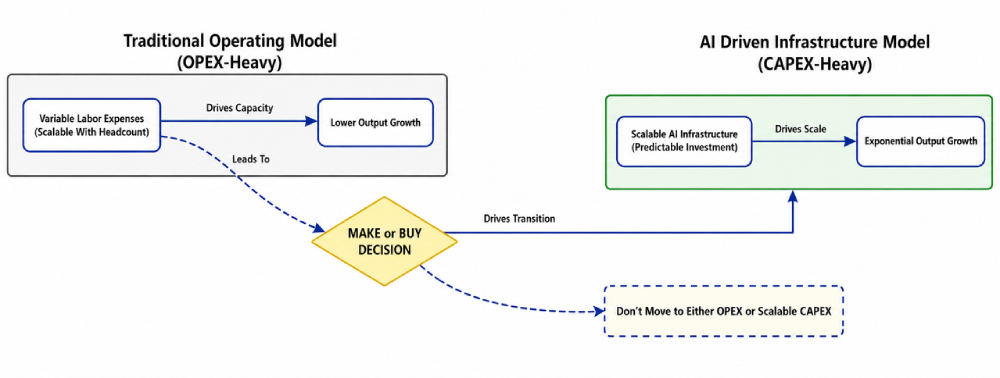
Figure 1. The Cost Structure Reallocation Model. This diagram illustrates the fundamental shift in organizational productive capacity, moving from a traditional operating expense (OPEX)-heavy model, where scaling is primarily driven by variable labour, to an AI-driven capital expenditure (CAPEX)-heavy model, where scalable AI infrastructure becomes the primary mechanism for output growth. This reallocation mechanism fundamentally alters the economic logic of the firm. Source: Conceptual diagram based on analysis of corporate reporting and economic trends.
The pattern described earlier becomes clearer once it is named. What firms are doing is best understood as a labour-to-AI reallocation mechanism—a shift in how productive capacity is funded and scaled, rather than a simple replacement of tasks.
As illustrated in the Figure 1 model above, this distinction matters. Automation, in its traditional sense, implies a direct substitution: a machine performs a task previously done by a person. What is happening now operates at a different level. Companies are not waiting for full task replacement. They are restructuring how output is generated and how costs are organised.
The shift sits inside the difference between operating expenditure and capital expenditure.
Labour has historically been treated as OPEX. It scales with headcount, renews continuously, and increases proportionally as output grows. Hiring more people has been the default way to expand capacity.
AI systems behave differently. Investment in models, compute infrastructure, and internal tooling is increasingly treated as CAPEX-like spending. Once deployed, these systems can generate output repeatedly without scaling costs in the same linear way. The expense is front-loaded, but the marginal cost of additional output declines.
That changes the decision logic inside firms.
When AI systems begin to produce usable work at scale—code, support responses, internal analysis—the comparison is no longer “human vs machine.” It becomes a capital allocation question: should the next unit of output come from hiring another employee or from expanding machine-driven capacity?
Recent signals make this shift visible. At Snap, internal metrics showed AI generating a majority of new code while handling large volumes of support work, a pattern reported across multiple outlets. In that context, reducing headcount is not a standalone move. It follows from the fact that the same output can now be produced through a different cost structure.
This is why the current wave of layoffs does not map cleanly onto traditional automation narratives. The underlying change is slower but more consequential. Firms are converting variable labour expense into scalable intelligence infrastructure, then reorganising around that new constraint.
How AI reshapes organisations: a five-phase transition model
The shift from labour-driven scaling to AI-enabled capacity does not arrive as a single decision. It unfolds in stages, each one lowering resistance to the next, as mapped in the following figure 2 process flow.
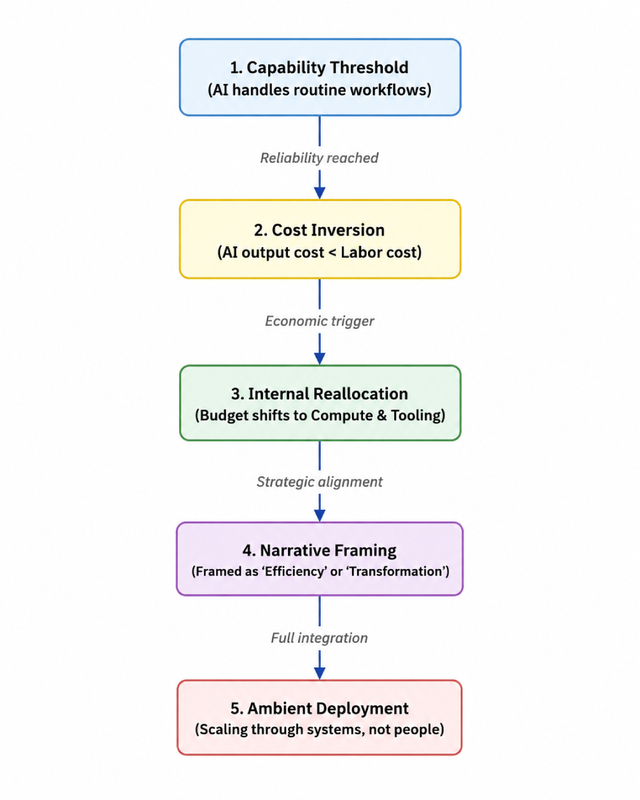
Figure 2. The Five-Phase Transition Model. This model outlines the sequential stages through which organisations integrate AI, from initial capability thresholds to ambient deployment. Each phase lowers resistance to the next, culminating in a system-driven scaling mechanism that quietly reduces the reliance on linear headcount expansion. Source: Conceptual framework developed by the author.
1. Capability threshold
The transition begins when AI systems become reliable enough to handle multi-step, routine workflows—coding assistance, summarisation, and customer query handling. This threshold has already been crossed in many domains; industry data shows AI tools are now used in the majority of development workflows, with roughly 41% of code being AI-generated or assisted in 2026 . At this point, AI stops being experimental and starts influencing real output.
2. Cost inversion
Once AI produces usable work, the economics begin to shift. The cost of generating output through AI systems declines relative to labour, especially for repeatable tasks. The comparison changes quietly: not whether AI can replace a role, but whether it can reduce the marginal cost of producing the same unit of work. Hiring slows first. Replacement comes later.
3. Internal reallocation
With cost differences established, budget decisions follow. Resources move away from expanding teams and toward compute, tooling, and model integration. This is already visible in how firms prioritise AI infrastructure spending while holding headcount flat or reducing it in selected functions. The reallocation is rarely announced as a single strategy, but it shows up in how budgets are actually deployed.
4. Narrative framing
Organisations do not describe this shift in financial terms. Instead, it is framed as efficiency, transformation, or workforce evolution. Public messaging emphasises augmentation and reskilling, even when internal changes reflect cost restructuring. This gap between operational reality and narrative is not accidental—it reduces friction while the transition is still uneven.
5. Ambient deployment
The final phase is the least visible. AI becomes embedded inside existing tools—code editors, support systems, internal dashboards—rather than introduced as a separate layer. Evidence of this shift is already widespread: recent workplace data shows that roughly half of employees now use AI in some form, often indirectly through the software they already rely on. At this stage, substitution no longer appears as a discrete event; it accumulates through everyday workflow changes.
Across these phases, the pattern is cumulative rather than abrupt. No single step forces restructuring on its own. But once all five are in motion, the organisation is no longer scaling primarily through people—it is scaling through systems that quietly reduce the need for them.
What the data and corporate signals actually show
What is emerging across major technology firms is not interpretive speculation about AI disruption but a financial pattern visible in earnings guidance, capital allocation, and workforce adjustments. The consistent signal is not layoffs or investment in isolation, but the structural coupling of rising AI-linked capital expenditure with simultaneous labour compression inside the same reporting cycles.
Amazon reflects this pattern at scale. The company has guided toward approximately $200 billion in capital expenditure for 2026, directed primarily toward AWS expansion, AI infrastructure, and large-scale data centre buildout. At the same time, it has executed multiple rounds of workforce reductions across corporate and operational layers, removing tens of thousands of roles across successive restructuring cycles. The internal structure matters more than the timing: labour is being reduced in variable-cost segments of the organisation while fixed, long-duration investment into compute infrastructure accelerates in parallel, reinforcing a shift toward capital-heavy operating models.
Microsoft shows a more systematised version of the same transition. Its capital expenditure has expanded alongside rapid AI deployment, with annual investment approaching $100 billion as Azure infrastructure scales to support model training and enterprise AI workloads. In parallel, the company has implemented repeated workforce reductions, including roughly 9,000 roles tied to organisational streamlining and AI integration. The sequencing is consistent: labour compression is concentrated in support and mid-layer functions, while capital flows into GPU-dense infrastructure designed to scale independently of headcount growth.
Oracle sharpens the structural signal rather than merely repeating it. The company has increased its capital expenditure to roughly $50 billion annually, directed toward AI data centres and cloud infrastructure expansion. At the same time, it has undergone workforce reductions estimated in the thousands across cloud operations and enterprise support functions. Unlike hyperscalers with diversified business layers, Oracle’s more concentrated enterprise structure reduces the distance between spending decisions and operational outcomes, making the substitution pattern between labour and infrastructure more directly visible within a narrower financial architecture.
Recent reporting also links these workforce reductions explicitly to funding and accelerating its AI infrastructure buildout, reinforcing the coupling between payroll compression and capital expansion rather than treating them as separate cycles. This divergence between capital investment and labor input is quantified in figure 3 below.
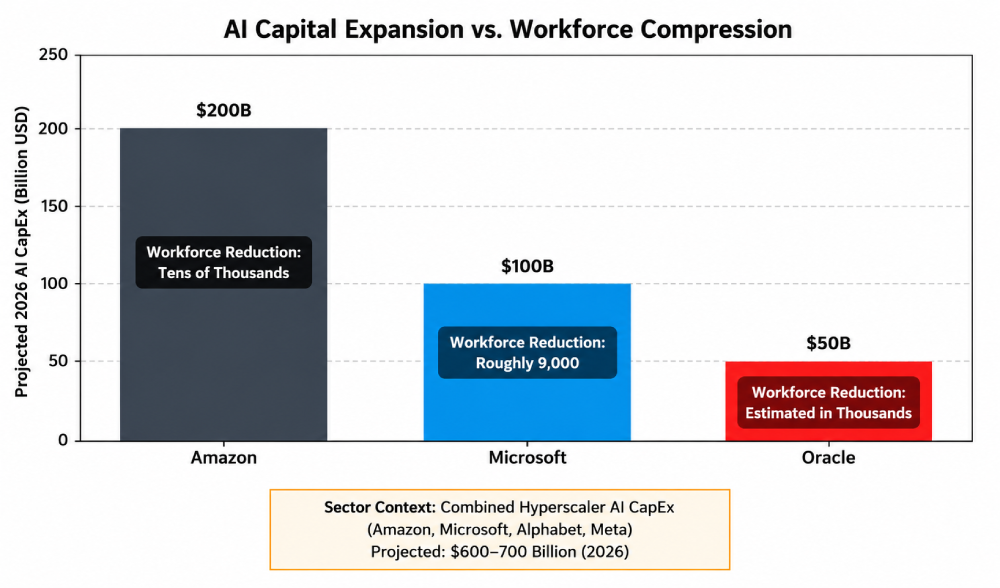
Figure 3. AI Capital Expansion vs. Workforce Compression in Major Tech Firms (2026 Projections). This chart highlights the significant projected capital expenditures by Amazon, Microsoft, and Oracle on AI infrastructure for 2026, juxtaposed with simultaneous workforce reductions. The inset box provides context on the broader hyperscaler AI CapEx projections, illustrating a sector-wide trend of reallocating resources from labor to scalable AI-driven production capacity.Source: Data compiled from Amazon.com, Inc. (2026), Microsoft Corporation (2026), Oracle Corporation (2026), and CNBC (2026).
Across the sector, capital intensity is rising faster than workforce stability is normalising. Combined capital expenditure among major hyperscalers is projected to reach roughly $600–700 billion annually by 2026, driven primarily by AI infrastructure buildouts rather than traditional IT investment. This is not incremental digitisation spending. It reflects large-scale physical infrastructure accumulation anchored in compute demand, especially GPU clusters and data centre expansion.
A second signal emerges from the internal structure of this spending. Firms are increasingly shifting cost exposure away from payroll and toward compute infrastructure. Investment concentrates in long-life assets such as data centres, networking systems, and accelerator hardware, while staffing levels in operational and support functions remain flat or decline. The result is not balanced substitution but structural divergence between capital expansion and labour input.
This divergence extends into how output is generated inside the firm. Productivity gains are increasingly emerging through workforce compression rather than proportional hiring. The change is not visible in headline employment figures alone but in output density per remaining employee, where fewer workers are now responsible for larger volumes of AI-mediated production.
In practice, this shift appears first in high-repetition functional areas: customer support, internal tooling, documentation workflows, and segments of software development. Industry analysis of enterprise AI adoption shows that firms increasing AI deployment often reduce reliance on outsourced labour and entry-level production roles while maintaining or increasing total output capacity through automation layers rather than headcount expansion.
Within cloud-native organisations, this produces a consistent operational pattern. Fewer employees are now supervising broader AI-assisted systems, where tasks are distributed across automated pipelines rather than individual contributors. The mechanism is not full replacement but compression of labour per unit of output, with AI systems absorbing coordination and execution layers that previously required human scaling.
In financial terms, this creates a structural divergence inside the firm: headcount growth flattens or declines, revenue and infrastructure scale continue upward, and output per employee increases through AI mediation layers. The result is a shift in how productivity is defined internally. It is no longer primarily a function of hiring capacity, but of how effectively AI systems are embedded into production architecture.
Common objections to the AI substitution thesis and what they miss
The strongest objections to AI-driven labour substitution do not deny the technology’s impact. They question its timing, its limits, and its long-term economic effects. Taken seriously, each raises a valid constraint. But none fully accounts for the cost structure shift already underway.
The first objection is capability-based: AI is not yet reliable enough to replace human labour at scale. This is directionally correct. Current systems still require oversight, correction, and domain-specific tuning. Yet the substitution dynamic does not depend on full replacement. It begins when AI systems become economically viable at the margin. Partial automation of support functions, code generation, or internal workflows is often sufficient to reduce hiring needs or eliminate roles altogether. Evidence from firm-level adoption shows that even incomplete automation can compress labour demand when integrated into production systems, without requiring human-equivalent performance. The threshold is not capability parity—it is cost advantage.
A second objection draws on historical precedent: productivity gains from new technologies tend to create more jobs than they destroy. This argument has strong grounding in economic theory, where automation increases efficiency, lowers costs, and expands demand, often generating new forms of work. But that mechanism assumes that productivity gains translate into proportional labour demand. What is visible in current AI deployment is a different pattern. Output is increasing without corresponding hiring and, in some cases, alongside workforce contraction.
The gap between productivity growth and employment expansion—what earlier research described as a “decoupling” effect—suggests that gains can accumulate without reabsorbing displaced labour at the same rate. Job creation may still occur, but it is no longer tightly coupled to the firms generating the productivity gains.This historical trend is visualised in the following figure 4 long-term economic index.
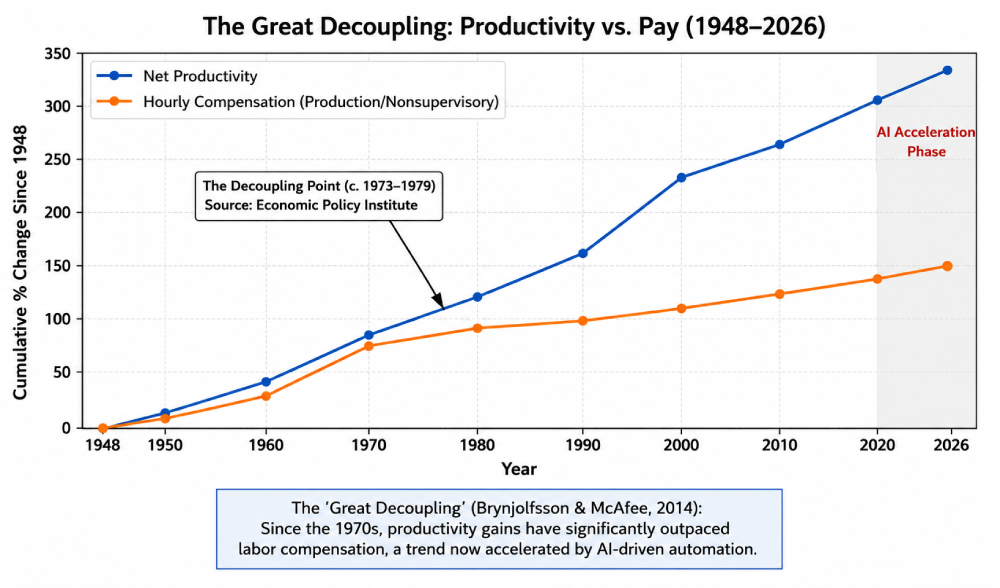
Figure 4. The Great Decoupling: Cumulative Percentage Change in Net Productivity vs. Hourly Compensation (1948–2026). This historical trend illustrates the widening gap between labor productivity and real hourly compensation, a phenomenon known as the "Great Decoupling." While this divergence began in the late 1970s, the current "AI Acceleration Phase" (2020 onwards) suggests a further exacerbation of this trend, where technological advancements drive productivity gains that do not proportionally translate into increased labor input or compensation.Source: Data adapted from the Economic Policy Institute (EPI) (1948-2023). Concept popularised by Brynjolfsson & McAfee (2014).
The third objection focuses on adaptation: workers can be reskilled into new roles created by AI systems. This is partly true and historically supported. New technologies do generate new tasks, and demand shifts toward complementary skills. However, the speed and direction of current changes complicate this transition. Evidence from recent labour market research shows that AI exposure is already reducing demand for certain entry-level and routine cognitive roles, even as demand rises in more specialised or senior positions. Reskilling does not eliminate displacement; it redistributes opportunity unevenly, often requiring time, capital, and access that are not evenly available.
Taken together, these objections identify real constraints. What they miss is the structural layer underneath them. The shift is not driven by AI achieving full autonomy, nor by immediate labour market collapse. It is driven by firms reconfiguring how work is produced and how costs are allocated. Once that reconfiguration begins, the direction of change becomes less dependent on any single limitation and more firmly anchored in the economic logic already evident across data and corporate signals outlined earlier.
The shift from labour to AI as productive capacity
What is unfolding across large firms is not simply another wave of digital transformation nor a marginal efficiency cycle driven by automation tools. It is a deeper reconfiguration in how productive capacity itself is defined. The decisive shift is occurring when AI stops functioning as an input into production and begins operating as a competing mechanism for scaling output alongside labour.
At that point, the core constraint inside organisations changes. Decisions are no longer organised around how many people are required to meet demand, but around whether incremental output is cheaper to generate through labour expansion or through AI-mediated systems. This reorientation quietly rewrites the internal logic of the firm.
Workforce strategy is already moving beyond linear hiring
Workforce strategy is one of the first domains where this shift becomes visible. Rather than expanding headcount in proportion to demand, firms are increasingly decomposing work into tasks that can be redistributed between human labour and machine systems.
McKinsey Global Institute’s analysis of generative AI exposure across occupations frames this not as job elimination, but as task-level reallocation, where work is broken into discrete components that can be selectively automated or augmented depending on efficiency and risk. In this model, roles become less stable units of organisation, and more fluid bundles of tasks that are continuously recomposed.
This mechanism is reinforced by empirical evidence from generative AI field studies in knowledge work. Controlled experiments show that when AI tools are introduced into production environments, workers do not simply produce more output within existing routines. Instead, they reallocate time away from coordination-heavy and repetitive tasks toward higher-value production activities, reshaping the internal composition of labour without immediate structural changes in headcount.
At the organisational level, Reuters reporting on recent restructuring cycles shows how this logic translates into practice. In large firms undergoing efficiency programmes alongside AI deployment, workforce reductions are disproportionately concentrated in support, administrative, and coordination layers, while core revenue-generating functions are largely preserved. What emerges is not broad labour contraction but selective substitution at the task layer, where AI absorbs intermediate work previously distributed across teams.
The result is a quieter but fundamental shift in planning logic. Hiring is no longer the default mechanism for scaling output. Instead, firms increasingly distinguish between work that requires human judgment and work that can be absorbed into AI-mediated systems. As that boundary stabilises, workforce size becomes a secondary output of design choices, while output per employee becomes the dominant internal reference metric.
Capital allocation is reweighting toward compute-driven scale
This reconfiguration of labour demand is mirrored in how firms allocate capital. Across major technology companies, capital expenditure has shifted materially toward AI infrastructure, including data centres, GPU clusters, and model deployment systems.
Microsoft, Alphabet, Amazon, and Meta have all reported sustained increases in CapEx in recent earnings cycles, with a growing share explicitly tied to AI training and inference capacity. These investments differ structurally from earlier waves of cloud expansion because they are designed not just to support software workloads, but to expand computational throughput as a primary production constraint.
Analysts at Morgan Stanley describe this phase as a shift toward AI-capital deepening, where marginal gains in output are increasingly driven by infrastructure intensity rather than workforce expansion. In this framing, capital is no longer simply a complement to labour productivity but a parallel scaling mechanism that can expand output independently of headcount.
The International Monetary Fund reinforces this interpretation in its macroeconomic analysis of AI diffusion, characterising AI as a general-purpose technology with infrastructure-like properties. Its productivity effects are uneven in the short term but potentially transformative once adoption and complementary investment reach sufficient scale. That distinction matters, because it implies that capital is being allocated not toward immediate efficiency, but toward long-horizon production capacity.
What emerges is a reweighting of firm-level balance sheets. Labour remains essential, but it is no longer the primary bottleneck for scaling output. Instead, compute capacity becomes a competing form of productive capital, capable of expanding throughput without proportional increases in organisational size.
Operating models are changing through accumulation, not redesign
The most structurally important changes are occurring at the level of operating architecture, where firms are not explicitly reorganising around AI, but gradually accumulating AI-mediated processes until the underlying coordination logic changes.
Gartner describes this emerging configuration as the “composable enterprise,” where organisational capability is no longer embedded in fixed departments but assembled dynamically across digital systems, automation layers, and human oversight functions. Execution becomes modular, distributed across interoperable components rather than concentrated in hierarchical chains.
The World Economic Forum’s Future of Jobs Report 2023 supports this directional shift at the labour-system interface. It documents a structural decline in clerical and routine cognitive roles, alongside rising demand for analytical, oversight, and systems-interaction functions. Importantly, it frames this not as simple substitution, but as a redistribution of tasks across human and machine systems, where augmentation becomes the dominant integration mode.
McKinsey Global Institute similarly emphasises that productivity gains from generative AI are maximised not through isolated task automation, but through end-to-end workflow redesign. In this configuration, the unit of organisation shifts away from roles or departments and toward process chains that span both human and machine execution.
As these systems embed deeper into enterprise software environments, decision-making itself becomes partially relocated into tool layers. AI copilots and agent-based systems embedded in enterprise platforms increasingly handle scheduling, drafting, routing, and classification tasks directly within operational interfaces, reducing the need for intermediate coordination layers.
The consequence is a gradual compression of organisational depth. Not because hierarchy disappears, but because fewer layers are required when execution is increasingly system-driven. Employees are progressively repositioned toward supervision, validation, and exception handling rather than primary production.
Taken together, these shifts converge on a single structural redefinition of the firm. Workforce strategy is moving toward task decomposition rather than linear hiring. Capital allocation is shifting toward compute-intensive infrastructure that scales independently of labour. Operating models are being reorganised around distributed execution systems rather than hierarchical coordination structures.
What unifies these developments is not automation in isolation, but a deeper shift in the meaning of scale itself. Growth is no longer primarily constrained by how many people a firm can employ or coordinate. It is increasingly constrained by how effectively it can expand and orchestrate AI-enabled production systems across its organisational architecture.
The signals that will confirm the shift has become structural
What will ultimately confirm this shift is not whether companies “use AI” or even whether they report efficiency gains. Those signals are already widespread and, on their own, don’t distinguish experimentation from structural change. The real indicator is when AI stops appearing as an input and starts appearing as a measurable unit of productivity inside corporate reporting systems.
One early signal is the emergence of formal AI productivity metrics inside enterprise measurement frameworks. A recent analysis from Deloitte shows that while roughly two-thirds of organisations report efficiency gains from AI, far fewer are able to translate those gains into measurable business outcomes such as revenue or operating performance. What this gap reveals is not a lack of activity but a lack of measurement maturity. Productivity is being observed at the task level, such as time saved and outputs accelerated, but not yet stabilised into system-level metrics.
This distinction matters. As long as AI is tracked through usage or efficiency proxies, headcount remains the dominant scaling variable. But once firms begin measuring output per employee within AI-mediated workflows, the unit of analysis shifts. Scale is no longer tied to labour input in the same way. It becomes a function of system productivity.
A second signal is the gradual reorientation of governance from model safety toward organisational impact. The imbalance is already visible. Deloitte’s latest enterprise research notes that while AI adoption is accelerating rapidly into production environments, oversight mechanisms, particularly around autonomous systems, remain immature, with only a small minority of firms having fully developed governance models for these deployments. What emerges is a structural lag. Systems are scaling faster than the frameworks designed to monitor them.
That gap is not just technical. It is institutional. A pattern highlighted across multiple industry analyses shows that firms are prioritising deployment speed over control readiness, creating a situation where AI systems are already embedded in decision-making before auditability is established. This helps explain why so many organisations report confidence in AI’s potential while simultaneously lacking the ability to demonstrate its impact or risk exposure in formal terms.
The consequence is subtle but important. Governance, in its current form, still treats AI as a tool to be managed. But as AI systems begin to shape operational decisions such as pricing, hiring, and resource allocation, the relevant question shifts from “is the model safe?” to “what is the model doing to the organisation?” That transition marks the point at which governance becomes inseparable from economic structure.
A third signal will come from reporting language itself. Today, most companies still describe AI in terms of investment, experimentation, or capability building. But early evidence suggests a divergence is already forming. Deloitte’s data shows that while a majority of firms report productivity gains, only a much smaller subset are actually reconfiguring their business models around those gains. In parallel, external analyses indicate that the financial benefits of AI are becoming concentrated among a relatively small group of firms able to operationalise it at scale, rather than those merely adopting it.
What this suggests is a shift in how AI will eventually be communicated. The separation between “technology narrative” and “workforce narrative” begins to collapse once firms can directly attribute revenue growth, margin expansion, or output increases to AI-mediated processes, especially when those outcomes occur alongside stable or declining headcount.
Once these elements align, measurement, governance, and reporting, the interpretation changes. The shift is no longer inferred from indirect signals like hiring patterns or pilot adoption rates.
It becomes visible in the system the firm uses to measure and recognise output.
Notes
Acemoglu, D., & Restrepo, P. (2018). Artificial intelligence, automation, and work (NBER Working Paper No. 24196). National Bureau of Economic Research.
Amazon.com, Inc. (2026, February 5). Amazon reports fourth quarter 2025 results and 2026 infrastructure investment plans. [Press release].
Alphabet Inc. (2026). Fiscal year 2025 earnings and 2026 capital expenditure guidance. Investor Relations.
CNBC. (2026, February 6). Big Tech AI spending approaches $700 billion in 2026.
Deloitte AI Institute. (2026). The state of AI in the enterprise 2026: From integration to operating system. Deloitte Development LLC.
Frank, M. R., et al. (2019). Toward understanding the impact of artificial intelligence on labor. Proceedings of the National Academy of Sciences (PNAS), 116(14), 6531-6539.
Gartner. (2025, October 20). Gartner identifies the top strategic technology trends for 2026. [Press release].
International Monetary Fund. (2026). Global economic and financial implications of artificial intelligence: Lessons from a scenario-planning exercise. (IMF Note 2026/002).
McKinsey Global Institute. (2023, June 14). The economic potential of generative AI: The next productivity frontier. McKinsey & Company.
McKinsey Global Institute. (2023, July 26). Generative AI and the future of work in America. McKinsey & Company.
Meta Platforms, Inc. (2026). 2026 capital expenditure outlook: Scaling AI infrastructure. Investor Relations.
Microsoft Corporation. (2026, January 27). Earnings release FY26 Q2: Azure and AI infrastructure expansion.
Morgan Stanley Research. (2026, February 11). AI: Mapping the rate of change. Morgan Stanley & Co. LLC.
Morgan Stanley Wealth Management. (2026, March 11). AI capex 2026: $740 billion signals bank tailwinds. Morgan Stanley. Oracle Corporation. (2026, March 10).
Oracle reports Q3 fiscal 2026 results: $50 billion AI data center expansion. [Press release]. (https://www.oracle.com/news/announcement/q3-fiscal-2026-results-2026-03-10/).
Reuters. (2026, April 9). Reporting on recent restructuring cycles and AI infrastructure buildout.
Snap Inc. (2026, April 15). Organizational changes at Snap: Embracing AI-driven efficiency. Snap Newsroom.
Tyson, L. D., & Zysman, J. J. (2022). Automation, AI, and work. Daedalus, 151(2), 202-220.
World Economic Forum. (2023, May). The future of jobs report 2023.