English
 Español
 Français
 Deutsch
 Italiano
 Português
On September 22, during the United Nations General Assembly in New York, President Donald Trump brought together 15 Latin American and Caribbean heads of state to formalize the so-called “Shield of the Americas.” The stated purpose is to combat transnational crime, drugs, and terrorism, which are ravaging certain countries with particular intensity. Under this agreement or pact, the United States aims to increase its economic, military, and political presence through a new model that threatens to erode sovereignty.
From South America, Argentina, Bolivia, Chile, Colombia, Ecuador, Guyana, Paraguay, and Peru joined the initiative. Curiously, Venezuela—a country now considered a protectorate after being invaded, having its president kidnapped, and signing an agreement with Washington to exploit the world’s largest oil reserves—is not part of the agreement. From Central America and the Caribbean, Costa Rica, El Salvador, Honduras, Panama, the Dominican Republic, and Trinidad and Tobago joined.
Previously, on March 7 of this year, President Trump invited a group of ideologically aligned leaders to his private residence in Miami, Mar-a-Lago—an event attended by Chile’s newly elected president, José A. Kast, even though he had not yet been sworn in—where the creation of the “Shield of the Americas” was announced to combat the real threat of drug trafficking and terrorism.
The underlying, real message was to contain China’s growing presence in the region, ease border restrictions for the deployment of military forces, and establish a new type of U.S. presence. This is the realization of the Pentagon’s and the powerful Southern Command strategic, geopolitical vision, which seeks to implement the concept coined by Trump as the “Donroe Doctrine”—which is no longer the original 1823 version by President Monroe, intended to keep Europeans away from the nascent American republics—but rather U.S. control over the continent in all areas considered threats to its national security.
This became clear from the initial statements and, subsequently, from the formal text signed in New York, which highlights three main pillars: economy, security, and multilateral coordination. Without explicitly mentioning China, the document states that “supply chains for critical minerals must be safeguarded”—that is, to close the door to investments in strategic areas by countries outside the region.
On the security front, it seeks to address threats through coordinated government action in the intelligence sphere, as well as to “facilitate access, where appropriate, to security technologies and capabilities” and to maintain a common position—that is, one in line with the United States—in multilateral forums. Furthermore, the document invokes the Inter-American Treaty of Reciprocal Assistance, signed in 1947 at the onset of the Cold War, which contains a clause similar to NATO’s Article 5, whereby an attack on one is an attack on all. This means facilitating the deployment of troops into a country to combat terrorism and drug trafficking, which are regarded practically as an autonomous, sovereign power.
In effect, we appear to be facing a new definition of the concept of sovereignty—this time on a continental scale—inspired by the principle invoked by one of the founding fathers of political science, Thomas Hobbes, who in 1651 identified the state as a great monster, an absolute and sovereign power, which he called Leviathan and which is the result of a pact among individuals to overcome the state of nature and guarantee security. This is like the pact proposed by Washington and embodied in the “Shield of the Americas.”
Since narco-terrorism is a transnational threat and not all countries have the capacity to confront it, they can do so with U.S. support, ceding part of their sovereignty in exchange and, in turn, receiving military equipment, intelligence, and military training that the U.S. is willing to provide.
The new Colombian government has already accepted this, as have those of Ecuador, El Salvador, and Guatemala, which have authorized joint military operations. Added to this is the U.S. government’s demand for increased defense spending in the region, as stated by Secretary of Defense Peter Hegseth on August 12 during a meeting in Panama with 18 of his Latin American counterparts. There, in a stern, authoritarian tone, he stated that the percentage of GDP allocated to defense in the region was “ridiculous” and that it should be significantly increased, since on average it does not reach 2% of GDP.
Argentina and Peru have begun purchasing U.S. aircraft and military equipment. Chile announced on September 24 that it will make a historic purchase to replenish its military equipment, though the total cost has not yet been specified. Hegseth’s call went further, extending to the multilateral level, as he urged countries to withdraw from the International Criminal Court (ICC) on the grounds that it poses a threat to national sovereignty. Venezuela has already formalized its withdrawal, which will take effect on July 24, 2027.
It remains to be seen whether other countries will comply with this demand. Likewise, Colombia has severed diplomatic relations with Iran, while Chile announced its withdrawal from the Non-Aligned Movement and has closed its embassy in Tehran.
The United States, bolstered by a political climate that has enabled the far right to take power in several governments, has so far managed to rally 15 countries behind it. While some are more closely aligned than others, U.S. strength and power are very difficult to counter due to dependence in the areas of defense, technology, investment, and culture. Washington’s sights are set on absolute geopolitical control of Latin America, its strategic natural resources, the Strait of Magellan, and, above all, its strategic reach into Antarctica.
Then there is Brazil, the region’s leading power, with a population of nearly 222 million, which maintains close ties with China in the areas of investment, trade, technology, science, and even defense. In 2025, bilateral trade between the two countries reached $171 billion, and Chinese investment in Brazil totaled $6.1 billion.
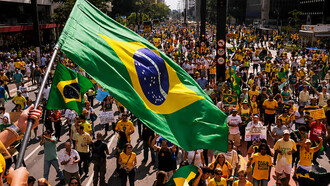
The upcoming Brazilian elections for president, governors, and part of Parliament—scheduled for October 4, with a likely runoff on October 25—will determine whether the country continues to be governed by center-left President Luiz Inácio Lula da Silva or by Flavio Bolsonaro, who follows the far-right line of his father, former President Jair Bolsonaro, who is serving a 27-year sentence for attempting a coup d’état. If re-elected, Lula will likely ensure that Brazil remains the only South American country to maintain a degree of independence from Washington. Conversely, if Bolsonaro wins, Brazil will most likely become another member of the “Shield of the Americas.”
The political development that has gained prominence in several countries across the region is the internal division that is beginning to grow in some nations between those who support joining this new pact with the United States and those who reject it—a division that has become part of the debate among the government, the opposition, and civil society.
The most significant development has occurred in Chile with a public letter signed by former presidents Michelle Bachelet and Gabriel Boric on September 25, calling on the Kast administration to withdraw the country from the “Shield of the Americas” for endangering our independence, eroding sovereignty, and breaking with a tradition of strategic autonomy dating back more than a century that Chile has maintained throughout its democratic history. Temporary far-right governments, such as those in Argentina, Chile, or Colombia, must look beyond the immediate situation and weigh the national interest, traditions, and national dignity—and not bow to the imperialist pressures ravaging the continent.