English
 Español
 Français
 Deutsch
 Italiano
 Português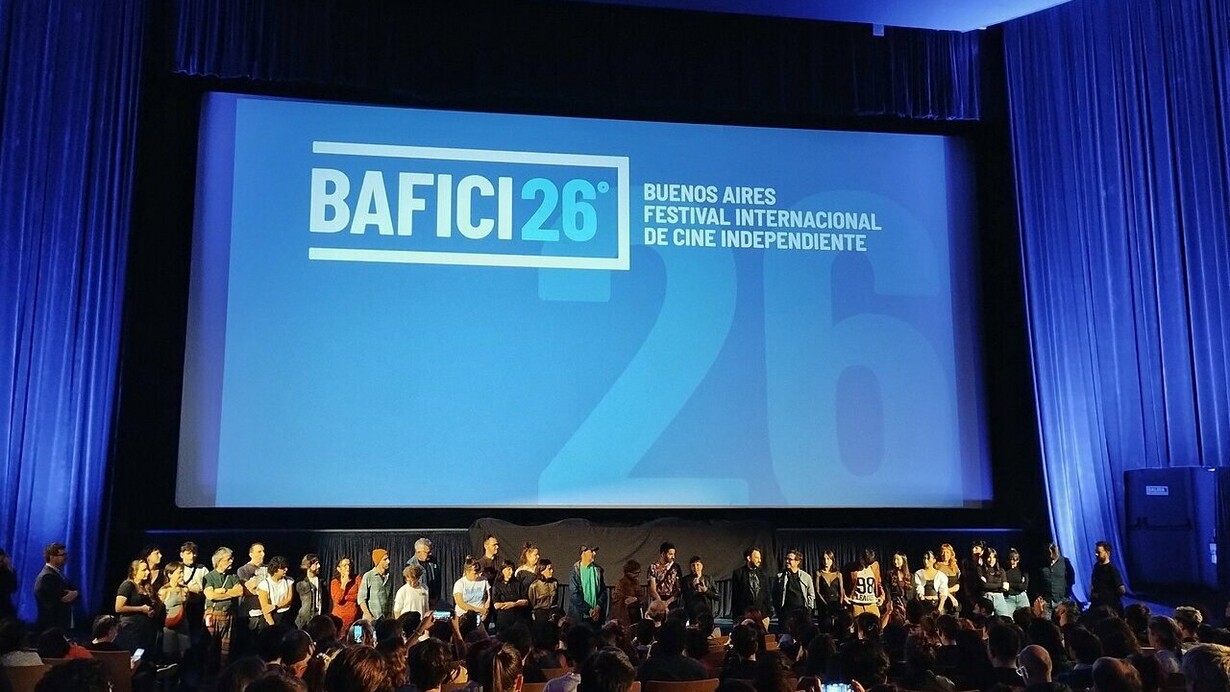
The Buenos Aires International Independent Film Festival (BAFICI) held its 27th edition in April. The festival programmed 327 films—shorts, medium-length works, and feature films—144 of which were Argentine productions. Javier Porta Fouz, the festival’s artistic director since 2016, once again stated that Argentine cinema remains the backbone of BAFICI and insisted that no one involved is attempting to deny the crisis currently affecting the sector. As an example of this crisis, he mentioned the lack of movie theatres outside Buenos Aires that screen subtitled films.
This is, to put it bluntly, a remarkably weak diagnosis. The issue Porta Fouz points to is marginal when compared to the real and structural problems facing Argentine cinema today. The absence of sustained and intelligent distribution strategies for national films is far more damaging, as is the complete lack of a competitive digital platform capable of expanding their circulation beyond the festival circuit. These are not secondary concerns; they are central to the survival of any contemporary film industry.
I will not even begin to address the dire state of the National Institute of Cinema and Audiovisual Arts, whose dismantling has been widely documented. Claiming that films continue to be made in Argentina “despite everything” is not a consolation—it is an empty slogan. Moreover, the constant invocation of “crisis” has become meaningless. This is no longer a temporary downturn. The crisis has lasted so long that it has hardened into a structural condition, shaping not only how films are made but also how they are seen, distributed, and remembered.
BAFICI was founded in 1999, at the same historical moment as the emergence of what came to be known as the New Argentine Cinema. In clear opposition to films produced by large television-backed studios, a group of filmmakers—among them Martín Rejtman, Lucrecia Martel, and Adrián Caetano—began making films that confronted social reality head-on while reactivating aesthetic traditions such as the experimental cinema of the 1960s. The festival’s first director was filmmaker Andrés Di Tella, son and nephew of Torcuato and Guido Di Tella, towering figures of Argentina’s artistic avant-garde. From its inception, BAFICI was not merely a festival but a political and cultural intervention: a space where a different idea of cinema could be seen, discussed, and validated.
That identity suffered a decisive blow in 2007, when Mauricio Macri’s party, Propuesta Republicana, took control of the Buenos Aires city government. That same year, after only three years as artistic director, Fernando Martín Peña resigned, publicly denouncing the progressive loss of the festival’s financial autonomy. According to Peña himself, from that point onwards the festival began to lose its mass appeal, while official statistics—particularly attendance numbers—were manipulated to conceal that decline. This moment marked a rupture. BAFICI ceased to function as a genuinely autonomous cultural space and instead became increasingly aligned with the political priorities of the city administration.
Over nearly three decades, the festival has repeatedly reshaped its profile as different directors imposed their own curatorial visions. In recent years, BAFICI has increasingly served as a platform for advance screenings of films that are independent in name only. In reality, many of these works belong more comfortably to the category of international auteur cinema. The public knows this well: if they want to see these films on a large screen, the festival may be their only chance. Otherwise, they face the prospect of an extremely delayed commercial release—or no release at all.
In the 2026 edition, notable examples included François Ozon’s L’Extranjère and Richard Linklater’s Blue Moon, films that circulate comfortably within global festival networks but hardly embody the spirit of independence that once defined BAFICI.
Still, it would be dishonest to deny that BAFICI remains a crucial showcase for student films and for works by young Argentine filmmakers. In this edition, the Argentine short film Queda en mí, directed by Rafael Nir, won Best Short Film in the international competition. This award speaks to the undeniable strength and creativity of contemporary Argentine cinema. The presence of Argentine films in virtually every major international festival today is not accidental; it is the result of the early visibility and legitimacy that BAFICI provided when few other institutions were willing to take that risk.
The programming of the 2026 edition also stood out for the inclusion of four Ukrainian films addressing the war launched by Russia in 2022. These productions would almost certainly never reach Buenos Aires screens through commercial distribution channels. This is precisely where festivals still matter: they can create access to images and narratives that the market has no interest in circulating. Within national cinema, the festival paid tribute to filmmakers Raúl Perrone and Liliana Paolinelli, whose work has remained outside the mainstream yet has exerted a profound influence on younger generations.
The most significant—and perhaps most urgent—development of this edition was the launch of the BAFICI Archive, an initiative led by former festival director Sergio Wolf in collaboration with the Museum of Cinema. The degree of institutional neglect surrounding the preservation of Argentina’s cinematic history is nothing short of scandalous. While researching this article, I found shockingly little information about the festival’s own past: a handful of articles published more than seven years ago and very little else.
The Museum of Cinema has issued a public call on social media, asking individuals to donate programmes, catalogues, and other materials in order to reconstruct the archive. The obvious question is whether the city government itself preserved copies of these materials from all 27 editions. The silence on this matter is, unfortunately, telling.
Finally, one omission in the national sections deserves explicit mention. No programmer selected La noche está marchándose ya by Córdoba-based directors Ezequiel Salinas and Ramiro Sonzini. The film is a masterpiece and, without exaggeration, one of the most powerful Argentine films of recent years. This exclusion is not incidental; it exposes the fiction that film festivals are neutral spaces guided solely by aesthetic merit. Salinas and Sonzini’s film confronts the country’s social collapse head-on and proposes cinema itself as a form of refuge. This is not a metaphor. The story revolves around a group of characters who literally seek shelter in the municipal film club of the city of Córdoba. To overlook such a film is to make a political choice.
A few weeks before the Cannes Film Festival, director Nanni Moretti publicly lamented the absence of Italian films in its official selection. There are co-productions, yes, but no Italian titles competing under their own flag. At the same time, the only Argentine presence at Cannes this year was a remastered version of The Angel’s House by Leopoldo Torre Nilsson, a 1957 film screened in the Classics section.
The parallel is impossible to ignore. What do Argentina and Italy have in common? Right-wing governments that treat culture as expendable—and then feign surprise when the consequences become impossible to hide.