English
 Español
 Français
 Deutsch
 Italiano
 Português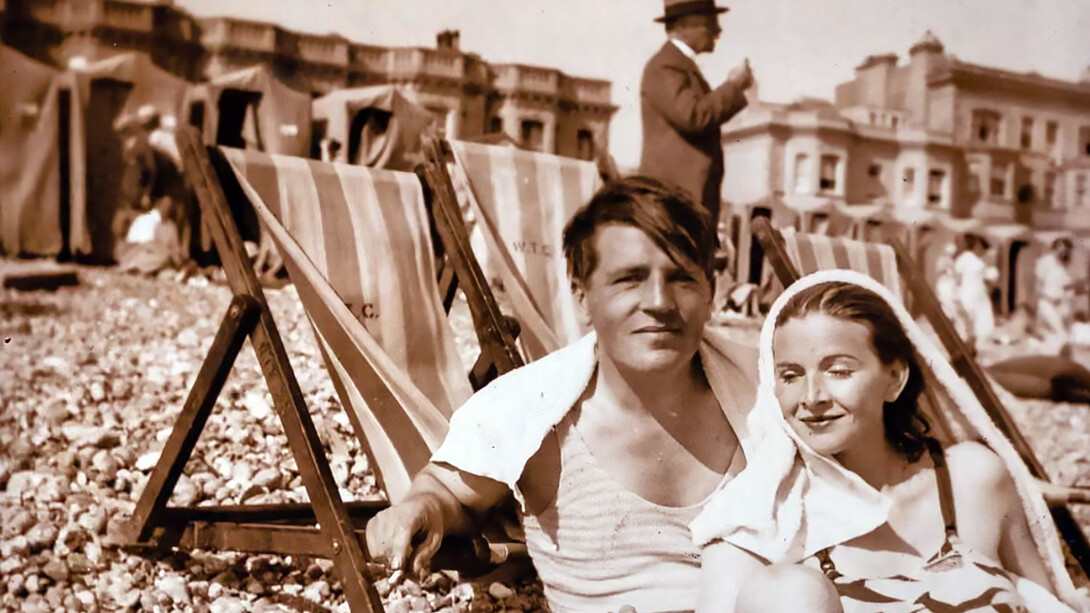
Why has an author as gifted, well-connected, and culturally vital as Arthur Calder-Marshall remained—until quite recently—on the margins of collective memory? An author of refined education, with remarkable ties to Hollywood, and a career poised between masterpieces and underappreciated works. The elusive yet pioneering nature of his writing may have denied Calder-Marshall the same hold on the public imagination granted to other twentieth-century British authors.
One of the central titles from which a rediscovery of his work should begin is The Way to Santiago (published in 1941), which a recent article by Mary Kaminsky describes as “a powerful hybrid of espionage thriller, mystery, adventure, and noir.” Set in South America shortly after the Spanish Civil War and at the outbreak of the Second World War, the novel follows the English reporter Jimmy Lamson as he investigates the murder of a fellow journalist. Over the course of the narrative, the protagonist moves through a “Hollywood backlot” universe: sinister cellars, glittering palaces, crumbling railways, and dirt roads populated by ambiguous figures—beautiful women, trigger-happy hitmen, and English gentlemen.
The narrative substance of The Way to Santiago derives from Calder-Marshall’s personal experience: the author had travelled across Latin America during a six-week break from a film assignment for Metro-Goldwyn-Mayer (MGM). It is therefore a hybrid “mission”: reportage, fiction, adventure, and irony. It is precisely this nature that may have made Calder-Marshall difficult to place within the rigid framework of literary labels.
One of the most fascinating anecdotes in this story is the novel’s connection with Orson Welles. The young director proposed it for a film adaptation, sensing an affinity with his own vision, but the project never came to fruition. In developing the screenplay, Welles altered characters, plots, and narrative emphases—in some cases reducing or eliminating entire figures to suit his interpretation; in one instance, he replaced a character with a role conceived by himself. This “rewriting,” though intriguing, likely failed to do justice to the complex figures created by Calder-Marshall, whose integrity would have required a more audacious stroke of fate.
That stroke arrived decades later. In 2020, the actor who portrays Welles in Mank (directed by David Fincher), Tom Burke, turned out to be Calder-Marshall’s grandson. Burke has said that he learned of this connection only by chance, after accepting the role—his grandfather, he explains, rarely spoke about it. This meta-biographical intersection adds an almost mystical note to the entire story, knotting together art, fate, and family memory.
The Way to Santiago is not, however, the only tile in a complex mosaic. Calder-Marshall emerged from a remarkable intellectual milieu: he studied at Oxford, moved among leading figures such as Stephen Spender, John Betjeman, and Isaiah Berlin, and his friendships and editorial relationships allowed him to circulate with ease within the literary circles of the time.
He was also involved in the film world: together with his wife, Ara, with whom he formed an elegant couple of Hollywood charm, he collaborated with MGM (in part as a writer of story treatments) until the pressures of wartime and life in Hollywood, Los Angeles, forced them to flee the “city where people looked as good as the food but turned out to be bland.”
Moreover, Calder-Marshall was regularly “optioned” by Hollywood. James Mason was among those who expressed interest in adapting the novel Occasion of Glory, with the intention of directing it—a project that never materialized.
In literary terms, one of his early novels was Levy, which received a highly favorable review from The New York Times, praising it for its “remarkable quality.” In response, the publisher Jonathan Cape offered him a contract for six novels. Yet despite these openings, his name was never firmly established.
Calder-Marshall also explored a wide range of genres: not only novels—often with a thriller bent—but also children’s books, biographies (including those of the Victorian sexologist Havelock Ellis, the ethnographic filmmaker Robert Flaherty, and the Anglican monk Joseph Leycester Lyne), and finally an autobiography, The Magic of My Youth, written in a visionary and nostalgic key, blending obsessions, fantasies, occult allusions (including Aleister Crowley), and literary memory.
The fact remains that, as Kaminsky writes, The Magic of My Youth “does not solve the mystery” of Calder-Marshall, remaining “encoded” in its style and ambiguities. Another, more complete and detailed autobiography is said to be preserved in the private archives of his daughter, Anna Calder-Marshall, but has yet to be published. Paraphrasing one of his most successful works (The Scarlet Boy), we hope it will soon see the light of day—and that some twist will make the exceptional strange, the dreaded welcome, our cherished ambition empty, and the recognition of defeat a victory.
Ultimately, the trajectory of Arthur Calder-Marshall seems to embody the fate of those authors who elude simplification and easy canonization: too eclectic to be neatly classified, too torn between literature and cinema, between commitment and irony, and between private memory and collective myth. For this very reason, his work appears strikingly modern today. To reread him is to question not only what literary history remembers but also what it chooses to forget. The rediscovery of Calder-Marshall is therefore not a nostalgic exercise but a critical act: an invitation to reopen archives, to pursue new research, and to restore a voice to a figure who, long relegated to the margins, was able to capture, like few others, the ambiguity of the twentieth century and the subtle boundary between failure and revelation.