English
 Español
 Français
 Deutsch
 Italiano
 Português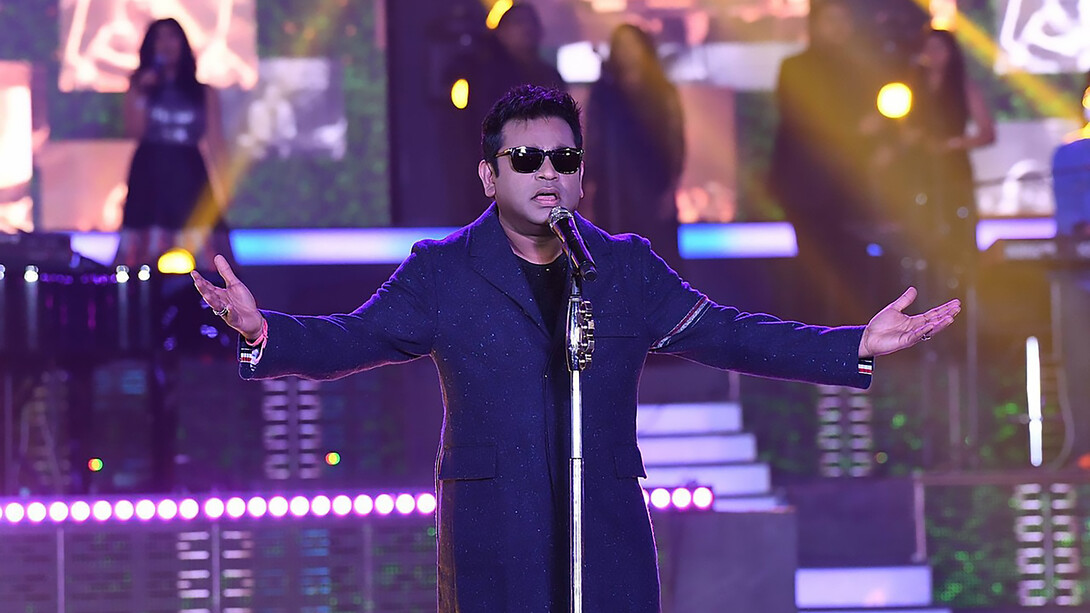
Academy Award winner A.R. Rahman is perhaps the best-known mainstream Indian popular music composer in much of the world. The diminutive composer from the South Indian city of Chennai, in the state of Tamil Nadu, has to his credit two Oscars, two Grammys, one BAFTA, and one Golden Globe among his collection so far. The soft-spoken composer, who has a squeaky-clean image as a totally non-controversial professional, recently dropped a bombshell about being discriminated against by the Hindi film industry, popularly known as Bollywood.
In an interview with the BBC Asian Network, Rahman opened up about the “communal” angle suspected of denying him work in Bollywood for about eight years now. When asked about how the Hindi film industry that had once embraced him had been treating him of late, he replied, “Past eight years, maybe, because the power shift has happened. People who are not creative have the power now to decide things. And it might have been a communal thing also. But not in my face.”
“I hear Chinese whispers that this happened and they booked you and the music company funded the movie and got their five composers,” he explained, citing industry information about why he was dropped from certain projects.
But he took it rather lightly. “I said, ‘Oh! That’s great. Rest for me. I can chill out with my family’.”
What needs to be read from the unsaid is that the new India, where Hindu nationalism is all-pervasive, even in the entertainment industry, could be behind him being ignored for work in Bollywood, based in Mumbai.
He also recalled how even an industry stalwart like Subhash Ghai, known for big-budget commercial Hindi films, had once asked him to learn Hindi if he wanted to survive in Bollywood.
On why he felt he never belonged to Bollywood, despite delivering such super-duper hits as Bombay, Rangeela, and Taal, apart from Tamil movies dubbed into Hindi, such as his debut movie, Roja, Rahman said, “I think the reason was that I never spoke Hindi.”
But what came next is a loaded political statement with multiple layers of a language issue that India has never been able to settle. “And for a Tamil person to learn Hindi is very difficult, because we have such an attachment to Tamil,” said the composer.
For the uninitiated, it needs a bit of an explainer on why the Tamil speakers in particular, and South Indian states in general, have been resisting the imposition of Hindi by the Union government.
The southern states had witnessed heavy violence in the 1960s and intermittent mass protests whenever the Union government tried to impose Hindi. Tamil Nadu has been the leader in that struggle against linguistic chauvinism. Rahman’s position on Hindi literally stems from that reality.
Firstly, Hindi is not a pan-Indian language. It is only one of the 22 languages listed in the Eighth Schedule of the Indian Constitution that accords equal status to each of them.
Interestingly, English, along with Hindi, is one of the official languages of the Union government. The states have their respective languages and English as their official languages. This shows how English has always been the sole link language in India that got rid of the British colonialists in 1947, but retained the language that helped Indians become one of the biggest English-speaking populations in the world.
Rahman recalled how Subhash Ghai prodded him to learn Hindi. “Subhash Ghai said that if you want to be (in Bollywood)—I love your music, and I want you to stay longer—you should learn Hindi. I said, “Okay, let me go one step further and learn Urdu, which is the mother of Hindi music in the 60s and 70s.”
The allusion was to how Hindi film songs of the 1960s and 1970s were in Urdu, one of the classical Indian languages listed in the Eighth Schedule of the Constitution.
So, Rahman recalled, he went on to learn Urdu and then Arabic, upon which it is rooted, before learning even Punjabi, another classical Indian language.
His stunning revelation about a hugely popular and immensely talented composer like him being ignored for work due to his faith has gone on to grab media attention in India.
But he admitted that his work continues to be embraced by Hindi-speaking North Indians and film industry professionals who still meet in Chennai.
“So it's a beautiful thing (that I have such acceptance in Mumbai). I am honored and grateful,” he said, thanking the Hindi film industry and music lovers for accepting him although he’s not had any work with them for eight years.
But, as one of the busiest global musical icons, Rahman has been busy writing his symphonic compositions, running his music academy in Chennai, Firdaus Studio in Dubai, and taking care of his international assignments and stage shows.
But the silver lining is that Rahman has collaborated with Hollywood composer Hans Zimmer in writing the scores for Ramayana, a multilingual film on the eponymous Hindu epic.
While Ramayana, the epic about the victory of good over evil, could well be the harbinger of good news for the composer, the god-fearing Rahman, who follows the Sufi, a mystical dimension of Islam, trusts in God.
“Whatever I deserve, I get from God,” he noted, insisting that he doesn’t search for work.
He noted how he, a practicing Muslim, and Hans Zimmer, a Jew, were composing the music for Ramayana, a Hindu epic. Rahman clearly drew inspiration from “the good things” that he learned from the Ramayana and the Mahabharata, another Hindu text, that he studied in the Brahmin school he attended.
The comments from the tallest figure in Indian popular music come at a time when India is grappling with Hindu right-wing propaganda films. Nearly all of them are in Hindi. Considering the ruling Hindu nationalist Bharatiya Janata Party’s dominant reach in North India, some of these films are box office hits.
One of them, Chhaava—a huge commercial success—came in for reference, with Rahman calling its content “divisive.” He composed music for the film upon its director’s insistence.
“It is divisive. It cashed in on divineness,” he said, but added that the people were smart enough to reject such ideas.
“The people are much smarter than that. Do you think people will get influenced by movies? They have something called the internal conscience, which knows what the truth is and what manipulation is,” he said as a redeeming fact that could negate the influence of even propaganda films.
But the suspicion of the “communal” angle being a discriminatory element has been rejected by a few who spoke up in Bollywood. Veteran lyricist Javed Akthar argued Rahman could be mistaken, while others like actor-turned-BJP politician Kangana Ranaut called Rahman “prejudiced and hateful,” and columnist Shobha De termed his remarks as “very dangerous.”
Rahman, however, clarified his comments in an Instagram video.
“India is my inspiration, my teacher, and my home. I understand the intention can sometimes be misunderstood. But my purpose has always been to uplift, honor, and serve through music.”
He then spoke about his musical initiatives and having the “honor of scoring Ramayana alongside Hans Zimmer; each journey has strengthened my purpose.”
“I remain grateful to this nation and committed to music that honors the past, celebrates the present, and inspires the future,” he added, signing off.
While it is a fact that Shahrukh Khan, Salman Khan, and Aamir Khan are three top Muslim stars that rule Bollywood even today, veteran actor Naseeruddin Shah has not been in the thick of things, as he has been in the crosshairs of the Hindu nationalist ecosystem.
It is also a fact that film industry professionals from South India often find it difficult to stay in Bollywood. Whether it is legendary singers KJ Yesudas and SP Balasubrahmanyam or actors such as Kamal Hassan, South Indian stars don’t usually enjoy staying power in the Hindi film industry.
Others, like South Indian actor Prakash Raj, known for his strident criticism of the ruling BJP and its Hindu nationalistic ecosystem, had alleged that he was abruptly pulled out of movies and commercials due to his political stand.
It’s no wonder Rahman landed in the crosshairs of the right-wing ecosystem, although his comments were based on his experience.