English
 Español
 Français
 Deutsch
 Italiano
 Português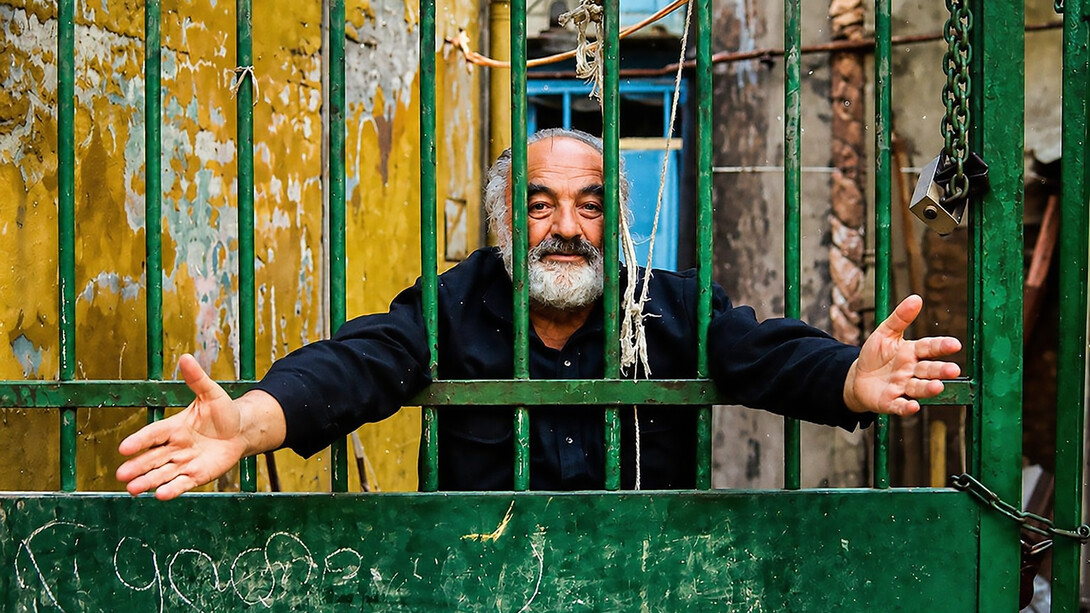
In the long and complicated history of the South Caucasus, where a beautiful mixture of neighboring cultures rises on hillsides and where the flavors of two ancient cuisines blur at the table, few individuals embodied the spiritual fusion of these neighboring cultures as completely as Sergei Iosifovich Parajanov. Born in Tbilisi in 1924 to an Armenian family, he carried within himself the double inheritance of his people: the stubborn, poetic grief of Armenia and the theatrical, life-loving exuberance of Georgia. These were not contradictions for Parajanov. They were the two hands with which he fashioned his art.
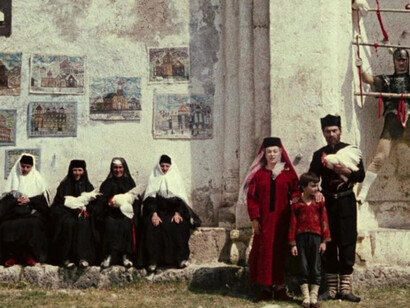
He is sometimes called simply a Soviet filmmaker, which is technically accurate and spiritually misleading. Parajanov used the infrastructure of Soviet cinema the way a prisoner uses the walls of his cell—as something to push against, to mark, and to transform through sheer force of imagination. His films belong not to any state but to the mountains, the monasteries, the looms, and the legends of the Caucasus. They belong to pomegranate trees and folk songs, to embroidered cloth and the candlelight of ancient churches.
His Armenian identity was profound, but so was his Tbilisi soul. He grew up in the old city's Armenian quarter, in a house filled with antiques his father collected, surrounded by the overlapping sounds of Armenian and Georgian spoken in the courtyards and bazaars. This bilingual, bicultural childhood was not an accident of biography—it was the raw material of genius. Parajanov would spend his life converting that raw material into images of heartbreaking beauty.
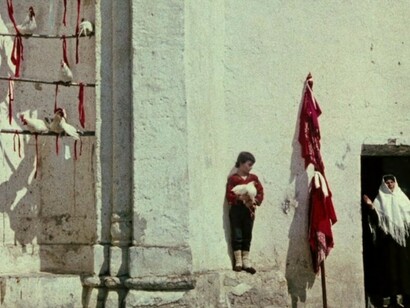
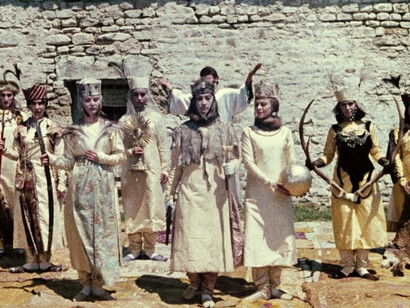
In 1969, Parajanov completed what many consider his masterpiece: Nran Guyne—known in the West as The Color of Pomegranates. The film is a loose biography of the eighteenth-century Armenian poet and troubadour Sayat-Nova, but to describe it as a biography is to say that a cathedral is a building. It functions more as a visual poem, a sequence of ceremonial tableaux in which the life of a poet becomes a meditation on Armenian culture, religious devotion, sensory experience, and the mystery of artistic creation itself.
The pomegranate is the film's central symbol, and it is difficult to overstate how perfectly chosen it is. The pomegranate is the fruit of the Caucasus, thriving in the warm valleys between the mountains, its skin the deep crimson of dried blood, its interior an intricate architecture of jewel-like seeds. In Armenian tradition, the pomegranate symbolizes fertility, abundance, and the complexity of the soul—hundreds of seeds contained within a single skin, like the many facets of a person or a people. In the film, pomegranates bleed onto white cloth in the opening sequence, their juice spreading like ink or like life itself, staining everything it touches.
That image — deep red against white — recurs throughout Parajanov's visual universe. It is the color of sacrifice and of joy, of the liturgical and the earthy. It is the color that connects the Armenian church to the Georgian marketplace, the color that runs through the veins of both peoples. When Parajanov placed bleeding pomegranates at the center of his film about a poet who sang in Armenian, Georgian, and Azerbaijani with equal fluency, he was making a statement about art as a force that transcends the borders men draw between cultures.
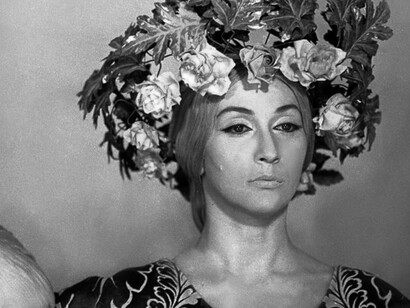
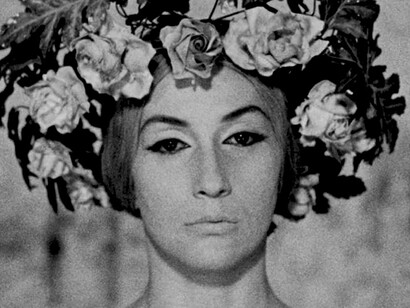
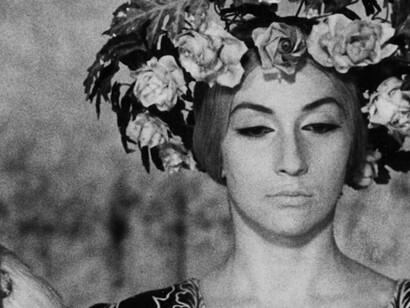
If the pomegranate is the film's symbolic heart, then Sofiko Chiaureli is its living soul. The great Georgian actress, one of the most celebrated performers in Soviet cinema, plays no fewer than six roles in The Color of Pomegranates, including both the male poet as a young man and his idealized female beloved. That Parajanov — an Armenian director making a film about an Armenian poet — chose a Georgian actress to serve as his central presence is not incidental. It is the thesis of the film made flesh.
Sofiko Chiaureli was the daughter of the Georgian film director Mikheil Chiaureli and the actress Veriko Anjaparidze, herself a legend of the Georgian stage. She was aristocracy of the Caucasian arts world, carrying in her face the aquiline dignity of Georgian court portraits and in her bearing the trained stillness of a woman who understood that true performance is not about movement but about the quality of attention one brings to a space. Parajanov recognized in her something that transcended national boundaries: she was a vessel for the Caucasus as a whole.
In Parajanov's hands, Sofiko becomes an icon in the Byzantine sense—not a realistic person but a hieratic presence, a figure flattened against ceremonial backgrounds, her expressions controlled to the point of saintliness. Yet through this extreme stylization, she radiates warmth and grief and desire. She moves through the film's tableaux like a flame moving through a cathedral: contained, deliberate, and illuminating everything around her. Her collaboration with Parajanov was one of those rare unions in cinema where director and actor seem to think with a single mind.
The bond between them was also a bond between their cultures. When Sofiko later spoke of Parajanov, she described him as someone who could not be contained within any single identity. He was Armenian, she said, the way a pomegranate tree is Armenian—rooted in that particular soil, shaped by that particular climate, but belonging ultimately to anyone with the eyes to see its beauty. Their friendship lasted decades, surviving Parajanov's imprisonment, his exile from filmmaking, and the political storms that battered both of their careers.
To understand what Parajanov achieved, it helps to think about what makes Caucasian art distinct. Armenia and Georgia are both ancient Christian civilizations, both heirs to traditions of manuscript illumination, stone carving, polyphonic song, and textile craft that predate most European cultural traditions. Both cultures developed in the narrow valleys and high passes between mountains that served simultaneously as highways and barriers, connecting them to Persia, Byzantium, and the steppe while keeping them distinct from all of these.
In Armenian art you feel the weight of stone—the great carved khachkars, or cross-stones, where geometric interlace and sacred symbol interweave in patterns of almost mathematical complexity. There is a density to Armenian aesthetic culture, a sense that beauty must be earned through patience and precision. In Georgian art you feel something more theatrical, more operatic, freer, and more flexible—the sweeping frescoes of medieval churches, the elaborate goldwork of the national treasuries, and the grand polyphony of Georgian choir singing, where individual voices weave together like threads in a tapestry.
Parajanov absorbed both traditions and synthesized them into something entirely his own. His films are filled with the dense symbolic patterning of Armenian manuscript art—every frame composed like an illuminated page—but they also breathe with Georgian theatricality, with a delight in costume and performance and ritual display. He understood that the border between Armenia and Georgia was a membrane, not a wall: porous, vibrating with the passage of influences in both directions across centuries.
The Soviet authorities, who had initially celebrated Parajanov's earlier, more conventional work, did not know what to make of his mature films. The Color of Pomegranates was suppressed, screened only in limited venues, and subjected to cuts and alterations by censors who demanded narrative clarity from a work that had deliberately abandoned narrative. In 1973, Parajanov was arrested on charges that were clearly pretextual and sentenced to five years in a labor camp. He served four years.
Even in the camps, he continued to make art—small collages assembled from whatever materials he could find, tiny shrines of scraps and threads and found objects that possessed the same quality of sacred intensity as his films. These collages, which survive in museums in Yerevan and Tbilisi, are perhaps the most moving documents of his creative life: proof that imagination cannot be imprisoned, that the aesthetic impulse survives even when stripped of resources, even when the only available materials are a scrap of tin foil and a withered flower.
After his release, Parajanov remained under surveillance and largely forbidden from working. International pressure, including from luminaries like Federico Fellini, Luis Buñuel, and François Truffaut, eventually allowed him to return to filmmaking. His late films—Suram Fortress and Ashik Kerib—draw even more explicitly on Georgian legend and Turkish folk tale, confirming that his art was always about the whole Caucasian world, not any single thread of it.
Parajanov died in Yerevan in 1990, in the city that was culturally his ancestral home even though he had been born in Tbilisi. Both cities claim him. The Parajanov Museum in Yerevan, housed in a nineteenth-century building in the heart of the Armenian capital, is one of the most extraordinary artist's museums in the world—not a solemn archive but a living carnival of objects, where the director's collages, costumes, props, and personal possessions create an environment that feels less like a memorial than an extension of his creative life.
In Georgia, his memory is equally cherished. Sofiko Chiaureli, who outlived him by nearly two decades, continued throughout her life to speak of him as the greatest artist she had ever known — greater than any she had encountered in the Soviet Union, greater than the European directors she met at international festivals. She said he saw with the eyes of both an Armenian and a Georgian simultaneously and that this double vision was not a division but a multiplication: it gave him access to twice the depth of imagery and twice the repertoire of symbol and feeling.
What Parajanov demonstrated, through a body of work created under conditions of censorship, imprisonment, and official hostility, is that culture does not respect the borders that politics draws. Armenia and Georgia have a complicated shared history—centuries of adjacency in which they have sometimes been allies and sometimes rivals, always deeply intertwined. Parajanov lived that entanglement not as a contradiction but as a gift. His art is the most eloquent argument ever made that the richness of the South Caucasus lies precisely in this interweaving, in the fact that no single strand can be fully understood without the others.
When the pomegranate bleeds onto white cloth in the opening of The Color of Pomegranates, it is releasing something that cannot be contained: the juice of a culture, the blood of a tradition, the insistence of beauty even in the face of everything that tries to suppress it. In that image Parajanov distilled his whole life and his whole vision. He was born between two nations, and he made of that in-between place the most fertile ground imaginable. His legacy belongs to Armenia and Georgia equally, and through them to everyone who understands that the most enduring art is always made at the border between worlds.