English
 Español
 Français
 Deutsch
 Italiano
 Português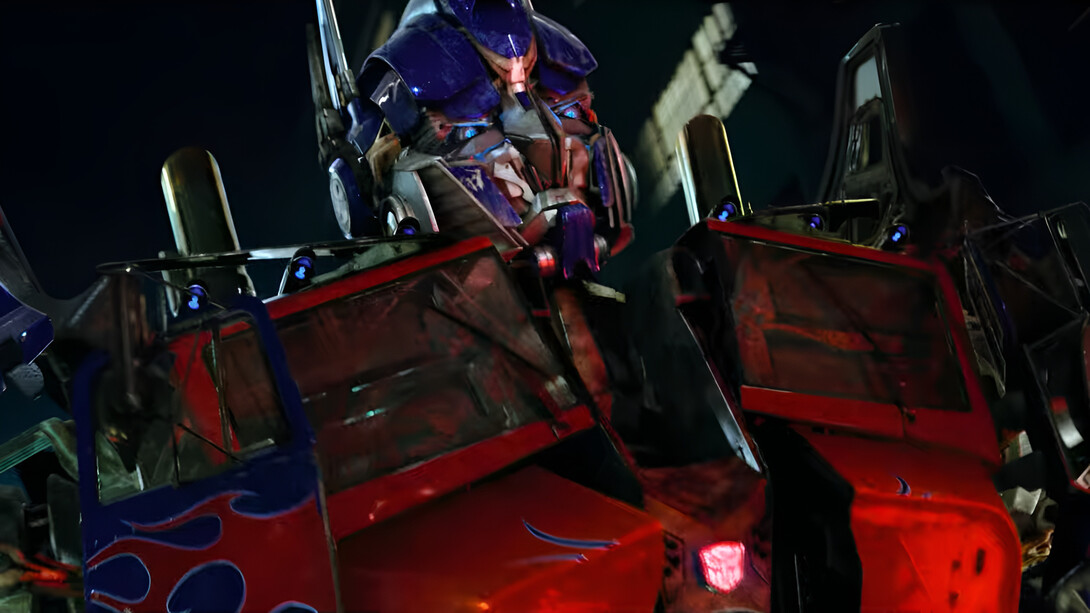
There was a time not long ago when Michael Bay’s slew of Transformers films was pretty much synonymous with everything wrong with Hollywood cinema—loud, empty, studio cash grabs. And while that’s not entirely untrue, compared to what gets released now, they’re practically a breath of fresh air. What stands out isn’t just their excess—it’s that even within that excess, there was still a director with style.
These films come from a time where commercial filmmaking hadn’t yet sanded off every edge of personality. Bay’s work is maximalist, overwhelming, and often ridiculous—but it is never anonymous.
His saturated colour grating once criticized for its harshness, now looks better than 99% of what gets released today. Where modern films flatten their images into digital grey mush, Bay leans the other way—deep blues, hardcore, corroded yellows—every frame pushed to the brink of overexposure.
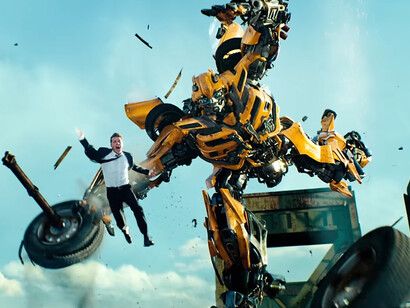
The visual effects, though never the problem, still hold up as some of the most innovative and believable in the field. There’s actual weight to everything; metal looks and sounds like metal. The Transformers themselves are hefty and loud—guttural clicking, panels locking, twisting pistons—a symphony of industrial movement that modern abstractions have all but abandoned.
More than anything, Bay has a uniquely underrated eye for action. He isn’t just throwing chaos at the wall—he’s curating it, handpicking the most striking needles from an exploding haystack and carefully stitching together jaw-dropping sequences that never lull.
His visual language is abrasive, cluttered, overbearing, and sometimes exhausting—but if you can tune into its wavelength, it reveals itself as something more precise. No accidental excess, but instead a controlled overload. These aren’t mindless studio blockbusters—they’re the work of an auteur with a solid grasp of cinematic language.
Transformers (2007)
Undoubtedly my favourite as a kid. I remember skipping through it, watching only the action scenes over and over again, much to my mother’s concern. That fragmented method of watching seems outlandish to me now because the sequences between actually hold up as some of Bay’s most coherent work.
Revisiting it today, it’s one of the most comprehensible stories in Bay’s entire oeuvre. Shia LaBeouf and Megan Fox are at the height of their stardom, one chaotically repellant and the other naturally magnetic. A constant push and pull of personas giving even their most mundane moments a static charge.
The visual effects, cutting-edge at the time, still feel tactile and precise. Paired with the pitch-perfect sound design, it’s an audio-visual treat. You don’t just see the transformations—you hear them. Clinking metal, grinding gears, machinery folding in on itself with serene clarity.
But what really defines this first entry is its restraint. Compared to what comes later, you could almost call it conservative. Don’t get me wrong, there’s still a lot of explosions, but it lacks the sheer visual pandemonium that would become the series’ defining trait. Although that limitation gives it a clarity, the sequels all but abandon it. You can follow the story, orient yourself within the space, and understand the stakes.
At the same time, Bay’s visual sensibilities are already fully intact. The film looks incredible, exactly what you’d expect from a disciple of Tony Scott—crimson sunsets, barren deserts, shimmering seas, and sweltering concrete. Every environment is heightened, stylized, and pushed toward something mythic. A blockbuster this tactile, this loud, and this alive was unique 20 years ago, and it’s all but unheard of now.
Revenge of the Fallen (2009)
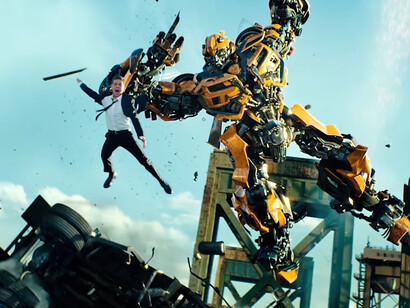
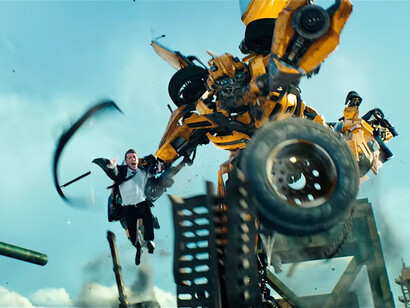
Currently my favourite, and the one that most clearly shows what happens when Bay is left completely to his own devices. Famously produced during the Writers Guild of America strike of 2007–2008, large sections were filmed without context and assembled later into something almost resembling a plot.
The result is an almost avant-garde action spectacle, where narrative coherence takes a backseat to pure momentum. This thing moves at a lightning pace, jumping from one explosive set piece to the next with barely any connective tissue. It shouldn’t work, but there’s something exhilarating about how little it cares.
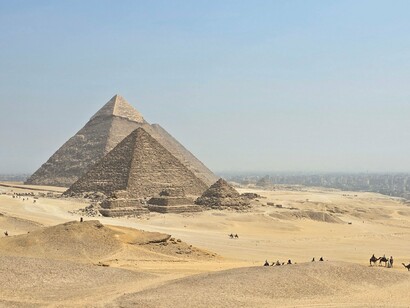
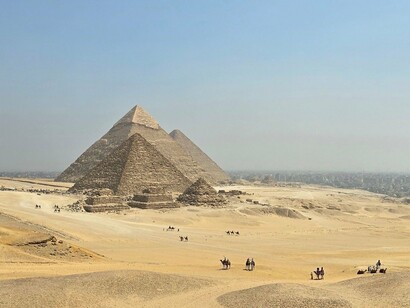
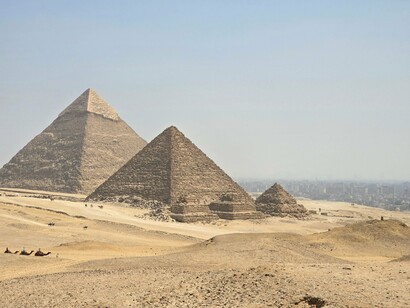
The Egypt section, which takes up nearly half the runtime, is the clearest example. As a kid, it bored me to tears. Now, it’s probably my favourite stretch in the entire franchise. It feels like Bay decided he wanted to shoot a massive action sequence on the pyramids and simply built the film around that impulse. The scale is absurd, the logic barely holds, but the imagery is undeniable.
Everything leading up to it still moves at breakneck speed, though. The college section does just enough to humanize the absurd stakes. It’s funny, unhinged, and anchored by Green Day’s “21 Guns,” which plays at 4 separate intervals.
Then there’s the forest battle—one of Bay’s best sequences, a brutal, kinetic display of his instincts not just as an action filmmaker but as a visual artist. Choreographing these huge, industrial ballets in vast open spaces with these non-existent entities. There’s truly nothing else like it in all of cinema.
Dark of the Moon (2011)
At this point I was starting to buy into the idea that these movies were bad. Losing Megan Fox and my initial problems with the previous film made it easy to fall into that collective mindset, and for a long time I didn’t really enjoy this one. But even then, there were moments that stuck with me.
The first act, especially Sam’s arc, is surprisingly tangible. His struggle to find a job despite saving the world feels just as relevant as it did then. His interviews hint at potential themes regarding government, technology, and how those forces are going to coexist, even if the film never fully commits to exploring them. There’s also a lot of humor that still lands. Ken Jeong’s character in particular is very quotable, which is the way that I remember latching onto.
But the real centerpiece is the Chicago climax. It adopts a real “bad guys are winning” mentality, appropriate for America’s ongoing occupation of the Middle East. It’s remarkably bleak and relentlessly large. Shockwave’s tendril sequences alone, with their intricate, multi-part design, remain a staggering achievement in visual effects. Probably the movie that broke Shia LaBeouf, as he’s constantly on the verge of losing his mind.
Expands the series’ sci-fi scope, with several sequences in space and on the moon, as the title would suggest. Also pulls references from Back to the Future, The Matrix, and Star Trek, with Leonard Nimoy himself voicing the antagonist and quoting Spock directly. It even made me think of Dune a few times, which is unbelievably high praise coming from me. Sam’s dad undercuts it perfectly with the line, “It’s like a bad sci-fi film.” Bravo, Michael.
Age of Extinction (2014)
By the time this one dropped, I was all but ready to wash my hands of the franchise. Shia LaBeouf was gone, the trilogy had ended on what I considered to be a mediocre note at best, and it just kind of felt like it had run its course. But the promise of Dinobots was too good to ignore, and so it was the last one I saw in theaters, forever tied nostalgically to a specific memory of all my middle school friends the summer before high school, alongside Godzilla (2014).
Marks the beginning of a new—slightly worse—era. New font, no Linkin Park, Mark Wahlberg. Even the Transformers themselves are new. The tactile, mechanical transformation is replaced by something smoother, and more fluid, a digital flowing instead of jagged, interlocking metal. It’s reminiscent of the shift from Iron Man (2008) to Avengers: Infinity War, where weighted physicality gives way to streamlined “nano-tech.” A lot of the cinematic heft is lost in that transition.
Thematically though, Age of Extinction is more self-aware of this than it gets credit for. Stanley Tucci’s character, obsessed with commercializing the Transformers despite not understanding them, essentially embodies the film’s own critique—modernity overtaking practicality, streamlined product over tangible experiences.
Yet, there are still moments where Bay’s natural instincts shine through. The entire China sequence, with its building-hopping chase and magnetic surges, is genuinely impressive—high-concept action rivalling something like Christopher Nolan’s Tenet. The Dinobots, though frustratingly fleeting, are undeniably sick as hell. If anyone else had directed this, it’d be a complete disaster.
The Last Knight (2017)
I have absolutely no nostalgia buffer for this, and it’s pretty unanimously considered the worst one. But I still enjoy it about as much as the last two. I never saw it in theaters—let alone IMAX, which I can’t even imagine—but even on a smaller scale, it’s still completely overwhelming. Anthony Hopkins narrates like he’s reading the script for the first time, delivering exposition with a sense of genuine bewilderment.
The Stonehenge climax, where Cybertron comes crashing into Earth for the third time, is one of the least intelligible sequences I’ve ever seen—and it goes on for like an hour. It reminds me of the sheer mechanical overload of The Matrix Revolutions’ Zion battle, pushed even further into abstraction.
What separates the sheer visual overload from something terrible like The Flash (2023) is that, despite the confusion, the images still feel real. There’s a tangible quality to the chaos, a level of craft that never fully dissipates. The technological and filmic dissonance is staggering—but so is the commitment to the image. Such beautiful nonsense.