English
 Español
 Français
 Deutsch
 Italiano
 Português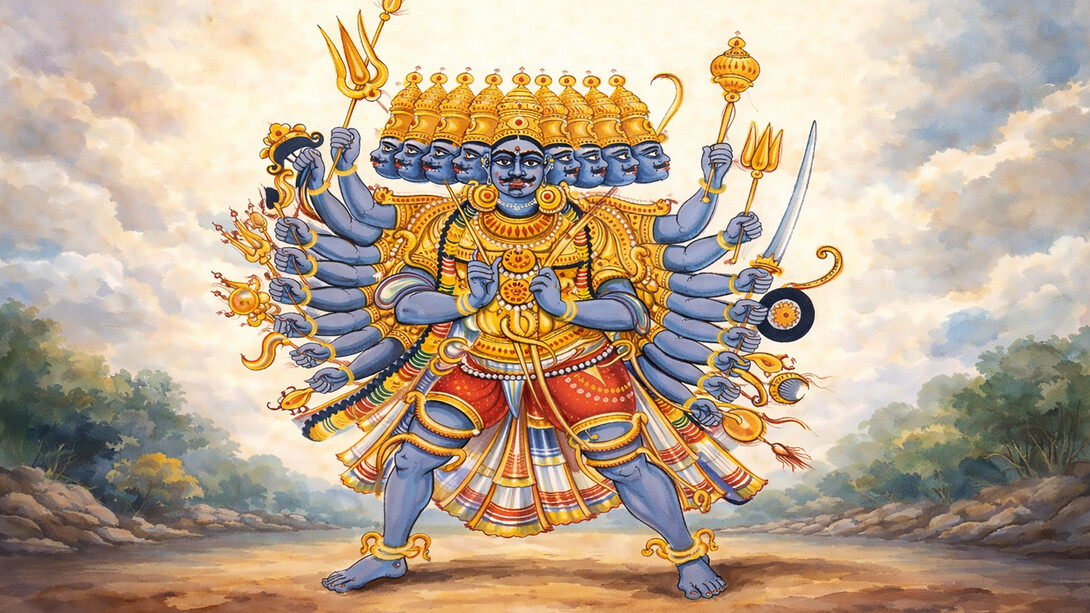
Ravana remains one of the most debated and misunderstood figures in the vast landscape of Indian sacred literature. Often reduced to the role of a villain in popular imagination, his character is far more layered, intellectually rich, and morally complex. To truly understand Ravana is to move beyond the binary of good and evil and enter a space where knowledge, power, devotion, pride, and downfall coexist. His story, most prominently narrated in the Ramayana, is not merely about his defeat but about the consequences of imbalance within a powerful mind.
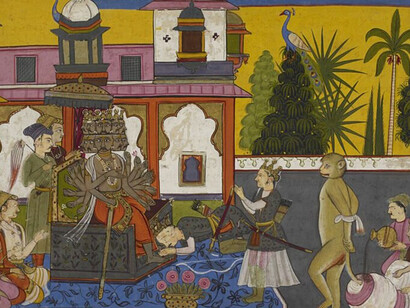
Ravana, also known as Dashanana, meaning the one with ten heads, was born into an extraordinary lineage. His father, Vishrava, was a revered sage known for his wisdom and mastery over sacred knowledge, while his mother, Kaikesi, belonged to the rakshasa clan. This union symbolically placed Ravana at the crossroads of two worlds: the disciplined, spiritual intellect of the Brahmin and the raw, ambitious energy of the asura. His grandfather, Pulastya, was one of the Saptarishis, further strengthening his connection to divine knowledge and cosmic order.
From an early age, Ravana displayed exceptional intelligence and a thirst for learning. He mastered the Vedas and was deeply versed in various branches of knowledge, including astrology, medicine, music, and statecraft. He was not only a scholar but also a practitioner of intense penance. His devotion to Shiva is legendary, and it is widely believed that he composed the powerful Shiva Tandava Stotram in praise of Shiva. This hymn, filled with rhythmic intensity and poetic brilliance, reveals a mind that was both spiritually elevated and artistically refined.
Ravana’s kingdom, Lanka, was described as a city of gold, symbolising not just material wealth but also architectural sophistication and administrative excellence. Under his rule, Lanka flourished as a hub of prosperity, culture, and learning.
His governance reflected strategic acumen and a deep understanding of policy. In many ways, Ravana embodied the ideal of a philosopher-king, someone who combined intellectual depth with political authority.
However, within this brilliance lay the seeds of his downfall. Ravana’s ten heads are often interpreted as symbolic rather than literal. They represent the multiplicity of human faculties—knowledge, intellect, ego, desire, anger, and more. While he possessed immense knowledge, he lacked the humility to balance it. His ego began to overshadow his wisdom, gradually distorting his judgement.
One of the defining aspects of Ravana’s life is his quest for invincibility. Through intense penance, he pleased the creator god Brahma and received boons that made him nearly indestructible. However, in his arrogance, he overlooked humans in his request for protection, considering them too insignificant to pose any threat. This oversight becomes crucial in the unfolding of his destiny, as it allows for his eventual defeat by Rama, an incarnation of Vishnu.
Ravana’s transformation from a revered scholar to a tyrant was gradual. Power, when unchecked by self-awareness, can become corrosive. Ravana began to assert dominance over sages and celestial beings, disrupting the balance of the cosmos. His actions were not merely political but also spiritual transgressions, as they interfered with the practices and freedoms of those devoted to dharma.
The most pivotal and controversial act of Ravana’s life was the abduction of Sita, the wife of Rama. This event is central to the narrative of the Ramayana and marks the point of no return in Ravana’s journey. It is important to examine this act not just as a personal wrongdoing but as a symbolic violation of dharma. Sita, often seen as the embodiment of purity and virtue, represents the moral order that Ravana disrupts.
Interestingly, many versions of the Ramayana emphasise that Ravana did not physically harm Sita during her captivity. He maintained a boundary, perhaps out of a sense of dignity or adherence to certain codes. However, this restraint does not absolve him of the initial act of abduction, which itself was driven by desire, revenge, and ego. It reflects a contradiction within his character, a man capable of both restraint and recklessness.
Ravana’s refusal to return Sita despite repeated counsel is what ultimately seals his fate. His brother, Vibhishana, advised him to restore Sita and avoid destruction. Even his ministers and well-wishers urged him to reconsider. Yet, Ravana’s ego prevented him from accepting his mistake. This inability to acknowledge error is perhaps his greatest flaw.
The war between Rama and Ravana is not merely a physical battle but a metaphysical one. It represents the eternal struggle between dharma and adharma. Rama, as an embodiment of righteousness, does not seek war but is compelled into it to restore balance. Ravana, on the other hand, stands as a figure who has deviated from his own potential for greatness.
The necessity of Ravana’s death lies in this deviation. It was not simply about punishing a wrongdoer but about restoring harmony in a world that had been destabilised. Ravana’s boons had made him a threat to both the earthly and celestial realms. His continued existence in that state of unchecked power would have led to further imbalance.
Yet, Ravana’s death is not portrayed as a moment of simple triumph. In many interpretations, Rama performs Ravana’s अंतिम संस्कार (last rites), acknowledging his greatness as a scholar and a devotee. This gesture reflects a profound cultural ethos—one that recognises the dignity of even a fallen adversary. Ravana is not denied respect; he is remembered for both his brilliance and his flaws.
In contemporary times, Ravana continues to hold symbolic significance. During Dussehra, effigies of Ravana are burnt across India, representing the destruction of evil. However, this ritual also invites introspection. Ravana’s ten heads can be seen as the many vices within human nature: pride, anger, greed, and attachment that must be confronted and overcome.
Interestingly, Ravana is not universally viewed as a villain. In certain regions, especially in parts of South India and Sri Lanka, he is revered as a learned king and a symbol of resistance. This plurality of perspectives highlights the richness of Indian narrative traditions, where characters are not confined to rigid moral categories.
Ravana’s story also resonates deeply in modern psychological and philosophical discourse. He represents the dangers of intellectual arrogance and the importance of emotional intelligence. Knowledge alone does not guarantee wisdom; it must be accompanied by humility and ethical grounding. Ravana knew the scriptures, understood the cosmos, and yet failed to govern his own impulses.
His life raises important questions. Can a person be both great and flawed? Can devotion coexist with ego? Can knowledge become a source of downfall? These questions make Ravana a timeless figure, relevant not just in mythology but in contemporary reflections on power and morality.
Ultimately, Ravana is not just a character to be judged but a mirror to be examined. His story is a reminder that greatness, when not balanced with self-awareness, can lead to destruction. His death was necessary not because he lacked virtue, but because he allowed his virtues to be overshadowed by ego and desire.
In this sense, Ravana’s narrative is not just about the victory of Rama but about the restoration of balance. It teaches that dharma is not a static concept but a dynamic force that must be upheld through conscious choices. Ravana had the opportunity to choose differently, to return Sita, to listen to wise counsel, and to align with righteousness. His tragedy lies in his refusal to do so.
Thus, Ravana endures in cultural memory not merely as a villain but as a deeply human figure—brilliant, flawed, powerful, and ultimately undone by his own excess. His story continues to resonate because it speaks to the eternal struggle within every individual, making him one of the most compelling figures in the spiritual and literary heritage of India.