English
 Español
 Français
 Deutsch
 Italiano
 Português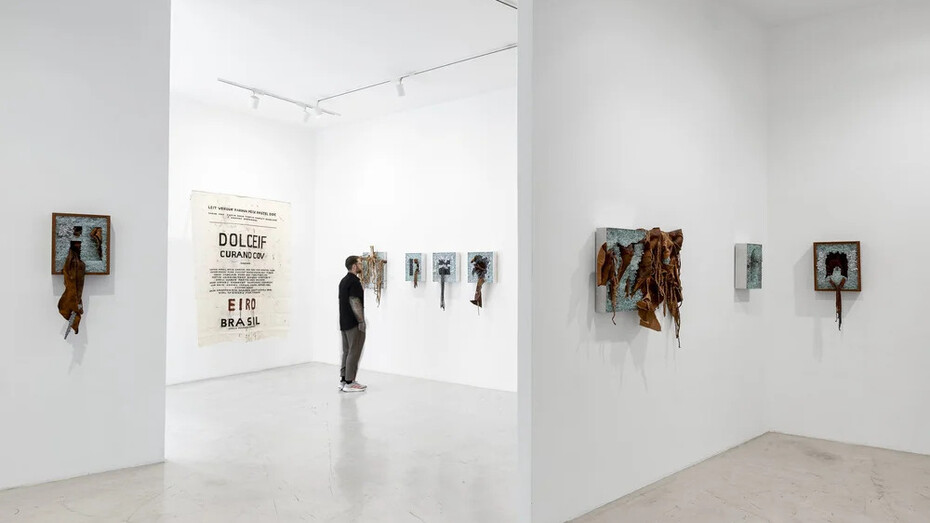
The idea of cycles appears as a compelling entry point into the artistic practice of Helô Sanvoy. If cycles, across their many fields and uses, can be understood both as a series of phenomena occurring in a determined order, or as a kind of transformation of causes whose effectreturns to its initial state, it is striking how Sanvoy’s work, in its present moment, reveals a range of other temporalities operating virtually and constantly. One part of the work refers to another, and so on, closing an open cycle in which the stages of division and renewal—features present in many cycles—manifest the artist’s materialist poetics and cosmo-perceptive horizon.
By materialist poetics, I refer to his use of pau-brasil, glass, sugar, leather, gold leaf, hemp, lead, cotton, coffee, rubber, meat, among other materials, each with specific origins from which Sanvoy works creatively. A practice that, in precise measure, produces an interface with processes of extraction (stage of division) and accumulation (stage of renewal) within cycles, highlighting the elements that have historically sustained and structured economic and artistic modes of production since Abya Yala was divided and turned into Brazil. Sanvoy’s practice is thus a contemporary case of the relationship between art as labor and as value, manifesting as a material possibility (the artwork) between history and form—an ongoing, open-ended investigation, layered overtime.
Strata [Layers]
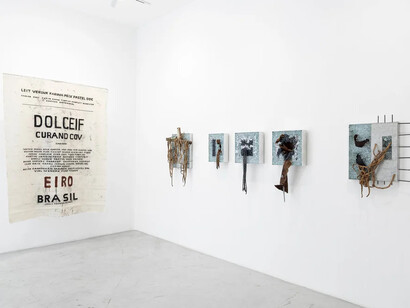
The successive and open-ended investigation proposed by Sanvoy takes on different forms, whether as specific works such as Sal de cura, or as a body of work such as Lucidez difusa, EIROAE, among others. This production, partially presented in this exhibition, establishes a symbolic regime in which form emerges as a right rather than as a mode of distinction. A right, as it is realized as free and remunerated labor, participating in the political economy of contemporary art, aware that its material and interpretive layers verge on the transparency of the formalization of the artistic object, as well as on the opacity of mediations—or vice versa.
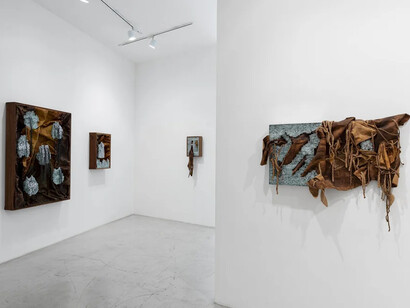
Sanvoy’s layers may be horizontal, in the creation of topologies where glass, leather, and lead, for example, draw our attention to the various levels of material intervention the artist performs in each work—gluing glass, melting lead, braiding leather. In doing so, he composes layers that begin at the surface and penetrate the interior of the artwork, prompting us to question the points of connection between materials—when that section of smoked glass became three paths of braided leather—as well as the choices of superimposition and transposition from one area of the work to another.
Das passagen-werk [Passages]
The cycles and layers in Sanvoy’s work invite an active and curious mode of observation that does not settle on a single point, but instead confronts us with its modes of production and circulation of the gaze, leading it through cyclical layers of material extraction, poetic transformation, and visual presentation in an objective manner.
When brought together, these elements ultimately tell a kind of narrative that is both fictional and documentary—a story of national formation and of contemporary social and artistic structure. His works may perhaps be understood as amber boxes that crystallize past and present, no longer cyclical, but increasingly spiral.
(Text by André Pitol)

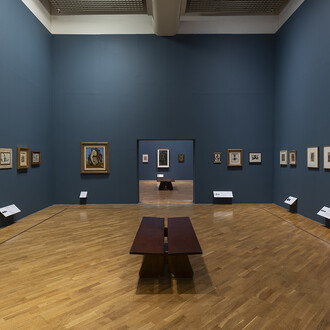
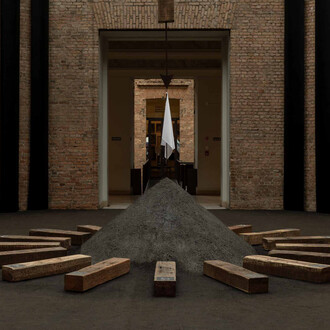
![Various artists, Histórias latino-americanas [Latin american histories], exhibition view. Courtesy of MASP](/attachments/2ec1b7615df2d9b9c3f211de14c70faefd850aea/store/fill/330/330/8481e63599516249cba60f15e188644bb76fc1eec25547e2c4b88b8f1c92/Various-artists-Historias-latino-americanas-Latin-american-histories-exhibition-view-Courtesy-of.jpg)