English
 Español
 Français
 Deutsch
 Italiano
 Português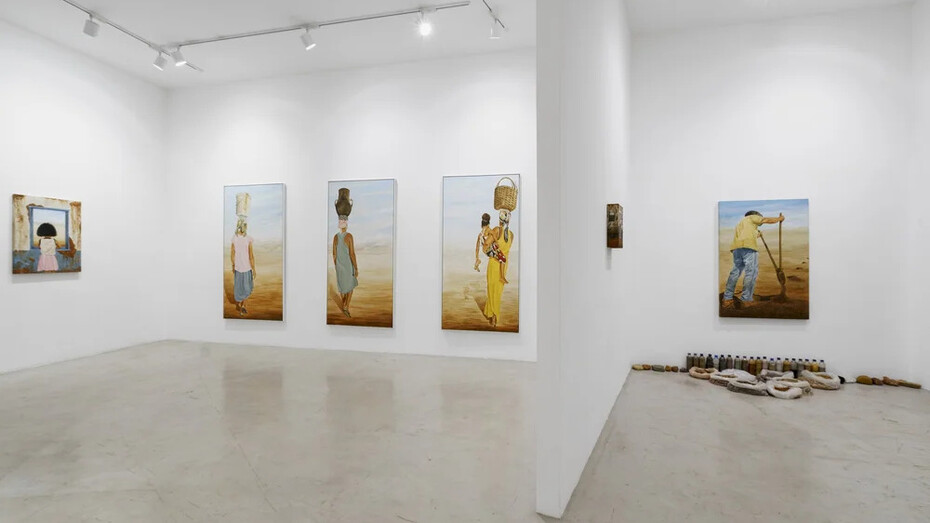
When I first met Leandro Júnior in the spring of 2022, during my first visit to Brazil, I was immediately struck by his work. It wasn’t only the weight of the materials or the richness of his surfaces—it was the way his paintings and sculptures seemed to breathe with the life of the Jequitinhonha Valley. The land wasn’t simply represented; it was a living collaborator. In Between Earth and memory, Leandro’s debut solo exhibition at Aura, we encounter an artist who refuses the false boundary between maker and material, between individual creativity and collective inheritance. His practice emerges from deep conversation with place, history, and community—where the earth itself becomes both subject and medium, both witness and voice.
Born in 1984 in Cachoeira, Chapada do Norte, Leandro was raised in a quilombo community founded by Africans who escaped working the mines of Minas Gerais. That legacy of resilience and ingenuity forms the ground of his artistic sensibility. He began painting as a child, guided by intuition and the world around him. The Jequitinhonha Valley, long celebrated for its ceramic traditions, has shaped generations of makers whose practices bridge necessity and expression. Leandro stands firmly within this lineage yet pushes beyond it—transforming inherited knowledge into a language that feels both ancient and new. His art is not about preserving tradition but activating memory. Through earth, pigment, and time, he excavates the emotional archaeology of place,revealing how geography and identity intertwine.
After earning his degree from Faculdade São Luiz de Jaboticabal, Leandro returned home to teach art to young people in the Quilombo de Cuba and through CRAS, the Center of Reference of Social Assistance. This commitment to education is not an act of charity but of continuity—a way to ensure that ancestral and artistic knowledge endures. For Leandro, art is not extraction but exchange—a dialogue between generations that honors the wisdom of the past while shaping the imagination of the future. His engagement with youth keeps the traditions of the Valley alive and evolving, ensuring that what he creates in the studio remains inseparable from the community that sustains it.
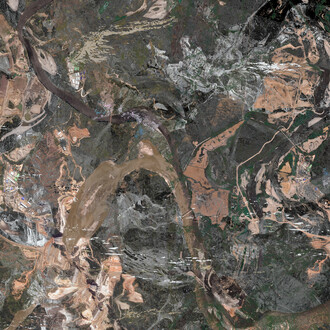
The materials at the core of his practice—clay, powdered earth, cow dung, and natural pigments—are gathered directly from the land. This is not a symbolic gesture but a method rooted in lived experience. The same clay that forms the walls ofrural homes becomes the foundation of his canvases; the same soil that nourishes crops provides the colors that animate his compositions. In Leandro’s hands, the land becomes language, and geology becomes autobiography.
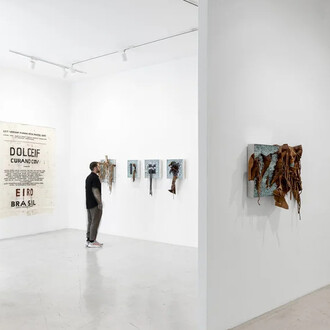
The Lágrimas (Tears) series draws directly from the architecture of the Jequitinhonha Valley. His research into quilombola communities revealed how red clay mixed with cow dung is used to build homes, which are later coated with white clay from the Tabatinga community. During the rainy season, when roofs leak, the water washes away the white clay, allowing the red to bleed through—what he calls “tears.” Many works include nails driven into the walls, a familiar feature in local homes used to hang tools essential to daily life. Through these textured surfaces, Leandro transforms domestic architecture into metaphor: a record of endurance, vulnerability, and the intimate dialogue between body, home, and land.
His Casinha (Little houses) series extends this reflection, presenting small three-dimensional constructions made from clay and manure on book pages affixed to canvas. These modest forms speak to the stories lived within them—houses as vessels of memory, layered with the residue of everyday experience. Here, as throughout his practice, Leandro fuses the material and the metaphysical, grounding memory in matter itself.
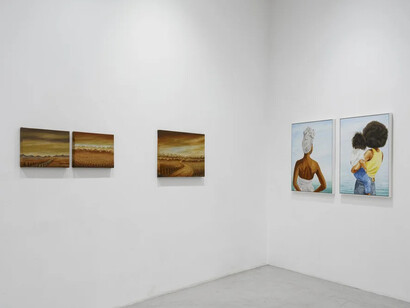
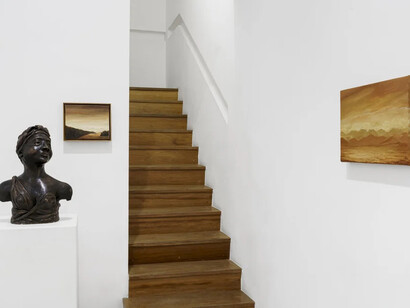
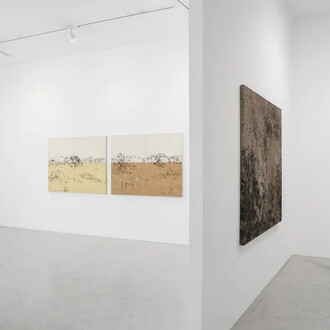
The Vale (Valley) series marks a turn toward landscape as tactile topography. Painted entirely with natural pigments, these compositions—full of mountains that dissolve into sky—capture the porous relationship between land and atmosphere. The series is deeply personal, since the very earth it depicts provides the pigments from which it is made. Its sequel, Sertão, continues this inquiry, introducing the light blue tones of the sky that also appear in his Costas (Backs) series. The Horizonte (Horizon) paintings push this exploration further, using rhythmic, gradient brushwork to evoke the Valley’s arid heat and hazy light, where dust and sun blurthe horizon until the backlands and sky become indistinguishable.
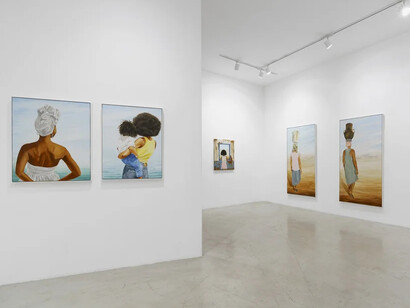
The Sonho (Dream) and Cabo Verde series was my own point of entry into Leandro’s work. These figures, seen from behind—walking, laboring, dancing—capture moments of quiet movement and solitude. To paint the back is to reveal something unguarded, something profoundly human. In the context of the Valley, these figures evoke both the physical demands of agricultural labor and the psychic weight of migration. Leandro’s subjects, often young Afro-Brazilian men and women, are rendered with sculptural presence and painterly tenderness. There is no trace of victimhood here; instead, there is pride, poise, and persistence.
That same empathy shapes the Viúvas de maridos vivos (Widows of living husbands) series. Through painting and film, Leandro honors the women left behind when men migrate to distant cities in search of work. Their lives unfold in the space between presence and absence, love and loss. By giving visual and emotional form to these stories, Leandro offers not spectacle but testimony—centering dignity and complexity where silence once prevailed.
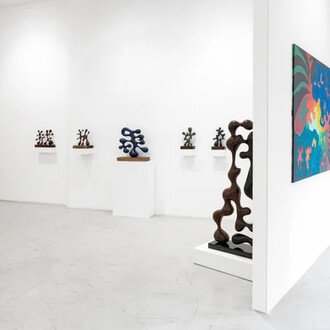
Leandro’s sculptures, modeled in clay and fired in earthen kilns, further articulate his dialogue between tradition and contemporaneity. His engagement with sustainability is not theoretical but rooted in daily practice—a way of working that honors both ecological balance and human connection. Many of his sculptural portraits pay homage to figures who have shaped the Valley’s cultural and political landscape, ensuring their legacies remain visible. Each becomes an act of acknowledgment, a gesture of care.
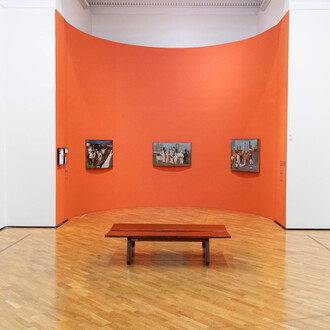
Throughout Between Earth and memory, Leandro incorporates raw materials—earth, pigment, and manure—alongside finished works, allowing viewers to witness the transformation at the heart of his process. This decision demystifies creation while amplifying its alchemical quality. It reminds us that every work begins with labor: the gathering of materials, the shaping of form, the long engagement between hand, spirit, and soil. By painting the gallery walls in the same hues used on rural homes in the Jequitinhonha Valley, Leandro extends this intimacy into the exhibition itself. The space becomes a threshold—part home, part landscape, part memory—collapsing the distance between urban gallery and rural origin.
Across these interconnected series, what emerges is an artist working with remarkable ethical and aesthetic coherence. Leandro Júnior’s practice speaks to migration, race, labor, gender, and ecology without losing touch with the tactile, the personal, the real. He builds meaning slowly, layer by layer, through material and gesture, through patience and presence. In an art world often driven by speed and spectacle, his work offers a vital counterpoint—rooted, deliberate, and deeply human.
The earth of the Jequitinhonha Valley finds voice through Leandro’s hands, and that voice resonates far beyond its point of origin. It reminds us that memory lives not only in stories and symbols but in matter itself—in what we touch, what we shape, and what we choose to carry forward.
(Text by Larry Ossei-Mensah, curator and co-founder Artnoir)