English
 Español
 Français
 Deutsch
 Italiano
 Português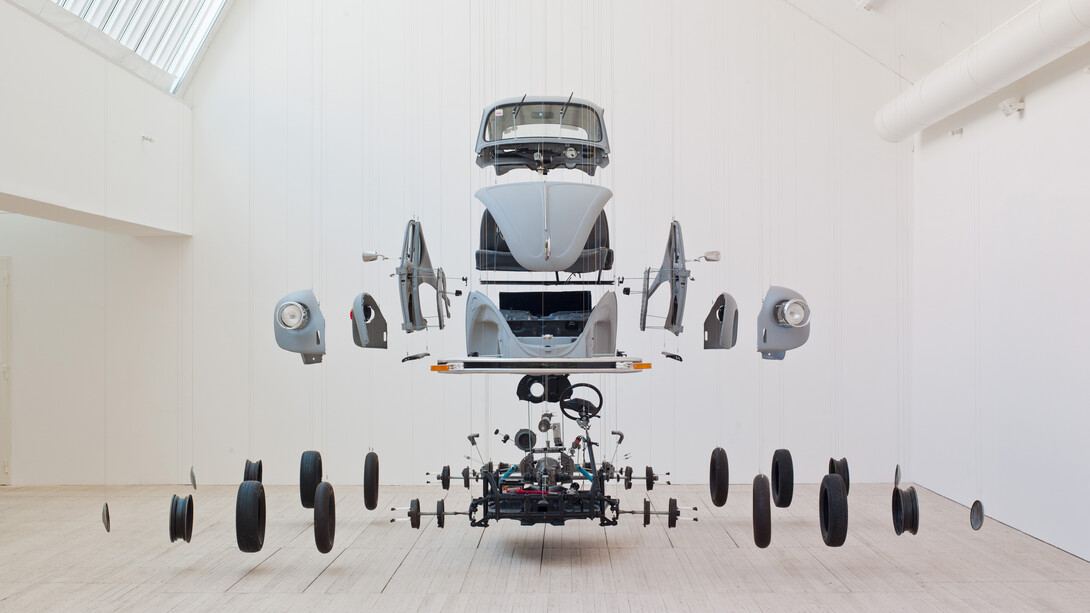
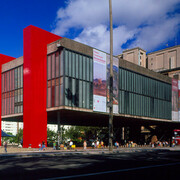
Museu de Arte de São Paulo Assis Chateaubriand presents, from May 15 to September 13, Damián Ortega: Matter and energy, the artist’s first major survey exhibition in South America. Featuring 35 works, the exhibition invites visitors into a universe where gravity seems suspended, and objects are dismantled and reinterpreted. One of the leading figures of his generation in contemporary art, Damián Ortega (Mexico City, 1967) encourages audiences to reexamine everyday life and the objects that surround them, reflecting on issues such as labor, consumption, time, and language.
Curated by Adriano Pedrosa, Artistic Director, MASP; Rodrigo Moura, independent curator; and Yudi Rafael, Assistant Curator, MASP, the exhibition brings together over three decades of the artist’s work, including photography, video, sculpture, and installation. The exhibition will also be presented at the Centro Cultural La Moneda in Santiago, Chile, from November 12, 2026, to March 28, 2027.
The artist conceives of sculpture as a relationship between force, resistance, balance, and gravity, engaging with engineering in a playful way. “Ortega develops an irreverent sculptural language from everyday objects. In his work, the idea of energy is expansive, referring both to notions of labor and to physical processes of the transformation of matter. He brings together perspectives on society with explorations of time and space, moving between micro and macro scales, between the atom and the cosmos,” notes Yudi Rafael.
Presented for the first time in Brazil, Cosmic thing (2002) consists of a completely dismantled Volkswagen Beetle, suspended like a spatial diagram in which all its parts appear to float. Beyond revealing the vehicle’s interior, Ortega draws attention to an industrial object that was once the most popular car in Brazil and Mexico, as well as a symbol of industrialization in Latin America. This new presentation invites viewers to reflect on the multiple layers of meaning—emotional, historical, and economic—that the automobile carries: promises of modernization, expectations of social mobility, as well as obsolescence and the underlying tensions of major metropolitan centers in the region.
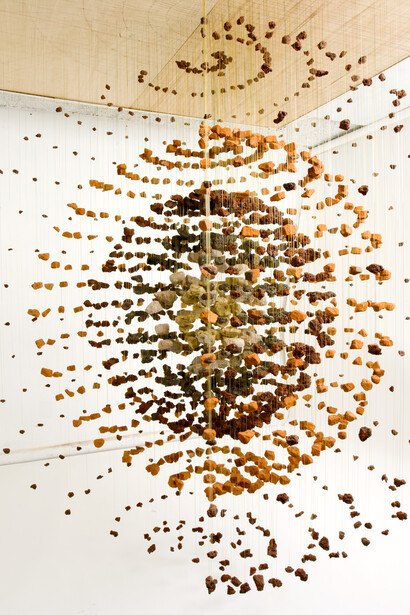
In Controller of the universe (2007), saws, shovels, sledgehammers, and axes become elements of an explosion seemingly frozen in time. The installation, composed of tools, revisits Diego Rivera’s mural Man, controller of the universe (1934). With a worker at the center operating a machine, Rivera’s work celebrates technological development and industry. By using worn tools extending into space, Ortega revisits this imagery while questioning the heroic and epic tone of Rivera’s composition.
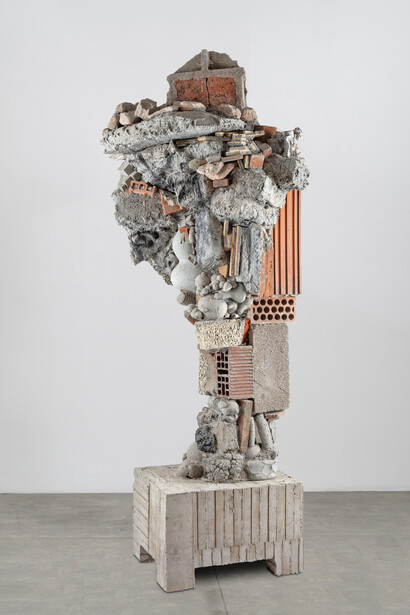
Ortega also brings art into dialogue with modern and vernacular architecture. He observes stacks of bricks stacked in front of houses, awaiting future expansions, and transforms them into sculptures that reveal energy in a latent state: a project not yet realized, but existing as a possibility. The sculpture Monster (2019) is one such figure, formed from remnants of construction materials such as metal structures, tile fragments, clay bricks, and concrete elements. By working with these materials, so prevalent in Latin American cities, the artist draws attention to modes of construction that emerge spontaneously in large urban centers.
A key figure in the Mexican art scene of the 1990s, Ortega belongs to a generation that sought to renew artistic language through collective initiatives that helped transform their local art context. Drawing on art history and Latin American social experience, the artist develops a sculptural and conceptual language capable of repositioning regional histories within an international narrative, addressing themes such as globalization and the circulation of goods.

![Colectivo Acciones de Arte, No+ [Não mais] [No more] (detail), 1983. Courtesy of MASP](/attachments/9b5e15c1c6ff59f1c8272376342c34a6f13efb4a/store/fill/330/330/0fcbe6a1da1016b4e092bd89473b45f8f01cb2d5d8ed180582c9b452d1b0/Colectivo-Acciones-de-Arte-No-plus-Nao-mais-No-more-detail-1983-Courtesy-of-MASP.jpg)