English
 Español
 Français
 Deutsch
 Italiano
 Português
![Claudia Alarcón & Silät, Oyhil ta iwo lhipa — Nuestros tejidos unidos [Nossos tecidos unidos] [Our united fabrics] (detail), 2025. Courtesy of MASP](/attachments/68d8ef03cf7b74f94e4d3fbbbbac7d9d4cbeeab5/store/fill/1090/613/6dff01b54b188468f916f91a879dd82d8693b8cc02c1ef3efef17d2aae01/Claudia-Alarcon-and-Silat-Oyhil-ta-iwo-lhipa-Nuestros-tejidos-unidos-Nossos-tecidos-unidos-Our.jpg)
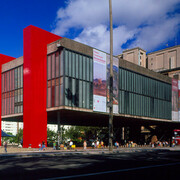
From March 6 to August 2, 2026, MASP — Museu de Arte de São Paulo Assis Chateaubriand presents Claudia Alarcón & Silät: living, weaving. The exhibition brings together 25 works tracing the artistic production of Claudia Alarcón (La Puntana, Argentina, 1989) & Silät, a collective of more than one hundred Wichí women weavers. Curated by Adriano Pedrosa, artistic director, MASP, and Laura Cosendey, assistant curator, MASP, the exhibition marks the first presentation of the artist and the collective in a Brazilian museum.
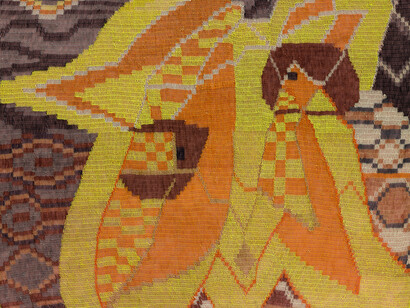
The works are made from chaguar fiber, a resilient bromeliad native to the semi-arid climate of the Gran Chaco—the largest biome in Latin America after the Amazon, spanning northern and northeastern Argentina and extending into Paraguay. The preparation of chaguar and the technique of interlacing fibers by hand, without the use of a loom, derive from the making of yica bags, a central object in Wichí material culture. Traditionally, yicas are square-shaped and feature geometric patterns referencing the flora and fauna of the territory, evoking motifs such as armadillo ears, owl eyes, and turtle shells. While this tradition forms the basis of Alarcón & Silät’s practice, their works extend beyond this repertoire. Through workshops dedicated to reimagining new formats for yica bags, the Silät collective was established in 2023 and began producing textiles within a contemporary artistic framework.
Historically, Wichí textiles were characterized by earthy, reddish, and bluish-gray tones. More recently, the artists have introduced more intense colors by adding aniline dyes during the fiber-preparation process, achieving vibrant hues such as orange and fuchsia. Another significant innovation in Alarcón & Silät’s practice concerns the production process itself. Whereas women traditionally wove individually, members of Silät developed methods that allow several weavers to work simultaneously on the same piece or to continue one another’s work.
Wichí mythology also informs Alarcón & Silät’s work. In Kates tsinhay — Mujeres estrellas [Star-women] (2023), Claudia Alarcón draws on the myth of the star-women. According to the story, women were once stars in the sky and descended to Earth each night along chaguar threads they had woven themselves, coming to feed by stealing the fish caught by men. When the men discovered this, they cut the threads, leaving the women on Earth. This work, and others inspired by this symbolic narrative, combine ancestral geometries with figurative elements to depict stars and celestial bodies.
“I recover legends and stories from our people; I feel there is much work to be revived. I think about how to recover this, because it is something that perhaps cannot be said orally, we cannot say it out loud. But the textile also speaks. There are those who can understand or feel it. I realized that even though we weave in silence, everything is said in the textile,” Alarcón comments.
The Wichí call tayhi the environment where they live and consider it a fundamental part of their identity, imbued with spiritual and symbolic meaning. In Spanish, the region is known as monte. Although the term suggests mountainous terrain, the landscape is predominantly flat. Everyday experience—the wind, daylight, dusk, night, the constellations, and many other elements of life in the monte—appears in the colors and in the organic and geometric forms of Alarcón & Silät’s works. The artists’ attentiveness to natural cycles is expressed abstractly in Kyelhkyup — El otoño [Autumn] (2023), from MASP’s collection, which evokes shifts in tone, texture, and light as the seasons change in the monte.
Working together, and building on the innovations developed by the group, has made possible textile compositions that bring together a multiplicity of voices and colors, articulating traditional patterns with a contemporary visual and poetic vocabulary. “The textiles have become banners of struggle, standards that carry messages and stories, giving voice to the women of the community,” states Laura Cosendey.
Both individual authorship and the collective dimension of practice are underscored in the installation Hilulis ta llhaiematwek — Un coro de yicas [A chorus of yicas] (2024–25), which brings together more than one hundred bags, each made by a member of the collective. Individual choices of color and pattern emerge when the works are displayed side by side, while the collective presentation highlights the political dimension of the group’s organization, enabling a critique of the devaluation of ancestral knowledge and the precarious conditions of the weavers’ labor.
In the exhibition, the works are presented in frames or on vertical wooden structures, evoking the production process and occasional forms of display within the communities where the weavers live. The set N’äyhay wet layikis — Caminos y cicatrizes [Paths and scars] is shown using this display developed by MASP. Conceived by the collective in 2025 for July 9, Argentina’s Independence Day, the work denounces the violent repression historically carried out by the Argentine State against Indigenous peoples.
![Claudia Alarcón & Silät, Honatsi — La noche [A noite] (detail), 2023. Courtesy of MASP](/attachments/463026a1615998b5088408c8806648d3985ab0f7/store/fill/410/308/d94014f9fc04c8da6e208ba8deba10f95d4c3b3e6665d729f7c1ef403982/Claudia-Alarcon-and-Silat-Honatsi-La-noche-A-noite-detail-2023-Courtesy-of-MASP.jpg)
![Claudia Alarcón, Otikyunhayaj n’äyij — Los saltos de mi recordar [Os saltos do meu lembrar] [The leaps of my memory] (detail), 2025. Courtesy of MASP](/attachments/6a252a7c00cd983afb3827941a4fa86fcb99dc12/store/fill/410/308/156ac41d56be66618bccab06da8bc3b4de61ab79b6c2d097debbef8ab48d/Claudia-Alarcon-Otikyunhayaj-nayij-Los-saltos-de-mi-recordar-Os-saltos-do-meu-lembrar-The-leaps.jpg)
![Colectivo Acciones de Arte, No+ [Não mais] [No more] (detail), 1983. Courtesy of MASP](/attachments/9b5e15c1c6ff59f1c8272376342c34a6f13efb4a/store/fill/330/330/0fcbe6a1da1016b4e092bd89473b45f8f01cb2d5d8ed180582c9b452d1b0/Colectivo-Acciones-de-Arte-No-plus-Nao-mais-No-more-detail-1983-Courtesy-of-MASP.jpg)