English
 Español
 Français
 Deutsch
 Italiano
 Português

Fashion, in its highest expression, transcends fabric and form. It becomes a conduit—an art form that moves between dimensions, memory, and myth. It is no longer something simply worn; it is something entered, inhabited, and experienced. It becomes architecture for transformation, a living threshold through which identity softens and something more archetypal emerges.
The most powerful examples of this transformation appear in one-of-a-kind, handmade creations shaped slowly and intentionally by human hands. These pieces feel less manufactured and more summoned—guided by intuition, devotion, and an unseen current of creative intelligence. They carry the imprint of journey, ritual, and lived experience. Every stitch holds presence. Every imperfection breathes humanity. In their making, time expands. In their wearing, time dissolves.
Often revealed within extraordinary environments—vast deserts, forgotten industrial spaces, liminal landscapes temporarily reimagined through immersive gatherings—these garments come alive. The setting becomes a portal. Time softens. The boundary between art installation, music, architecture, and human presence dissolves. Fashion in these spaces is not displayed. It is activated. It interacts with wind and dust, with firelight and shadow, and with sound waves that ripple through the body like ancient drums.
There exists a deep astral dialogue between clothing, sound, and large-scale artistic expression. When woven together, they generate something ceremonial. Cyclical gatherings across the globe serve as catalysts for this convergence. Though they return each year, they never repeat. Each cycle forms a new constellation—a living rhythm through which communities gather, transform, and disperse, carrying fragments of the experience like stardust embedded in memory.
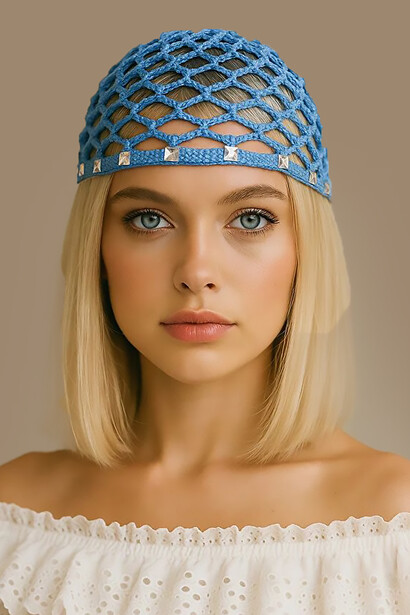
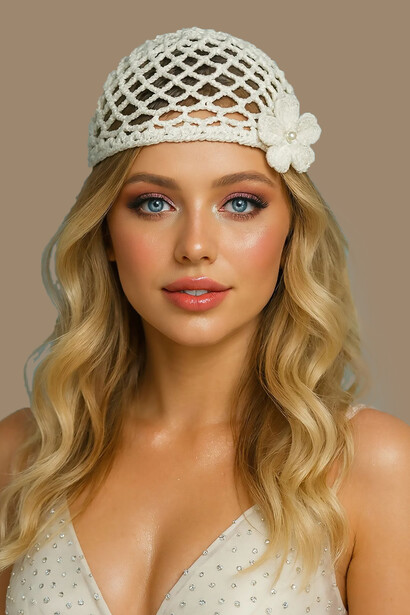
Within this ephemeral universe, certain handmade garments have become quietly emblematic—an unspoken dress code recognized instinctively by those who enter these ceremonial spaces. Their presence feels remembered rather than discovered. Each piece carries a frequency: part relic, part prophecy. They feel retrieved from a future-past timeline, shaped by ancient mythology, celestial geometry, and the sacred intervals between sound and silence.
The language of these garments is encoded in texture, movement, and symbol. Threads become maps. Silhouettes become architecture for transformation. They do not merely adorn the body—they attune it. They remind the wearer of something primordial and sovereign. Fringe moves like prayer in motion. Metallic details catch light like constellations mapping unseen stories across skin.
Beneath open skies, amid dust storms, firelight, and pulsating soundscapes, clothing becomes a second skin. A protective talisman. A threshold between the visible and the unseen. The individual dissolves into the collective; movement becomes meditation; dance becomes prayer. In these moments, fashion is no longer aesthetic—it is ritual embodiment. It is a choreography between self and cosmos.
And when the gathering fades, when the installations are dismantled, and the desert returns to stillness, the garments remain. They carry residue—not of dust alone, but of memory. Worn again in quieter settings, they whisper of expansiveness. They remind the body of freedom tasted and of communion felt. The ritual continues in subtle form.
The talisman as living practice
Jewelry, too, participates in this activation.
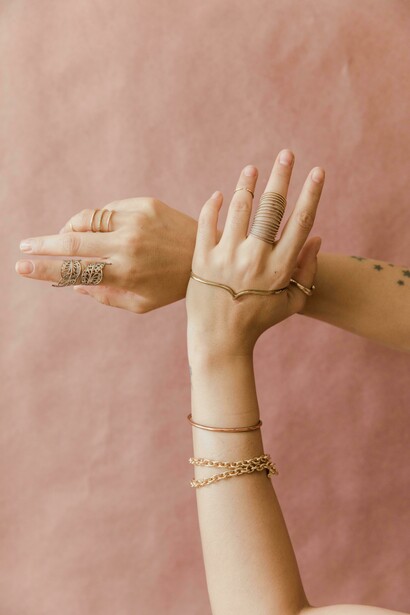
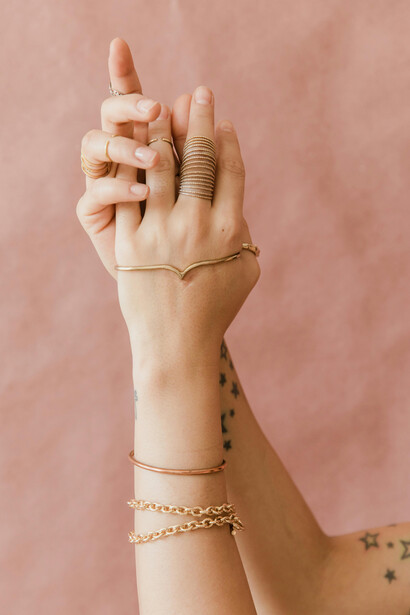
At the intersection of healing and sensual awakening, handcrafted gold talismans emerge as intimate companions to the body. These are not ornaments but energetic instruments—delicate yet intentional, designed to awaken vitality and cultivate presence. They shimmer not for spectacle, but for remembrance.
Worn close to the skin, they rest upon vital points—heart, throat, womb, hands—where subtle contact becomes a reminder of aliveness. Through gentle weight and continuous touch, they create a quiet dialogue between body and awareness. The sensation is almost imperceptible, yet transformative: a steady pulse of safety, confidence, and creative fire. The body begins to listen differently. Attention softens inward.
Inspired by philosophies that honor movement, breath, and life force, these pieces operate on two planes. Physically, they stimulate sensation and embodiment. Visually, they carry sacred geometry—ladders symbolizing growth, triangles sharpening intention, stars invoking wonder, and serpents embodying transformation. These forms are not decoration; they are symbols, portals, and prayers cast in gold. Geometry becomes language. Metal becomes memory.
Versatility allows each piece to shift with the wearer’s rhythm. A chain becomes adornment for hand, neck, ankle, or back. Jewelry transforms across settings—from ritual to daily life, from private intimacy to communal celebration. It responds to the body’s whisperings, moving as a second skin that evolves with its wearer. There is intelligence in its adaptability—an honoring of the cyclical nature of identity itself.
Through this shared language of symbol and sensation, adornment becomes lineage. Women across continents connect through intention, care, and embodied presence. Wearing these talismans is an act of remembrance—of sovereignty, sensuality, and sacred joy. It is a reclamation of the body, not as an object, but as an oracle.
Gold, historically revered across civilizations, carries its own mythology. It resists corrosion. It reflects light. It has adorned queens, priestesses, and visionaries. When shaped by hand and worn with intention, it becomes more than material wealth—it becomes spiritual currency. A quiet declaration of value that originates within.
Together, garment and talisman create a unified field. Fabric moves with air; gold anchors with weight. One expands, the other concentrates. One flows, the other focuses. In their interplay, the body becomes altar and instrument simultaneously. Presence sharpens. Sensation deepens. The mundane shimmers with subtle significance.
This convergence signals a return—not to nostalgia, but to origin. To a time when clothing was crafted with reverence, when adornment marked rites of passage, and when beauty was inseparable from meaning. Before mass production. Before trend cycles. Before speed replaced ceremony.
In reclaiming this ancient orientation, fashion transforms from commodity to conduit. From industry to invocation. The wearer is no longer a passive consumer but an active participant in a living myth. She steps into the archetype not as a costume, but as consciousness embodied.
And somewhere within that embodiment, something stirs.
A memory older than language. A knowing deeper than thought. A rhythm encoded in bone and breath.
In this convergence of garment and gold, fashion reclaims its ancient role: not trend, not commodity, but transformation.
An activation.
A return.
A remembering that was never truly lost.
A goddess remembering herself.