English
 Español
 Français
 Deutsch
 Italiano
 Português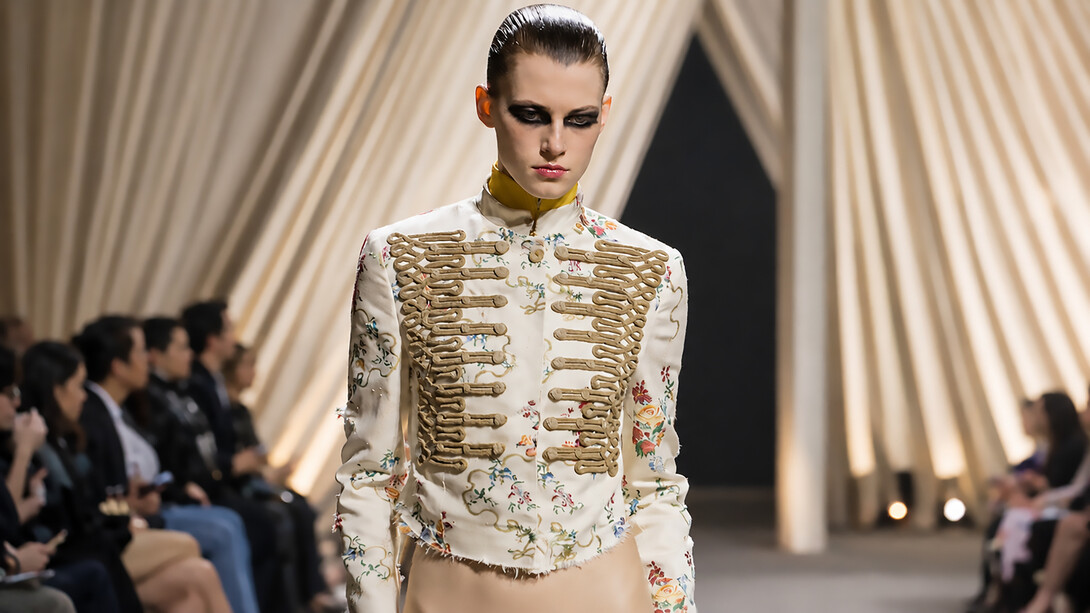
At the heart of fashion’s most talked-about moment this season lies a tension between heritage and hedonism—a collision of discipline and desire. Under the direction of creative mind Seán McGirr, McQueen’s Spring/Summer 2026 collection didn’t just walk a runway. It conjured a ritual. Against a backdrop of wicker and foliage, with the atmosphere of an eerie pagan fête, McGirr stitched together the brand’s storied past and an unbridled present. The result? A collection that feels less like clothes than like a primal invocation: raw, sensual, rebellious—and deeply McQueen.
Setting the stage: from fashion show to pagan rite
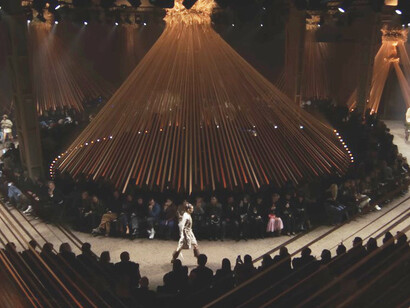
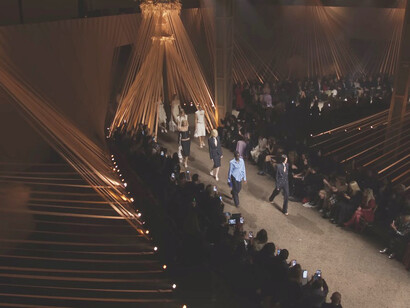
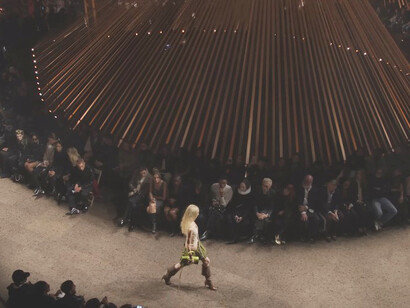
The SS26 runway didn’t resemble a minimalist gallery or sleek catwalk. Instead, it transported guests into something more elemental—something ancient and unrefined. McGirr built the set around a vast wicker-tent structure, fashioned with natural elements: hessian ribbon, foliage, cork, and maypole-like motifs referencing folk-ritual tradition.
Amid soft harp strings, elemental soundscapes, and occasional pulses of synthesized rhythm, the audience was arrested. The soundscape danced between forest murmurs and club-like beats—evoking the dual nature of the show: at once eerie and alluring.
In that space, the garments didn’t just appear—they emerged, as if summoned. The whole production felt like a modern-day ritual: a ceremony honoring instinct, desire, and the wild codes of nature.
The mood & theme: desire, instinct, rebellion
McGirr’s vision wasn’t whimsical. He framed SS26 around potent ideas: primal energy, bodily freedom, and the tension between control and abandon. The leitmotif was clear: What happens when order gives way to instinct?
Anchoring this statement was a canonical piece of McQueen history—reimagined with contemporary ferocity.
Revival of the bumster
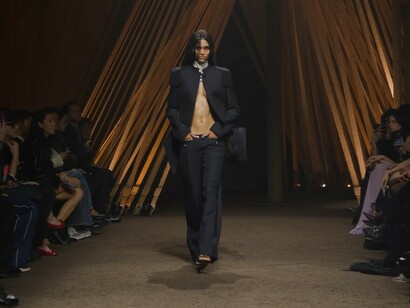
Yes: the infamous ultra-low-rise trouser silhouette is back. But the 2026 version pushes the envelope even further: skirts and pants sit so low they reveal unexpected glimpses of flesh—sometimes via slits, sometimes via zippers that snake from below the backside all the way down to the ankles.
It’s not nostalgia. It’s a bold statement: a reclamation of the body, of sensuality, and of defiant self-expression.
Uniforms, but deconstructed
Staples of authority—marching band jackets, frogged epaulets, structured tailoring—return in bones. But McGirr subverts them: swallowtail coats cut to cleave away from the body, rigid jackets with crumpled lapels, and suiting that seems purposeful yet undone. The uniforms still stand, but their discipline is fraying.
It’s as if the uniformed order is confronting the wild, and the wild is overpowering it.
Highlights from the collection: garments as symbols
Let’s walk through some of the standout visuals and material decisions from SS26—each contributing to McGirr’s bold thesis.
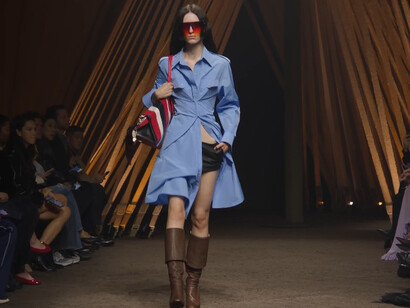
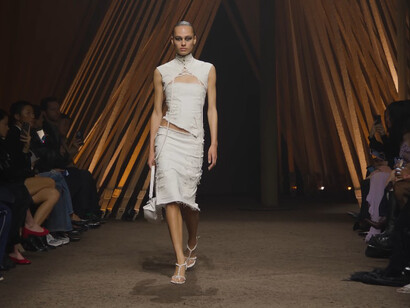
Low-slung denim & trousers: perhaps the most talked-about element: exaggerated low-rise pants with tight waists and wide hips. Where needed, slits or zippers expose skin, turning trousers into provocateurs’ garments. Combined with slim tailoring, the silhouette elongates the torso and emphasizes the hips—a renegotiation of body proportions.
Corsets, g-strings, and leather straps: corsetry didn’t vanish—it morphed. Worn under or over jackets, sometimes partially hidden or deliberately revealed, corsets became tools of sensual geometry. G-strings and lace elements peeked through or hung loose, inviting the viewer’s gaze to linger.
Leather made a strong appearance, used for slashed dresses, cage-like tops, and sharply tailored pieces, giving the collection an edgy, primal undercurrent.
Folkloric & pagan accents: true to the “Wicker Man” inspiration, McGirr didn’t shy away from pagan overtones. The collection featured insect- and talisman-inspired motifs—mother-of-pearl embellishments, wishbone charms, and earthy materials like wood. Floral prints were reinterpreted. What looked like delicate nature motifs in photos often revealed themselves as stylized ladybirds locked in embrace.
Even the footwear nodded to McQueen’s archive: the horn-shaped heel returned, adapted to sandals, mules, and tall boots—an echo of the brand’s past given a modern pulse.
Eveningwear: glitter, feathers, and ceremony: the finale of the show knit together all these threads into a ceremony of decadence. Feather-like gowns, shimmering beaded dresses, and three-dimensional floral tops closed the show with power. The contrast between raw leather/pagan motifs and sparkling eveningwear underscored the collection’s duality—nature and glamour, ritual and release.
The politics of exposure: why skin, why now?
For many, the return of bumsters and bodily exposure might seem like a self-indulgent throwback. But under McGirr’s gaze, this exposure carries deeper weight.
Reclaiming the body: in an era where clothing often conceals or sanitizes, McGirr strips down. Revealing the body—with all its curves, lines, and rawness—becomes an act of empowerment. Through structured tailoring that still shows skin, the collection refuses to hide behind formality.
Blurring gender codes: low-slung trousers, corsets, and G-strings challenge traditional gendered clothing norms. The designs don’t shout “male” or “"female"—they exist in a realm where sensuality and structure coexist.
Nature vs. civilization: the interplay of tailored uniforms (symbolizing order, society, and rules) with pagan-inspired garments (symbolizing instinct, wildness, and chaos) creates a narrative tension. The skin becomes a battleground between control and release.
In McGirr’s own words, the line between boundary and liberation matters less than the energy emanated by each garment. “Imperfectly perfect” was the ideal—a world where rawness and refinement aren’t opposites but partners.
The show as statement: why SS26 matters
It would be easy to dismiss McQueen SS26 as a provocation, a shock act to garner headlines. But this collection reaches further—it stakes a conceptual claim.
Reclaiming heritage: by resurrecting McQueen’s signature silhouettes—like the bumster—McGirr honors the brand’s rebellious roots. But he doesn’t merely replicate; he interrogates them, morphs them, and adapts them for a new generation.
Reinventing the runway: the show wasn’t a catwalk. It was theater. A ritual. A ceremony. The set, the sound, the lighting—everything contributed to an immersive experience that went beyond seasonal clothes.
Redefining luxury: Luxury here isn’t polished perfection. It’s wild leather; it’s uncouth beauty; it’s glamor with a scar, sophistication with a slash. It’s not about safe elegance—it's about a living, breathing tension.
In doing this, McGirr isn’t just designing clothes. He’s reasserting that fashion—especially at McQueen—is still a space for provocation, for dream-making, and for challenging norms.
Audience and reactions: who is this for?
The response to SS26 has been as mixed and charged as the collection itself.
Some critics celebrated McGirr’s revival of the bumster and his courage to embrace sensuality, ritual, and raw energy, calling the show a “spellbinding” return to McQueen’s wild spirit.
Others questioned if the exposure and sensuality were too much, debating whether ultra-low silhouettes and G-string underpinnings belong in a serious fashion house or risk reducing couture to spectacle.
For a new generation, though, SS26 might feel liberating. In a world saturated with minimalism, safe classics, and sanitized “versatility,” McGirr offers liberation: a way to wear defiance, desire, and identity on one’s skin.
What this means for McQueen—and fashion at large
A new McQueen of the body: under Seán McGirr, McQueen may be evolving into a house where the body is central again—not as a blank canvas for tailoring, but as a site of power, sexuality, and transformation.
Ritual as fashion language: SS26 reminds us that fashion shows don’t need to be sterile runways. They can be immersive, symbolic, and emotional. They can question civilization and celebrate instinct.
Provocation vs. wearability: the balancing act remains. As couture flirts with ritual and mythology, the question of everyday wear arises: which of these garments will transcend the runway? Which will influence streetwear, trend cycles, and everyday wardrobes?
At a time when many brands play it safe, McQueen chooses to stir something primal—to invite discomfort, to coax rebellion, and to celebrate the body.
Closing thoughts
SS26 wasn’t just about clothes. It was a summons. A gathering. A call to remember that beneath the veneer of clothes, couture, and civility lies something ancient and wild: instinct. Desire. The human body.
With this collection, Seán McGirr reclaims the DNA of Alexander McQueen—not as museum-sweet nostalgia, but as a beating, yearning force. Whether you love it or loathe it, SS26 forces a confrontation. And maybe that’s the point: to remember that fashion, at its most potent, isn’t decoration. It’s invocation.